
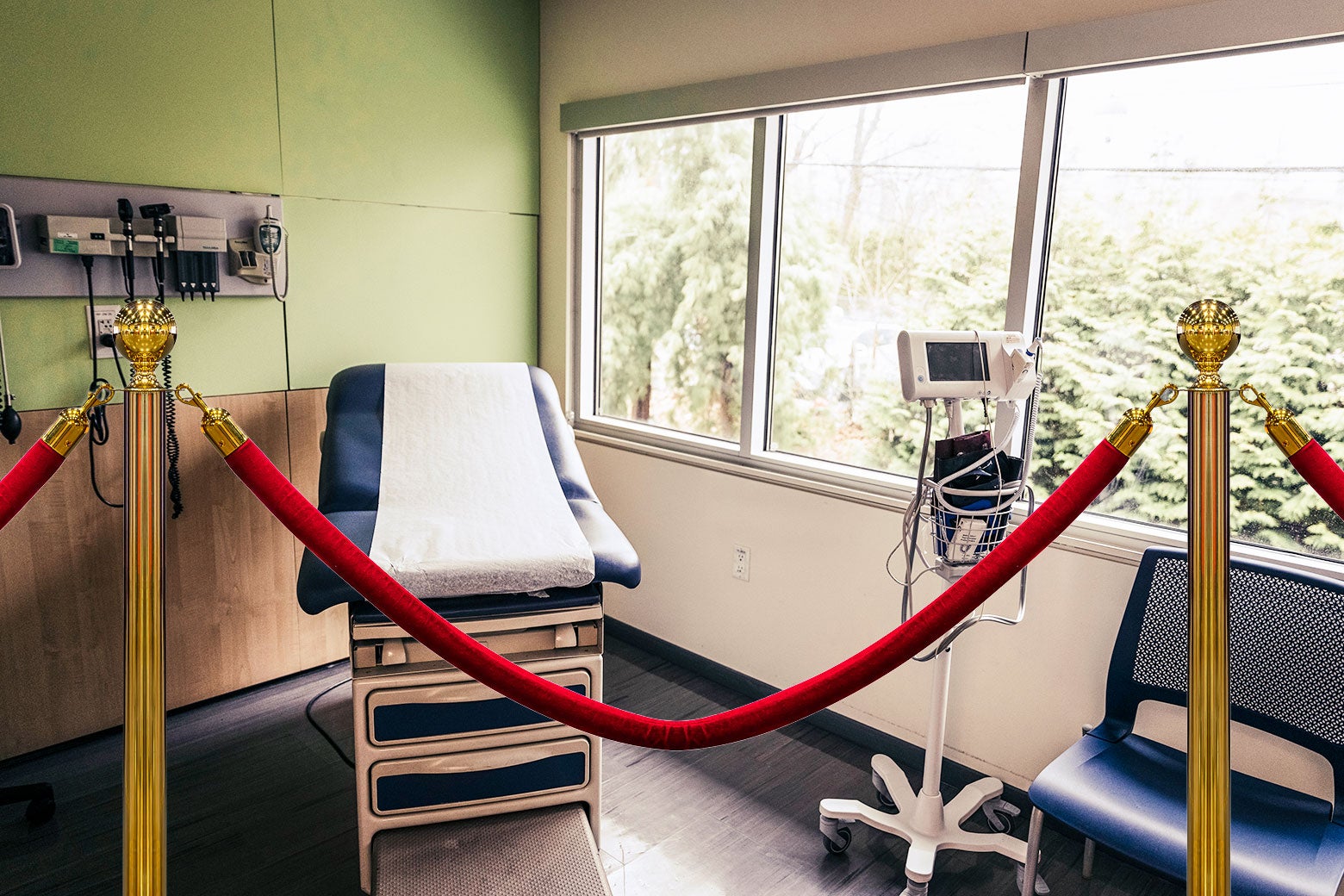
Medical Examiner Membership Fees Are Coming for Your Doctor’s Office Primary care physicians say they reduce burnout and increase the quality of patient care. Would you pony up? Photo illustration by Slate. Photos by Getty Images Plus. Sign up for the Slatest to get the most insightful analysis, criticism, and advice out there, delivered to your inbox daily. Your last visit to the primary care doctor likely followed a familiar sequence: You waited weeks, if not months, for the appointment. Once you were finally in the exam room, your doctor tried to squeeze a lot into a short visit before moving on to the next patient. In the parking lot, you remembered the question you meant to ask. This setup misses the point of primary care. In theory, the internal medicine or family medicine doctor oversees your preventive care, ongoing symptoms, chronic conditions, and referrals to specialists. Ideally, it’s an ongoing relationship with a doctor who can take the time to decode why, for instance, that pain in your toe might be a warning of a serious heart condition. All too often, though, it ends up being more of an annual one-off visit. The ideal kind of primary care model takes time, but it’s not really supported by insurance, which pays for quick visits and specific services—not time spent getting to know a patient’s health history. Most primary care doctors are responsible for more than 2,000 patients, who get visits of about 18 minutes, according to a study published in the Journal of the American Board of Family Medicine that measured electronic health data from over 21 million primary care visits. This is not always enough time to connect seemingly unrelated symptoms—or simply answer every question. And those visits often run over their allotted time, meaning that primary care doctors are often behind. So: Patients are frustrated because doctors seem rushed. Doctors are frustrated because they are bogged down with patients. A growing number of primary care doctors say they are finding a way back to an unhurried model of patient care. Instead of billing insurance for routine office visits, they’re charging patients directly through a monthly or annual membership fee, a model known as direct primary care, or DPC. Each DPC practice sets its own membership price, typically $50 to $100 a month, according to the American Academy of Family Physicians, though it can be more. This cost covers routine primary care visits, from annual physicals to chronic disease management. Patients have direct ongoing access to their doctors when they need it. Because DPC doctors are being compensated directly by the patients rather than billing insurance, they can operate with smaller patient panels, an average of 402 patients, according to an AAFP study. In theory, this translates to more time with your doctor. How much time varies, but for $200 a month for an adult, one Pennsylvania-based DPC practice promises visits that last up to two hours, which is plenty of time for a doctor to learn the nitty-gritty details of your life. According to the AAFP study, physicians operating on the DPC model were much more likely to report that they were not burned out. Which might be a reason that DPC is on the rise. A recent Health Affairs study led by Dr. Jane Zhu, an associate professor of medicine at Oregon Health & Science University, found that the number of clinicians participating in DPC and concierge practices increased 78.4 percent between 2018 and 2023 (concierge practices charge even more than DPC practices and promise even smaller patient panels for doctors). And now, the DPC model is getting easier to pay for. Federal legislation took effect this year allowing people with health savings accounts to use those tax-advantaged funds to pay for DPC membership fees. For patients, the rise of the DPC model becomes personal the moment their own doctor asks for a membership fee. Suddenly, the question isn’t whether a DPC practice might be a good idea for them to look into. It’s whether they can afford to keep the doctor who knows their health history best. Three years ago, Ashley Bates’ longtime primary care physician instituted an annual fee of $600 per patient, which was difficult for Bates and her family to afford. But this was the doctor who called every few months for health check-ins and once cried tears of joy when Bates announced her sobriety. She can’t imagine starting over with someone who doesn’t know her history, so she pays for the continuity of care. “This is someone who, actually, I think, loves me,” says Bates, 41, of Los Angeles. “I could be delusional, but I don’t think I am, so I will pay for her love.” Though visits with a primary care doctor are covered by a DPC fee, patients still need insurance, on top of that annual fee, for medication, hospital stays, specialist visits, surgeries, and emergencies. DPC providers often recommend pairing membership with a high-deductible health plan that has a lower monthly premium. Still, it’s an expensive setup that essentially requires participants to pay twice for primary care, both via health insurance premiums and through the DPC membership fee. For doctors, the freedom offered by DPCs is a major draw. “I’m a primary care physician myself,” says Zhu. “It’s really hard to give each of those patients personalized attention, the time that they need, the effort that it takes to manage chronic medical conditions, to engage in preventative care, to answer questions that patients have about their health.” And on top of that, they have to spend time dealing with insurance. Not all doctors agree with the DPC model, though. Ed Weisbart, a retired family doctor in St. Louis, Missouri, says DPCs encourage physicians to see fewer patients and limit access to primary care at a time when the U.S. already faces a nationwide physician shortage. The Association of American Medical Colleges projects the U.S. could face a shortage of between 20,200 and 40,400 primary care physicians by 2036. “We’re setting up a system where people of better financial resources can get physicians who can spend more time with them,” says Weisbart. “And people who have fewer financial resources will be the ones who are unable to do that.” Health Health Care Medicine
Your Doctor’s Office Might Soon Start Charging an Unexpected Fee
Full Article
Original Source
Read the full article at Slate →KhanList aggregates and links to publicly available news content. We do not host full articles from third-party sources. Always verify important information with original sources.