
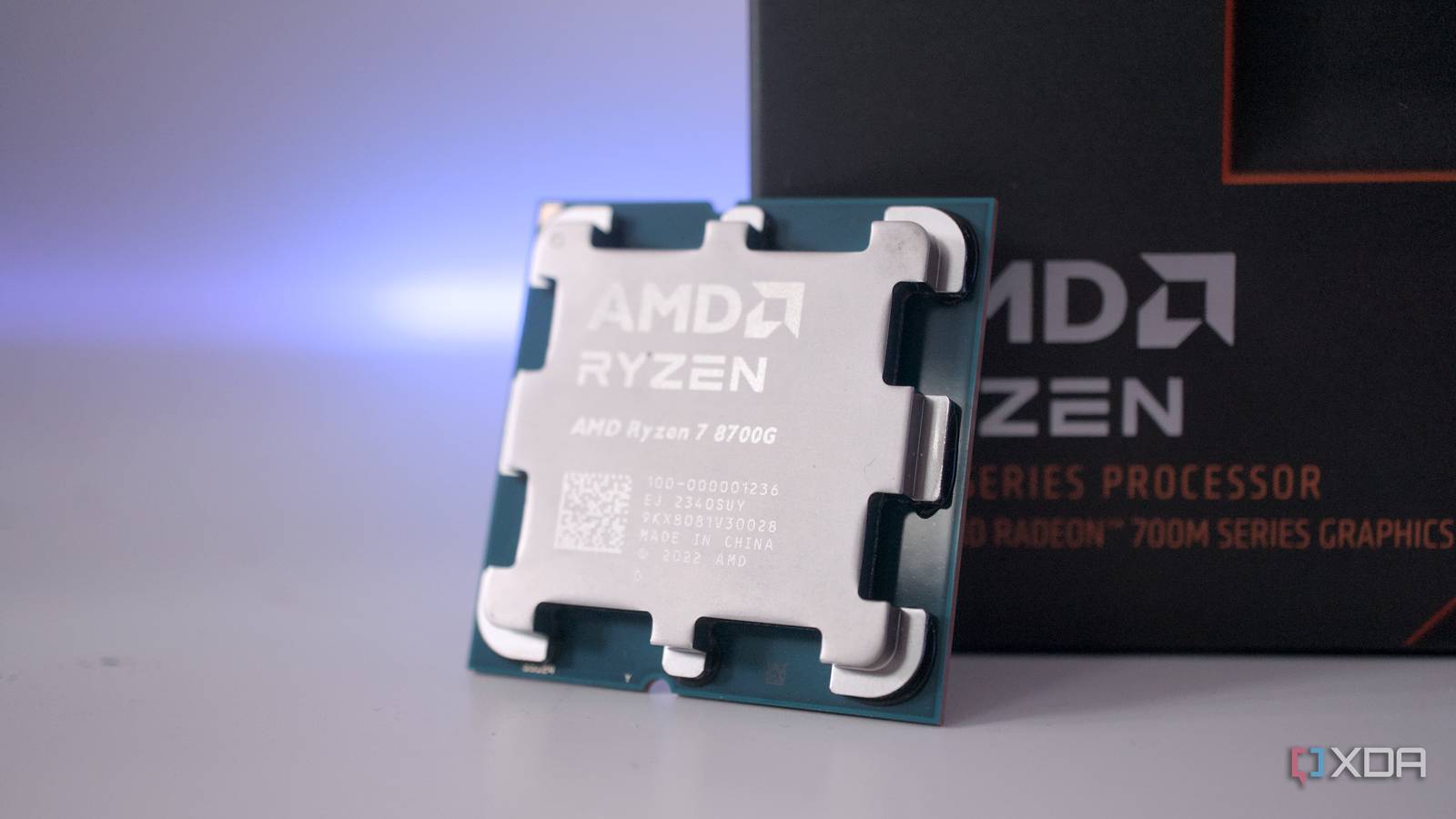
Published Oct 27, 2026, 12:01 PM EDT Abhinav pivoted from a career in banking to pursue his first love in writing. Even while working full-time, he continued contributing as an editor-at-large, a role he has held for more than 7 years. A lifelong tech enthusiast who has built three gaming and productivity powerhouse PCs since 2018, his passion for technology keeps him closely following the semiconductor industry, from NVIDIA and AMD to ARM. His MSc dissertation explored how artificial intelligence will reshape the future of work, reflecting his curiosity about the wider social impact of emerging technologies. The iGPU on the CPU is perhaps the most overlooked component in any PC, and perhaps part of it has to do with how few people know it even exists. Most people use their PCs rather predictably, and if they have a monitor that has always plugged into a GPU, it gives them no reason to think of the chip sitting on the processor. It's quite a shame, because some of the integrated graphics available on modern CPUs can be faster than an entry-level GTX graphics card released in 2016. Take the GTX 1050, for example, which was once Nvidia's entry ticket into PC gaming. There's a fascinating number of things you could do on your iGPU alone if it clears that bar, and not knowing them would mean you're leaving some great use-cases on the table. These CPUs can outperform an Nvidia GTX 1050 Budget cards of 2016 now come built into the processor Some consumer processors that AMD and Intel have built around an impressive iGPU pack more graphical power than the GTX 1050, which sounds absurd, but is true. On the AMD side, the Ryzen 7 8700G desktop chip and the Ryzen 7000 and 8000-series laptop chips that come with Radeon 780M graphics outperform it, and so do the top Ryzen AI 300 laptops with the newer Radeon 890M. Intel's Core Ultra 200V laptop chips with Arc 140V graphics make the list as well, as do the newer Core Ultra Series 3 chips with Arc B390 graphics. The 780M integrated graphics stand somewhere above a GTX 1050 and closer to a GTX 1050 Ti, which Nvidia launched in October 2016. AMD's Radeon RX 460, the 1050's rival from that era, on the other hand, is slightly below both. The Ryzen AI and Core Ultra chips push past even the 1050 Ti in terms of performance. Unfortunately, most standard desktop chips aren't close. My Ryzen 5 7600X has just two graphics cores, and Intel's desktop UHD Graphics are far behind as well. It's fascinating that this level of performance required a dedicated GPU in 2016, and now it's available inside the CPU package. Decent iGPUs already push past 100 fps in some games Depending on what chip you have, it might even be enough Source: Larian StudioCredit: Source: Electronic Arts With all of that said, you might be wondering as to what you can do with such a processor. One of the answers to that, obviously, is gaming. In January 2024, TechSpot ran the iGPU gaming benchmarks on the Ryzen 7 8700G's Radeon 780M at 1080p low preset, and the results depend on what each title asks for. Counter-Strike 2, still Steam's most-played game, and Fortnite, both lean heavily on the CPU, but the 8700G's eight Zen 4 cores did not hold them back. Counter-Strike ran at 119 fps and Fortnite managed 132 fps in the test. F1 2023 asks far less of the processor, so the 125 fps it managed is down to the 780M itself. Baldur's Gate 3, on the other hand, managed at a decent and playable 49 fps. Now, does any of this mean that it's possible to skip a discrete GPU altogether and still enjoy gaming? The benchmarks themselves say that a $329 processor can manage light gaming workloads at 1080p, so it is definitely possible. Now, whether that's reasonable is an entirely different question. It's worth taking into account that these benchmarks were run in 2024, and it would be a surprise to no one when I say that the standards of AAA gaming have changed a lot since then. The problem here is the fact that the iGPU gets nothing to itself. In the example of the 8700G, the 780M shares the 65W power budget with the CPU cores, so in a CPU-heavy game like Counter-Strike 2, the two end up drawing from the same pool. Since the iGPU also has no memory of its own, every gigabyte it borrows from system memory is memory the CPU can't use. As such, how fast your memory is also becomes a bottleneck to the iGPU's performance. Even an iGPU that can't game has a video engine worth using Encoding doesn't care how many graphical cores you have It's obvious that some of the compromises that come with gaming on an iGPU would be too much for nine out of ten gamers, and that's fair. However, even if you aren't using your iGPU for gaming, your chip still has a dedicated video engine for you to make use of. My Ryzen 5 7600X provides a good example. Its two graphics cores aren't good enough to play a modern game (or perhaps any game), but the same chip can handle encoding and decoding H.264 and HEVC in hardware and decode AV1 as well. Because the video engine itself is separate from the graphics cores, it doesn't matter how few of them are on the chip. Similarly, Intel's UHD Graphics 770 has QuickSync, and the 8700G's newer engine is slightly better with AV1 encoding on top. With that, you can stream in OBS or convert a video in HandBrake on the AMD or Intel hardware encoder, which hands the job to the iGPU instead of the CPU cores. That way, the iGPU takes some of the workload off the CPU and leave its processing cores free for other jobs on your desktop. Integrated graphics are not what they used to be in 2012 Integrated graphics have come a long way since the Intel HD 4000 era, which I remember particularly because of how much it disappointed me as a 12-year-old trying to play Warframe. Perhaps that's why it's fascinating to see modern chips run esports titles past 100 fps, and even the weaker ones that can take encoding off the CPU. Of course, that certainly does not make even the best iGPU a total replacement for dedicated graphics, but for those who have been ignoring their integrated graphics, it might be worth finding out what theirs can do.
Your CPU's integrated graphics might be faster than a GTX 1050, but most people never use them
Full Article
Original Source
Read the full article at Xda-developers →KhanList aggregates and links to publicly available news content. We do not host full articles from third-party sources. Always verify important information with original sources.