
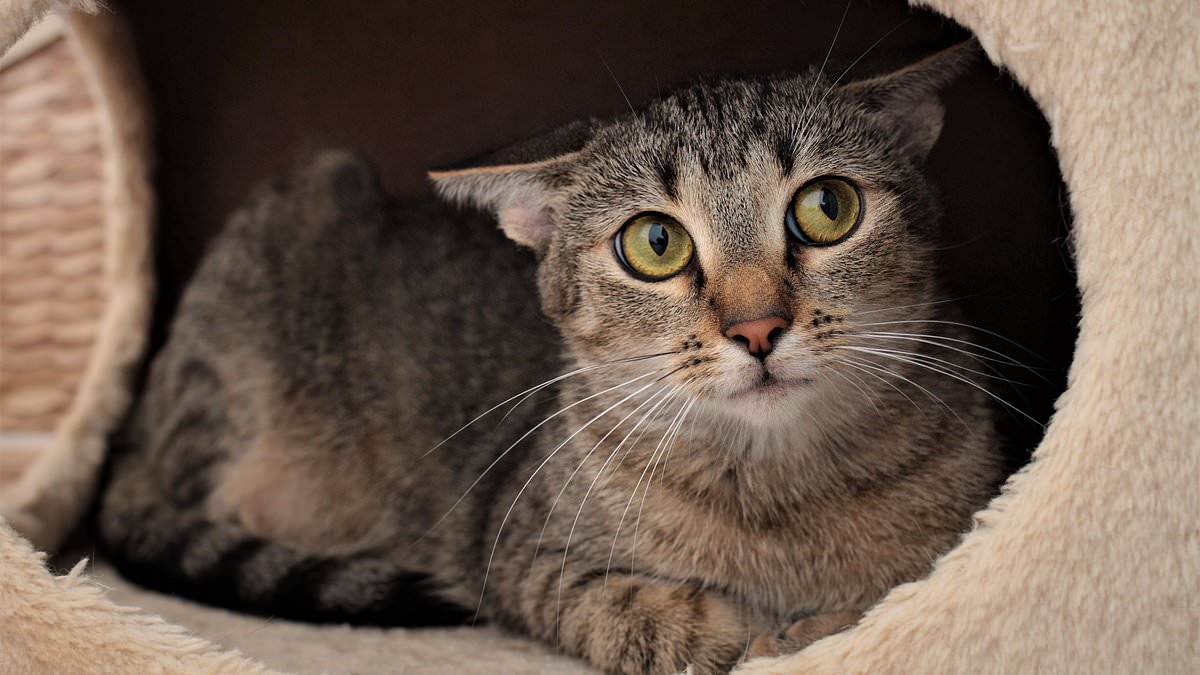
Published: 14:00 EDT, 4 November 2026 | Updated: 14:00 EDT, 4 November 2026 If you've ever been convinced your cat secretly hates you, scientists have some reassuring news – it might just be shy.In a study of 310 pet cats researchers found some displayed a mix of fear and curiosity, displaying a desire to approach unfamiliar people or objects while also being wary of them.The behaviour closely mirrors shyness seen in children, who are torn between exploring something new and staying out of harm's way.The trait was most commonly seen in male cats and those born as strays.The researchers said: 'Our findings suggest that shyness in cats is more complex than simply being afraid of humans, with cats showing diverse patterns of social behaviour.'Rather than simply labelling cats as "friendly" or "timid", we hope our research will encourage cat owners to observe and better understand each cat's individual behaviour.' Researchers found a strong link between cats who scored high for both shyness and fear - wanting to approach unfamiliar people or objects while also feeling wary of them The team found cats tend to have one of four personality types - highly sociable, sociable, fearful and human infant-like shyness How to tell if your cat is shy Approaches new people, then suddenly backs away.Wants to investigate unfamiliar visitors but keeps its distance.Hides at first, then gradually emerges to watch what's going on.Seems nervous around new toys or objects but cannot resist checking them out.Alternates between seeking attention and avoiding contact.Watches strangers closely rather than ignoring them completely. They added that studies of personality traits in animals often don't differentiate between shyness and fear, instead measuring behaviour on a scale from fearful to bold.For the experiment, they asked cat owners to complete an online survey adapted from a questionnaire used to evaluate children's personalities.They analysed their answers and scored each cat's shyness, fearfulness and tendency to approach new people or toys.Overall, the researchers found four main personality types – highly sociable, sociable, fearful and shy.Cats classed as highly sociable or sociable showed little fear and were willing to approach new people or objects.At the other end of the spectrum, fearful cats were nervous and reluctant to engage with unfamiliar things. Researchers also identified a fourth group that combined high levels of fear with a strong desire to investigate new people and toys, sometimes seen in children. Having a deeper understanding of these traits in cats could help pet owners and animal shelters better accommodate different cats' needs and improve their welfare, the team saidThe researchers said their findings suggest that complex personality traits can exist in animals.Having a deeper understanding of these traits in cats could help pet owners and animal shelters better accommodate different cats' needs and improve their welfare, they added.'We observed that certain cats displayed "human infant-like shyness", a trait defined by high fear and approach scores, similar to the shyness observed in human infants,' the study, published in the journal PLOS One, said.'This personality type was more frequently observed in males descended from stray cats.'The researchers also found that some cats remained wary but still showed an interest in approaching people.They suggest that gradually increasing contact with humans could help these animals become more comfortable around them.HOW WELL DO YOU KNOW YOUR CAT? THE SECRET SIGNALS FELINES GIVE THEIR OWNERS Cats are often branded aloof and solitary creatures who spend their days plotting their human owner's demise, but such characterisations could not be further from the truth.In fact, our feline friends constantly communicate their feelings of affection to us, whether it be through their whiskers, tail, face or body language.In her eye-opening new book Kitty Language: An Illustrated Guide to Understanding Your Cat, author Lili Chin - with the help of animal behaviourists - explains how to interpret your pet's movements.Below are some of the most common behaviours and what they could signal. Our feline friends constantly communicate their feelings of affection to us, whether it be through their whiskers, tail, face or body language
Your cat doesn't hate you...it's just shy! Some felines are reserved - just like humans, study finds
Full Article
Original Source
Read the full article at Dailymail →KhanList aggregates and links to publicly available news content. We do not host full articles from third-party sources. Always verify important information with original sources.