
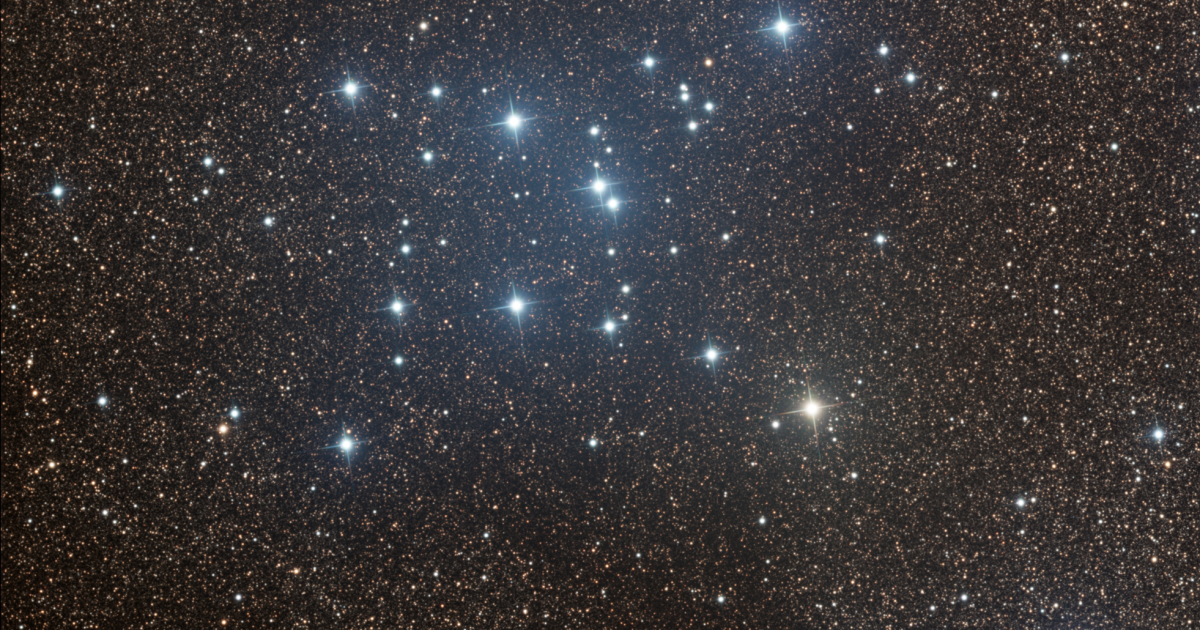
Messier 7 [Credit: Alexander Curry, Telescope Live] As with most hobbies, there’s a point in almost every astrophotographer’s journey when the backyard stops being enough. If you get serious about astrophotography, you’ll soon enough be disappointed by the light dome creeping in from town or another week of clouds wiping out what should have been a perfect imaging run. You’ll also inevitably want to capture some target that simply cannot be seen from where you live, no matter how dark the sky or how capable the equipment. If you’re a lone, amateur astronomer, you’ll run into many limitations in your craft. Telescope Live was built to raise the ceiling. The platform gives astrophotographers access to a curated archive of pre-calibrated imaging data captured by a global network of professional-grade telescopes. Sites in Chile, Spain, Australia, and the United States feed a library that now spans more than 10,000 hours of observations across thousands of objects, including galaxies, nebulae, star clusters, and beyond. New, exclusive datasets are added continuously. Subscribers download data, process it using their own preferred software on their own computer, and produce finished images. No telescope ownership is required, and you’re not reliant on weather, location, or season. “Our global network of telescopes runs continuously, capturing pre-calibrated data across dark-sky sites, and that data goes into a curated archive,” says Alex Curry, co-founder of Telescope Live. “What’s left is the part people actually want to do: process the data into an image that’s theirs.” The Telescope Live team frames its mission around four obstacles that hold most astrophotographers back: weather, light pollution, time, and equipment. The archive model addresses each one directly. Take a hypothetical imager based on the East Coast of the United States, where clear nights are scarce and city glow is a near-constant problem. Their local sky might be Bortle 6 or higher, heavily light-polluted and unreliable for serious deep-sky work. Telescope Live’s Chilean observatory, situated in the Rio Hurtado Valley at El Sauce Observatory, records sky brightness readings of roughly magnitude 21.5 to 22, firmly in pristine dark-sky territory (not to mention, with views from the Southern Hemisphere). It also sees around 300 clear nights a year, meaning data is almost always accumulating there even when skies are socked in along the North American coast. “Weather stops mattering because the data was captured on a clear night somewhere else,” Curry explains. “Light pollution disappears the same way. Instead of spending a full night acquiring, calibrating, and checking subs, a subscriber downloads an already-calibrated dataset and is able to start stacking and processing within minutes. Equipment cost disappears entirely. There’s no telescope, mount, camera, or filter wheel to buy, maintain, or transport.” The result, as Curry puts it, is that the limiting factor shifts: “It becomes the user’s processing skill, not their bank balance or their postcode.” That network now includes more than 30 instruments, including several large-aperture systems contributed by a growing community of partner astrophotographers who host their own telescopes at premium dark-sky sites and sell data exclusively through Telescope Live. The flagship instrument is the CHI-1, a PlaneWave CDK24. That’s a 24-inch (61cm) Corrected Dall-Kirkham reflector paired with a QHY600M Pro scientific-grade camera, located at El Sauce Observatory in Chile. “That Chile telescope, the actual setup, is about $200,000,” Curry notes. “Data of this quality from this kind of instrument is out of most people’s budget. We’re very fortunate that we can actually access it, and most people would never get that opportunity otherwise. With us, they can access it for $6 a month.” The CDK24 has accumulated hundreds of Astronomy Picture of the Day (APOD) credits associated with images processed from its data, a testament to the quality it delivers to astrophotographers. Unlike traditional remote imaging services, Telescope Live doesn’t require you to lease a time slot, supply hardware, or pay for a particular amount of observation time. “You don’t need to send a telescope to one of our facilities,” Curry says. And while some imaging facilities provide telescopes for live-session remote imaging, users typically pay for telescope time by the hour and are left with whatever the sky delivers that night. Cloud cover, poor seeing, and focus issues are the user’s problem. If ten hours of imaging time only yields seven usable hours, that’s the result. By contrast, says Curry, “We offer data that is already compiled and ready to turn into something beautiful.” Telescope Live separates the telescope from the platform. Data is reviewed against strict quality metrics before any dataset is published, such as point spread function (PSF) consistency, flat-field uniformity, and the absence of distortion in the imaging train. If ten hours of acquisition produces only eight usable hours, the platform either publishes eight hours or continues acquiring more to meet the standard. Users see ratings, metadata, and fully described specifications before committing a single credit. “When our user downloads our partners’ data, it’s held to the same standard as the data we would capture ourselves from Chile, Australia, wherever,” Curry explains. “Our partners are pre-vetted. You could send your telescope to a remote observatory, but it will cost you thousands to ship equipment and run it for a month. It’s a different kind of hobby compared to processing data from here.” The commitment to data quality also pays off specifically for beginners. On competing platforms, even veteran imagers can expect to discard 10 to 15 percent of acquired frames due to quality issues. On Telescope Live, the archive curation means what you download is usable in its entirety. “From a beginner point of view, you can get a very good image very straightforwardly,” says Curry. “If you want to go deeper and get more and more out of it, of course there is a very high ceiling to image processing. That’s also why we produce extensive tutorials to help you bridge that gap.” Alex Curry [Credit: Telescope Live] As Curry is an enthusiast himself with his own private collection of equipment, he says that Telescope Live is designed to complement what astrophotographers are already doing, not replace it. “We don’t want subscribers to go sell their hard-earned equipment in order to download data from us,” Curry says. “But there are things on here that you would never come across otherwise.” British astrophotographer Nik Szymanek, a long-time platform customer and contributing partner based in North Essex, describes the dynamic from firsthand experience. “There are three things that made Telescope Live an attractive option to my own imaging setup,” he says. “Firstly, it offers high-quality data taken in the southern hemisphere, which enables access to objects that are not visible from the UK. Secondly, the data were acquired from locations that have vastly better conditions and many more clear nights. Finally, Telescope Live has access to many large, long-focal-length telescopes which are ideal for imaging smaller targets such as galaxies and planetary nebulae. My own observing equipment is for wide-field imaging, so this is a very complementary situation.” If you’re an intermediate hobbyist and you already have a capable backyard setup, Szymanek says, you’ll still struggle with light pollution and cloudy nights. “By having access to data taken from a choice of better sites, there will be many more opportunities to improve image processing skills and techniques,” he says. “This is particularly beneficial to relative newcomers to the hobby, as they will be able to practice techniques on data that isn’t afflicted with the usual problems such as poor focus, bad guiding, and light pollution gradients.” Szymanek has contributed datasets with his own telescope in Spain, as well as images and tutorials for the platform. Even with his own setup, he’s an avid user of Telescope Live. “My favourite dataset from Telescope Live was taken with their remarkable 24-inch PlaneWave CDK telescope in Chile,” Szymanek says. “It’s an eight-hour LRGB set of the colliding galaxy NGC 5128 (Centaurus A). Of course, this isn’t visible from the UK, so there’s a certain mystique to it, but the dataset holds a hidden surprise that is revealed during image processing: the incredible star shells expelled from the galactic collision. Modern image processing software and techniques make it easy to display such low-contrast detail that transforms the view of this object, but the high-quality equipment and observing site make all the difference.” Start free, scale at your own pace Getting started on Telescope Live requires no subscription and no credit card. The platform rotates a selection of free, pre-calibrated datasets (updated every few months) that anyone can download without even creating an account. Each comes paired with a free beginner tutorial to guide first-time processors through the workflow using Siril, a capable, fully free open-source astrophotography processing application. “Anyone can browse the archive and pull a small selection of free, pre-calibrated datasets alongside free beginner tutorials,” Curry explains. “From there, someone can realistically produce a finished deep-sky image, often their first ever, using free software, without owning a single piece of equipment. That first result tends to be the hook.” The free datasets are chosen specifically for visual payoff. They’re not always the most obvious Messier objects, but targets with unusual, striking features. “They’re things you might not have seen before,” Curry says. “Things that when people process them, there are lots of interesting features to them. You can get a wow factor out of it.” Subscriptions begin at approximately $6 per month for Bronze access, which provides 5 credits monthly (enough for around ten hours of data on a single target, or up to five of the platform’s one-credit sample datasets) along with access to beginner tutorials. Silver ($24/month) expands the credit allowance and unlocks the higher-tier tutorial library. Gold ($59/month) opens all tutorials, provides 50 credits monthly, a 20% discount on individual dataset purchases, and discounted pricing on additional credit purchases. Silver is the entry point for most active users, but Curry says Gold is the best value if you’re deeply invested in the craft. The archive itself is open to anyone. There’s no login or subscription required to browse what’s available. The processing craft Some backyard imagers, according to Curry, might be skeptical about archive-based astrophotography. The concern, as he describes it, is that using data someone else captured amounts to downloading a picture and skipping the real work. It isn’t. Stacking, stretching, color balance, noise reduction, and gradient correction are the technical and creative decisions that define the final image, and they remain entirely the user’s. Nothing in the archive changes that. “Once experienced imagers actually try processing one of our datasets, that objection tends to fall away fast,” Curry says. “The skill gap they were worried about protecting turns out to be exactly the part we never touched.” The platform’s tutorial library supports processors at every level. Courses span multiple software applications, from the industry-standard professional processing suite PixInsight to Siril, a free, full-featured alternative available across Windows, macOS, and Linux. Tutorials are structured in digestible ten-minute-minimum segments, searchable by tutor, software, difficulty level, imaging type, and category. They’re produced by recognized authorities in the astrophotography world and accessible for whatever niche question you might have. New subscribers complete an onboarding form that assesses their experience level and guides them to appropriate starting tutorials. From there, the learning path is self-directed. A beginner can produce a respectable processed image within an hour following a guided tutorial, while an advanced user can spend days pulling every possible detail out of a 40+ hour integration dataset. As Curry says, the processing is the hobby, and the archive simply ensures the data it starts from is the best possible. “The process of astrophotography is the same whether I capture data in my own backyard or collect it from one of our datasets,” he says. “I wake up in the morning, see what has been captured, download and process. The difference is that from here I can access data from the southern hemisphere, from a PlaneWave telescope in the middle of the Atacama, that I could never gather on my own.” Whether or not you already own an imaging rig and have spent late nights under imperfect skies, Telescope Live gives you access to a world-class archive that any individual could never compile on their own. Click here to learn more about Telescope Live and access free datasets.
Your backyard telescope is just the beginning
Full Article
Original Source
Read the full article at Astronomy →KhanList aggregates and links to publicly available news content. We do not host full articles from third-party sources. Always verify important information with original sources.