
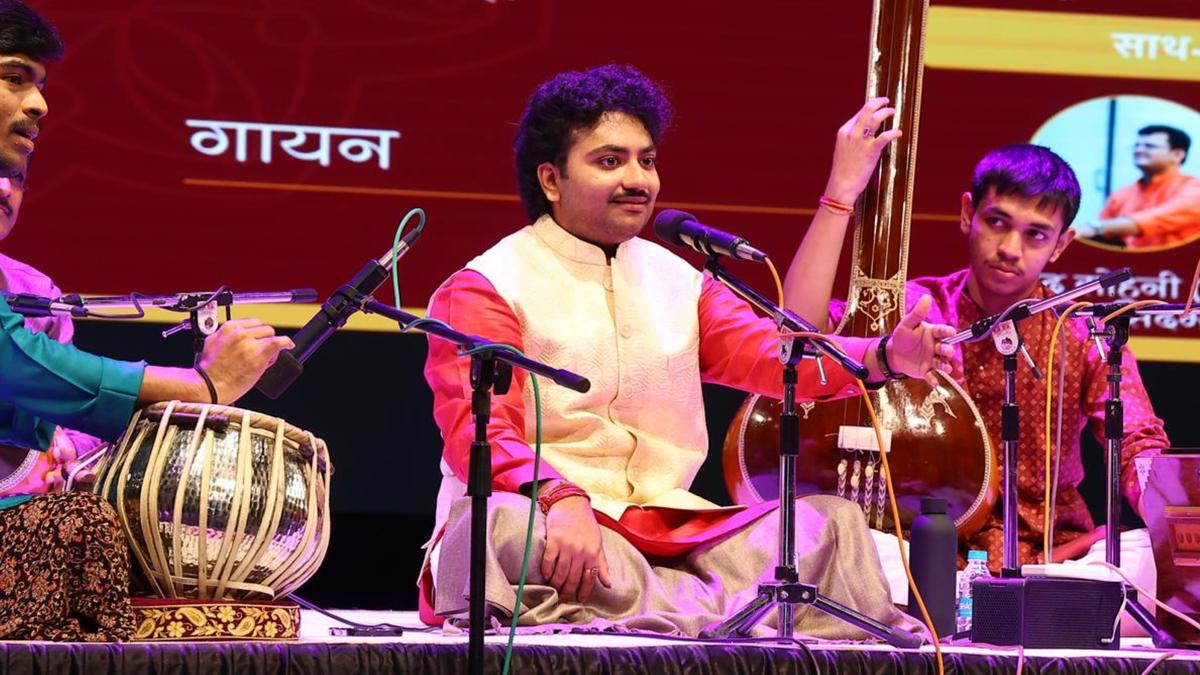
Delhi has long been an active centre for cultural activities, with music, dance and theatre festivals through the year. The Morning Raga series is one such event that shows the city’s continued engagement with the arts.A concert at the Habitat Centre, Delhi, as part of the Morning Ragas Series, organised by ITC SRA and Habitat Centre, featured 23-year-old Shadaj Iyer. His family hails from Kanchipuram, and he was born and brought up in Ahmedabad. Shadaj specialises in the niche Agra-Attrauli gharana that has had relatively few exponents on the concert stage. He was drawn to this challenging gharana, known for its distinctive sound, when he was barely four. He began training under Ustad Shaukat Hussain Khan when he was seven and began performing a few years later. He is currently training under vidushi Subhra Guha, at the ITC SRA, Kolkata.The founders of the gharana trace their musical lineage to the descendants of Tansen. Over time, they settled in Agra and Attrauli, from which the gharana derives its name. One of the best-known singers of the gharana in modern times was ‘Aftab e Mousiqi’ Ustad Faiyaz Khan, also known as ‘Barodawale’ as he settled in Baroda. Invited by the Gaekwad royal family when he was in his 20s, Ustad Faiyaz Khan lived till the end of his days in Baroda. The singer, who passed away in 1950, is regarded as the finest vocalist of his time. One of the best-known singers of the gharana in modern times was ‘Aftab e Mousiqi’ Ustad Faiyaz Khan, also known as ‘Barodawale’ | Photo Credit: Special Arrangement His nephew and disciple, Ustad Sharafat Hussain Khan, was 20 when the doyen passed away. It took him another 20 years to establish himself, but he died young at the age of 55 in 1985. Since then, the Agra gharana has not seen any ‘star’ singers. There have, however, been several erudite musicians and teachers, including Ustad Ata Hussain Khan, Ustad Vilayat Hussain Khan, Ustad Latafat Hussain Khan, Ustad Khadim Hussain Khan and Ustad Yunus Hussain Khan. Among the singers who did not belong to the gharana’s hereditary family were several distinguished musicians, including Zohrabai Agrawali, Pt. Bhaskar Buwa Bakhale, Prof. S.K. Ratanjankar (who established the Bhatkhande University in Lucknow) and Pt. Dilip Chandra Vedi. It was against this backdrop that Shadaj’s performance was particularly impressive. The young vocalist seemed to enjoy embracing his own musical identity rather than emulating the exponents of his gharana. Agra singers traditionally adopted a distinctive voice production, characterised by a rasping timbre and a texture that is difficult to acquire. Women vocalists of the gharana, including vidushi Lalith Rao, her disciple Bharati Pratap and Poornima Dhumale, have, however, had to develop a softer style. Prof. S.K. Ratanjankar, an exponent of the Agra gharana, went on to establish the Bhatkhande University in Lucknow | Photo Credit: Special Arrangement Shadaj began his performance with Ramkali, a raga closely associated with the Agra gharana. After an expansive alaap, he moved to ‘Aaj Radha tore’, a popular vilambit composition in Ek taal. Throughout his barhat, Shadaj’s singing bore the unmistakable stamp of the Agra gayaki. In his rendition of the popular madhya laya bandish, ‘Unn sang laagi akhiya’, he displayed impressive vocal power while rendering the taans, controlling the volume and force, which is characteristic of his gharana. His ability to execute heavy gamaks with ease was impressive. Equally laudable was his attempt to avoid repetitive patterns in his taans.The speciality of the Agra gayaki lies in its reliance on the dhrupad style throughout a concert, and not just in the raaga-ang alaap section, now commonly known as ‘nom tom’ alaap to distinguish it from the note-by-note progression preferred by khayal singers. The Agra alaap also includes ‘jhala’ — whether this was borrowed from instrumental music or instrumentalists adopted it from vocal music remains a matter of debate. The open-throated articulation is another defining feature of this style. The strong dhrupad influence is also discernible in the ‘bol baant’, minimal use of ‘murkis’, and the emphasis on ‘layakaari’.Shadaj next took up Gaud Sarang and sang a traditional composition, followed by one composed by ‘Daras piya’ (Ustad Mehboob Khan). He concluded with three highly lyrical, emotive compositions in Bhairavi, including a thumri.Shadaj was accompanied by Sagar Gujrati on the tabla and Paromita on the harmonium. One admired his deference to Paromita. He was in no hurry to assert himself or dominate the stage, allowing the music to unfold with a sense of ease and mutual respect. Agra gayaki is stark and austere. While some argue that it lacks emotional content, others maintain that the pukaar of a great Agra singer cannot fail to move the listener. Perhaps this explains why many Agra gharana vocalists, beginning with Ustad Faiyaz Khan, have also excelled in singing thumri.
Young Shadaj Iyer puts the rare Agra gayaki in the spotlight
Full Article
Original Source
Read the full article at Thehindu →KhanList aggregates and links to publicly available news content. We do not host full articles from third-party sources. Always verify important information with original sources.