
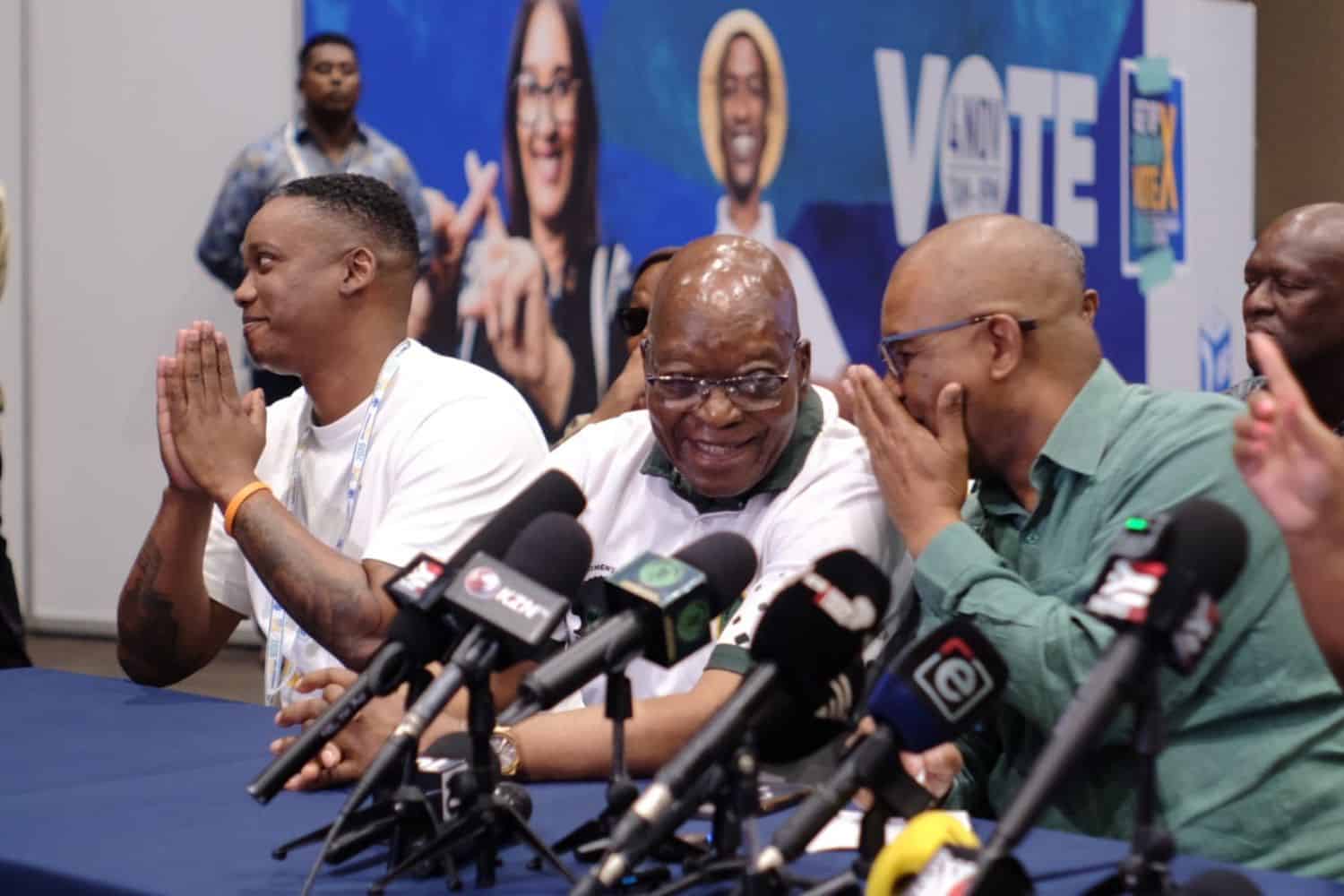
The MK party has established a national structure to manage the process. The uMkhonto weSizwe (MK) party has appointed a national team to oversee coalition negotiations with other political formations following 2026 local government elections. The party’s negotiating structure was announced on Saturday, 7 November, during a media briefing at the Inkosi Albert Luthuli International Convention Centre in Durban, KwaZulu-Natal (KZN). The announcement comes as the Electoral Commission of South Africa (IEC) continues to count and verify votes cast during Wednesday’s municipal elections on 4 November. With the commission expected to release the final results on Sunday, 8 November, political parties are already preparing for coalition discussions, particularly in municipalities where no single party secures an outright majority. The MK is also expected to emerge as the largest party in KZN’s eThekwini region. MK party on coalition talks MK party National Disciplinary Committee (NDC) chairperson Dali Mpofu described the party’s electoral performance as a significant achievement, highlighting its ability to secure nearly 10% of the national vote despite participating in municipal elections for the first time. Mpofu contended that the election outcome so far demonstrated a clear preference among voters for cooperation between political parties. Against this backdrop, he confirmed that the MK party was ready to engage other political formations and had established a national structure to manage the process. The responsibility of negotiating potential coalition agreements will rest with the National Negotiating Team (NNT), which brings together several senior figures within the party. The team comprises Mpofu, First Deputy President Duduzane Zuma, Second Deputy President Tony Yengeni, KZN provincial convenor Willies Mchunu, acting secretary-general Lindi Mtshali-Makhubu, national chairperson Mxolisi Phakathi and former treasurer-general Dr Thanti Mthanti. Mpofu said the team’s mandate was to ensure that any political partnerships entered into by the MK party were consistent with its policies including matters relating to land. He cautioned against allowing negotiations to become a contest for political influence or positions. “They must not be driven by the pursuit of political positions or short-term political expediency.” The selection of coalition partners would require careful consideration of their political alignment, ability to govern, financial sustainability, integrity and willingness to honour commitments. Mpofu stressed that the negotiations should focus on substantive issues and “not merely the distribution of positions”. Watch the MK party’s media briefing below: Coalition agreements subject to strict conditions The MK party has also set out requirements that must be met before any coalition arrangement can be finalised. All proposed agreements would have to be documented in writing, with clearly defined obligations, measurable targets and accountability mechanisms. According to Mpofu, the party expects these agreements to be concluded within the first 100 days after the establishment of the respective municipal councils. He further made it clear that the national negotiating team would not have the final say on coalition agreements, as that authority would remain with the party’s presidency. Matters that cannot be resolved within the team’s mandate must be escalated to the party leadership for consideration. Mpofu also issued a directive to the party’s provincial, regional and local structures, which prohibits public representatives and party structures from initiating or concluding coalition discussions without authorisation. “No coalition agreement may be concluded or signed on behalf of the party without the explicit approval of the presidency.” Hung municipalities During the question-and-answer session, Mpofu pointed to the likelihood of coalition governments being formed in a substantial number of municipalities, suggesting that at least 120 councils could be hung following the elections. “That’s almost half of the municipalities in South Africa,” the lawyer remarked. Mpofu further responded to media reports questioning the MK party’s stability, particularly in light of changes within its leadership structures. He argued that such assessments had underestimated the party’s support among voters. “You wrote off uMkhonto weSizwe on the basis of this so-called instability and the people on the ground have responded.” IEC faces questions over outstanding objections The IEC’s handling of objections submitted by political parties also came under scrutiny during the briefing. Mpofu questioned the commission’s reported intention to proceed with announcing the election results while objections allegdly remained unresolved. He argued that the IEC needed to “get its house in order”, warning that the legislation governing electoral processes and the timelines for resolving disputes might require changes. The MK party chairperson also indicated that the matter could be taken to the Electoral Court. “Clearly, we are going to confront the same in 2029.”
‘You wrote off uMkhonto weSizwe’, says Mpofu as party prepares for coalition negotiations
Full Article
Original Source
Read the full article at Citizen →KhanList aggregates and links to publicly available news content. We do not host full articles from third-party sources. Always verify important information with original sources.