
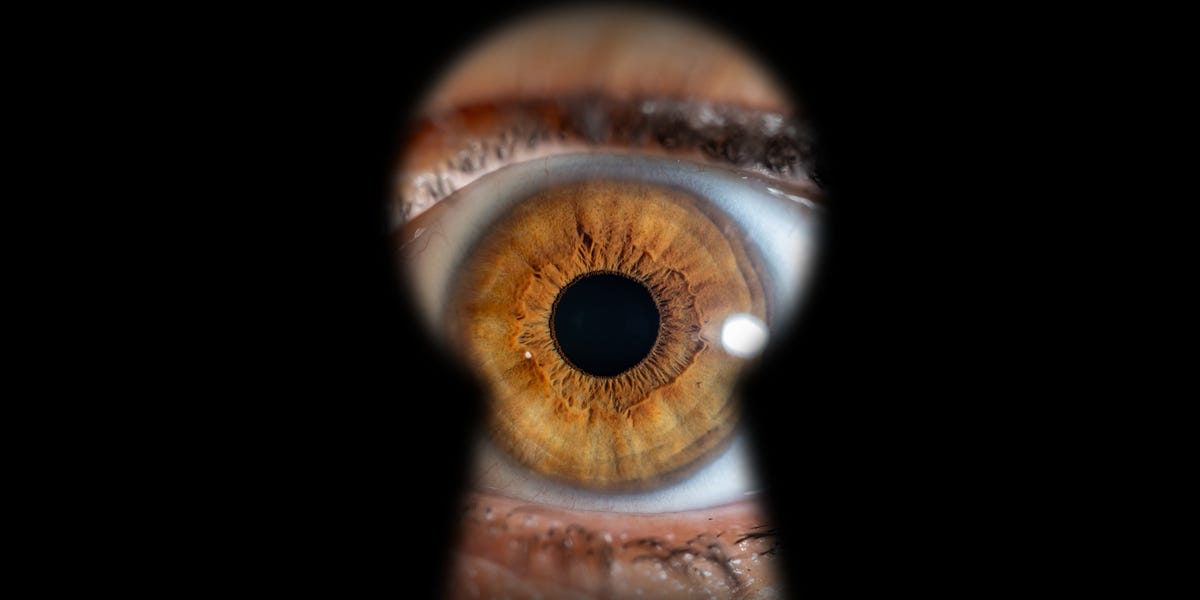
Here’s what you’ll learn when you read this story:Tiny lab-grown brain organoids have produced electrical activity patterns akin to those seen in premature infants.Before their thinking becomes more directed through learning, children’s brains may be more conscious of their environment, a researcher thinks.The researcher’s preliminary tests found that these organoids “learned” via repeated stimulation. Yet, their less “conscious” behavior suggested that learning may actually narrow perception.When you were a child, did you ever wonder what happened to the sea at the horizon? Perhaps you imagined it stretching forever. Or perhaps, like me, you believed that where the blue ended, the water simply fell off the edge of the world, spilling over in some enormous, invisible waterfall. It made perfect sense at the time, and there was quite a lot of magic involved, too. Then came geography lessons, maps, explanations, terminology, and the gradual realization that the world did not end where your vision did—that it was, in fact, far vaster than anything the eye could take in. So why has it become so difficult to recapture the purity and intensity of that experience as an adult?Could there be a chance, however counterintuitive it sounds, that you were actually more conscious back then?It sounds counterintuitive, but Alysson Muotri, PhD, a professor of pediatrics and cellular and molecular medicine at the University of California, San Diego, has given this poetic—almost philosophical—idea scientific legs. To do so, he used one of the most futuristic tools that currently exists for investigating the human brain: brain organoids, tiny clusters of living neural tissue grown from stem cells in a laboratory. He wondered whether these tiny lumps of living human brain tissue could illuminate that elusive inner experience. What he found was that as we grow and learn about the world, this process might really be changing how we perceive reality.But before you can explore consciousness in a lab, you need to build the organoids. The process begins with ordinary human cells, often collected from the skin. Scientists reprogram them into induced pluripotent stem cells, which regain the ability to develop into almost any cell type in the body. Researchers use chemical signals to turn these cells into neurons and other brain cells. The cells multiply, gathering into tiny clumps of tissue. Inside them, neurons begin making contact, and electrical signals pass between them. However, calling these organoids “brains in a dish” is rather generous, though tempting; they lack much of the anatomy of a developed human brain. Still, organoids allow scientists to watch human neural tissue take shape in ways that would be impossible to witness inside a living person’s skull.Muotri’s team discovered in 2019 that maturing organoids produced electrical rhythms resembling certain features of brain activity recorded in premature infants. Here was human neural tissue, deprived of the sights and sounds accompanying a child’s development, nevertheless organizing itself into patterns observed in living brains. Four years later, researchers at Indiana University Bloomington incorporated brain organoids into an experimental computing system that used their electrical responses to help recognize spoken sounds and predict mathematical patterns. By 2025, other scientists had reported that repeated electrical stimulation could alter how individual neurons in organoids responded, with some changes lingering for hours after the stimulation came to a halt—evidence of cellular mechanisms associated with learning and memory.Muotri, meanwhile, had begun wondering whether the electrical activity of his brain organoids could offer any clues to that elusive inner experience we call consciousness. Of course, even if we assume that consciousness arises entirely from the brain, there is something peculiar about trying to measure it. It’s not as though you can insert a thermometer into someone’s head and pinpoint the experience of being alive and aware—or the feeling of experiencing the world as a child.Muotri decided to investigate by borrowing an approach from consciousness research called the perturbational complexity index (PCI). In humans, the method involves delivering a brief magnetic pulse to the brain and recording the resulting electrical activity through electrodes placed on the scalp. Earlier researchers have analyzed the responses and calculated a score that has helped distinguish wakefulness from deep sleep and general anesthesia; a higher score indicates greater conscious awareness. While PCI cannot measure consciousness directly, it offers clues about the brain’s capacity to sustain it.In preliminary findings, Muotri measured the organoids’ electrical activity before exposing them to repeated stimulation, using an approach similar to PCI. To say that he found a startling degree of complexity in the way their neurons communicate with one another—with scores that exceeded those typically recorded in awake human brains—is an understatement. Because the organoid and human measurements use different methods, however, the scores cannot be compared directly. Still, he wasn’t expecting the organoids to have this PCI level, he says. “It’s very new, and I’m still thinking about what it means.”Muotri also found something shocking about how the organoids behaved as they were stimulated repeatedly with light. Gradually, the cells began reacting differently to the stimulation, and some of those changes lingered after the light was switched off. “So there is some kind of a memory embedded in those networks,” he says. But even more astounding was that, as the organoids adapted to the stimulation, their complexity score actually fell, similar to the way human brains with lower PCI scores were less aware.He thinks the reason is that a brain organoid increases its bias as it learns, just as we become more biased as we learn more over the years. By bias, Muotri means that experience makes certain neural responses, particularly those reinforced through repeated exposure, more likely than others. Learning, apparently, does more than give us knowledge. It may also condition us to overlook parts of the world we once experienced more freely.“It’s almost like when you are born…as soon as your brain is naive and fresh, you’re more conscious than when you are an adult,” Muotri continues. By adulthood, however, experience has cramped your brain’s style. “Because you already experienced so many things, you’re already [so] attached to the physical environment, that you become less conscious than you were [as] a baby.”The suggestion is extraordinary, especially coming from experiments involving tissue that has never seen a sunset, heard a lullaby, obeyed a teacher, or encountered anything resembling a childhood whatsoever.Yet there is a recognizable human parallel. Developmental psychologist Alison Gopnik has compared adult attention to a spotlight, concentrated on what matters for an immediate goal, and children’s attention to a lantern, illuminating more of their surroundings. A toddler entering an unfamiliar room might become absorbed by a patch of sunlight that an adult barely notices. The adult knows more about the room, but familiarity helps determine what deserves attention. Noticing more of the world doesn’t necessarily mean being more conscious of it.However, a baby’s brain, already shaped by months of development in the womb, is hardly comparable to an organoid that has never experienced the world outside a laboratory. That’s why Kenneth Kosik, MD, a neuroscience professor at the University of California, Santa Barbara, is skeptical. In a 2024 paper published in the journal Patterns, titled Why Brain Organoids Are Not Conscious Yet, he argued that organoids lack much of the organization and communication between brain regions that may be necessary for consciousness. And electrical activity, however complicated, is not enough to prove an inner life. Neurons firing independently can produce unpredictable signals that are difficult to reduce to a simpler description, even when there is no evidence that anything is being experienced. “So we still have a little bit of a jump there, yeah, to say that compressibility is related to consciousness,” Kosik says.Muotri himself is cautious about what the numbers mean and says they are still preliminary data. Nor does he claim that his organoids actually experience anything. “I should not say they are conscious outright,” he says.For now, Muotri’s experiments cannot definitively tell us whether we were more conscious as children than we are as adults, but they do open a window onto something just as intriguing: what happens to our experience of the world if learning itself changes how our brains encounter our environment? After all, the day I discovered that the sea did not plunge into an abyss, I gained precious knowledge that generations before me had strived to acquire. But have I ever again experienced the sea quite as fully as I did when I was a child, believing it could spill over the world’s edge? That is a whole different question, and we don’t have the answer yet.Download Pop Mech Digital IssuesStav Dimitropoulos is a Gold and Community Anthem Award–winning journalist, and writes about consciousness, science, and culture for Popular Mechanics, Nature, and the BBC. Her work often explores mind-stretching angles where science meets philosophy. Her debut nonfiction book, Slow, Lazy, Gluttons (Greystone Books, 2026) asks: What if the traits society shames — laziness, darkness, nostalgia, and more — are actually survival superpowers?
You Were More Conscious as a Child Than You Are Now, Neuroscientist Claims
Full Article
Original Source
Read the full article at Popularmechanics →KhanList aggregates and links to publicly available news content. We do not host full articles from third-party sources. Always verify important information with original sources.