
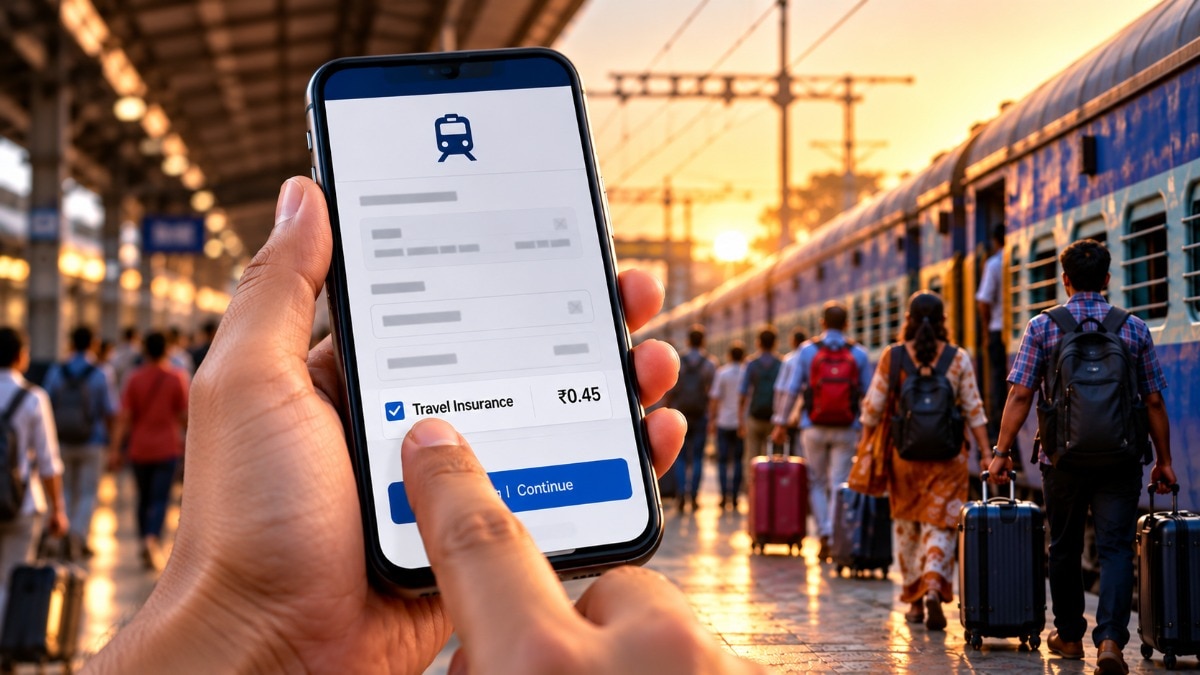
There is a moment in almost every railway ticket booking that most passengers come across. You have finally found a train that works. The seats are available.You enter the passenger details, choose your berth and move towards payment. Then, somewhere among the fare, convenience fee and other details, there is an optional travel insurance charge that costs less than Re 1.At less than a rupee, it is almost too small to think about. So most passengers don't. Why spend time reading insurance terms when the amount being deducted is not even enough to buy a toffee?During the festive rush, when people are desperately trying to get confirmed tickets to travel home for Dussehra, Diwali or Chhath, that tiny insurance option is even less likely to get anyone's attention. For a passenger who has just managed to secure a seat on a packed train home, an amount less than a rupee can feel like a rounding-off error.But that almost invisible charge comes with a surprising up to Rs 10 lakh in cover. And that is where things get interesting. What exactly is being insured for less than a rupee? Does the Rs 10 lakh cover apply if something goes wrong during any part of the journey? What happens if a passenger falls while boarding, gets injured in a train accident or needs to be hospitalised? And, perhaps more importantly, what if they simply fall sick on the train?The answer is that this is neither a tiny version of health insurance nor a general travel policy that covers every mishap. It is a narrowly defined accident cover linked to the railway journey — and the difference between the two matters.“Insurers is a game of probability and insurers distribute the risk of payout by charging at a nominal price because of high volume group underwriting across millions of railway passengers, where the vast majority complete trips safely without making claims,” says Abhishek Kumar, Sebi-registered investment adviser and founder of Sahaj Money.So, before you click that tiny insurance box the next time you book a ticket, it is worth knowing what those less than a ruppe insurance actually buys.WHAT DOES A FEW PAISE REALLY GET YOU?The headline numbers are striking.The optional railway travel insurance can provide up to Rs 10 lakh in case of accidental death or permanent total disability. Permanent partial disability can attract up to Rs 7.5 lakh, while hospitalisation expenses for injuries can be covered up to Rs 2 lakh. There is also a provision of Rs 10,000 for transportation of mortal remains.Insurance expert Shilpa Arora, Co-founder and COO of Insurance Samadhan, describes it as an unusually high-leverage product because the premium is just less than a rupee per passenger, inclusive of taxes, while the potential benefits run into lakhs.But the word to remember here is “accidental”.“This policy can offer cover running into lakhs of rupees despite costing less than Re 1,” Arora says. “It is not a regular life or health insurance policy.”And that one distinction explains most of the fine print that follows.HOW CAN A POLICY COST LESS THAN A RUPEE AND STILL OFFER LAKHS IN COVER?The obvious question is: how can an insurer potentially pay Rs 10 lakh when the passenger has paid only less than a rupee?The answer lies in the way this cover is structured. It is not an individual, year-long personal accident policy. The insurance is attached to a specific railway journey, meaning the period for which the insurer is exposed to the risk is much shorter.There is also the sheer scale of railway travel.Millions of passengers can opt for the cover, while only a small proportion are expected to experience the specific events covered by the policy. The premium collected across a very large pool helps insurers spread that risk.“Insurers is a game of probability,” Kumar says, explaining that the low premium is possible because of high-volume group underwriting across millions of railway passengers, most of whom complete their journeys without making a claim.Arora also points to the short duration of the cover and the large passenger pool as key reasons why such a product can be priced so cheaply.That also explains why passengers should not look at the Rs 10 lakh figure in isolation.Kumar says consumers should view the product “like a group accident cover rather than a comprehensive personal policy”. The headline amount, he says, should be understood as a fixed benefit for specific catastrophic events rather than flexible financial protection.In simple terms, you are not buying Rs 10 lakh worth of general insurance protection for a few paise. You are paying a tiny amount for protection against a defined set of events during a defined journey.WHAT IF YOU FALL WHILE BOARDING THE TRAIN?This is where the policy becomes more relevant to an ordinary passenger.People tend to associate railway accidents with dramatic events such as derailments or collisions. But accidents can happen in less dramatic ways too, particularly around the act of getting on or off a train.According to Kumar, the policy covers injuries sustained during a train accident, derailment or designated “untoward incidents”, and explicitly includes accidents occurring while actively boarding or getting off the train.“A passenger is covered for injuries sustained during a train accident, derailment, or designated untoward incidents but explicitly includes accidents occurring while actively boarding or getting off the train,” he says.If such an incident results in eligible hospitalisation, permanent disability or accidental death, the relevant benefit under the policy can come into play.That distinction matters because a passenger may assume the insurance only applies when there is a major accident involving the train itself. The cover can extend to certain incidents connected with boarding, getting off and defined untoward incidents, subject to the policy terms.WHAT EXACTLY CAN YOU CLAIM FOR?The policy has different benefits depending on what happens to the passenger.For accidental death, the maximum benefit is Rs 10 lakh.Permanent total disability can also attract up to Rs 10 lakh, while permanent partial disability is covered up to Rs 7.5 lakh depending on the nature and extent of the disability.If an injury during a covered event requires hospitalisation, expenses can be covered up to Rs 2 lakh. There is also a Rs 10,000 benefit towards transportation of mortal remains in case of death.Arora says the cover should therefore be understood as a combination of accident-related death, disability and injury benefits rather than as a conventional medical insurance policy.The distinction is important because hospitalisation being mentioned in the policy does not mean that every hospital bill generated during a train journey is automatically covered.The hospitalisation benefit is linked to an eligible injury.WHAT IF YOU FALL SICK ON THE TRAIN?This is perhaps where the biggest misunderstanding can arise.Imagine a passenger boards a train for a 20-hour journey and wakes up the next morning with a high fever. Or someone suffers a medical emergency unrelated to an accident.The fact that it happened inside a train does not automatically make it a claim under railway travel insurance.“The policy does not cover natural deaths, pre-existing illnesses, general sickness, suicides, self inflicted injuries, or accidents occurring outside the travel date,” Kumar says.Arora similarly stresses that this is not regular health insurance.So a passenger who falls ill during the journey should not assume that the railway policy will pay for the treatment simply because the illness occurred while travelling.This is where existing health insurance remains a separate consideration, subject to the terms of that policy.The railway cover is focused on defined accidental events rather than ordinary medical problems.WHAT IF YOU MISS THE TRAIN?“Travel insurance” is a broad-sounding phrase. A passenger could easily assume that it covers the wider inconvenience of travelling — from missing a train to getting injured somewhere around the station.But this policy does not work that way.Missing a train is not an insured accident under the cover.Nor does the policy continue indefinitely after the journey ends.Kumar says injuries sustained after exiting the station premises or reaching the destination are excluded. Accidents unrelated to the covered railway journey are also outside the scope of the policy.There are restrictions around certain passenger actions as well.“Accidents caused by unauthorised acts, such as crossing railway tracks instead of using foot overbridges, are also explicitly excluded,” Kumar says.That is why the Rs 10 lakh figure needs context. The amount is large, but the circumstances under which it can be paid are defined.MAKING A CLAIMBuying the insurance can take little more than a click.Making a claim is a different matter.If something goes wrong, the passenger or nominee has to approach the designated insurance company handling the policy rather than simply approaching IRCTC for the payout.“The filing of a claim requires submitting a completed claim form, railway authority accident reports, hospital discharge summaries, original bills, and KYC documents directly to the designated insurance company's office handling the policy,” Kumar says.The railway documentation is particularly important because the insurer needs to establish that the incident falls within the scope of the insurance.“Many face rejection of claims because they fail to establish that the incident qualifies as a formal railway accident, missing documentation, or filing outside admissible timelines,” he says.Arora says passengers should also pay attention to the nominee information sent after the ticket is booked.This is one of those things that is easy to ignore precisely because nothing appears to be wrong at the time.You book the ticket. You see that less than a rupee charge. You get the confirmation. Then life moves on.But in a fatal accident, the nominee details can become important for the family trying to access the insurance benefit.Arora says a nominee link is sent to the passenger after booking, allowing the passenger to provide nomination details. Passengers should therefore not treat that message as just another booking notification.WHAT IF YOU ALREADY HAVE HEALTH AND ACCIDENT INSURANCE?This is where the question becomes a little more interesting.Suppose you already have a health insurance policy and a personal accident cover. Is there any point in adding another layer of insurance to your railway ticket?The experts do not see it in exactly the same way.Arora believes the railway cover can still serve a purpose because the cost is extremely low and it can provide an additional layer of protection for defined railway-related accidents.She also points out that accident insurance is generally benefit-based, meaning that where the conditions of separate policies are met, the existence of one policy does not necessarily mean another cannot pay.Kumar takes a different view for someone who already has comprehensive personal accident protection.“For individuals already covered under comprehensive personal accident policy, this policy is largely redundant,” he says.But even he acknowledges the economics of the decision.“It fills no major financial gap for a well insured traveller, but given its negligible price, opting for it acts as an additional safety net for the dependent family members,” he says.That makes the decision less about replacing one policy with another and more about understanding what additional protection, if any, the railway cover provides.The funny thing about the railway travel insurance is that its biggest strength and its biggest weakness are almost the same thing.It is so cheap that passengers barely think about it.For less than a rupee, the potential benefits can run into lakhs. But those benefits are tied to a specific journey and specific accidental events. It does not become health insurance just because you bought it while booking a train ticket. It does not compensate you for missing your train. And it does not cover every accident that happens before or after your railway journey.That is perhaps the simplest way to understand what you are buying. You are not buying a Rs 10-lakh policy for less than a rupee.You are buying a very low-cost, journey-specific accident cover that can pay a substantial benefit if one of the defined events covered by the policy occurs.For the millions of Indians who will soon be logging on to book a ticket home for Dussehra, Diwali or Chhath, that tiny insurance box will probably once again appear just when they are most relieved to have found a seat.It will cost less than Re 1. The amount is tiny. The cover is not. But the fine print between the two is what passengers actually need to understand.(Disclaimer: The views, opinions, recommendations, and suggestions expressed by experts/brokerages in this article are their own and do not reflect the views of the India Today Group. It is advisable to consult a qualified broker or financial advisor before making any actual investment or trading choices.)- Ends
You paid less than Re 1 for railway insurance. But what exactly did you buy?
Full Article
Original Source
Read the full article at Indiatoday →KhanList aggregates and links to publicly available news content. We do not host full articles from third-party sources. Always verify important information with original sources.