
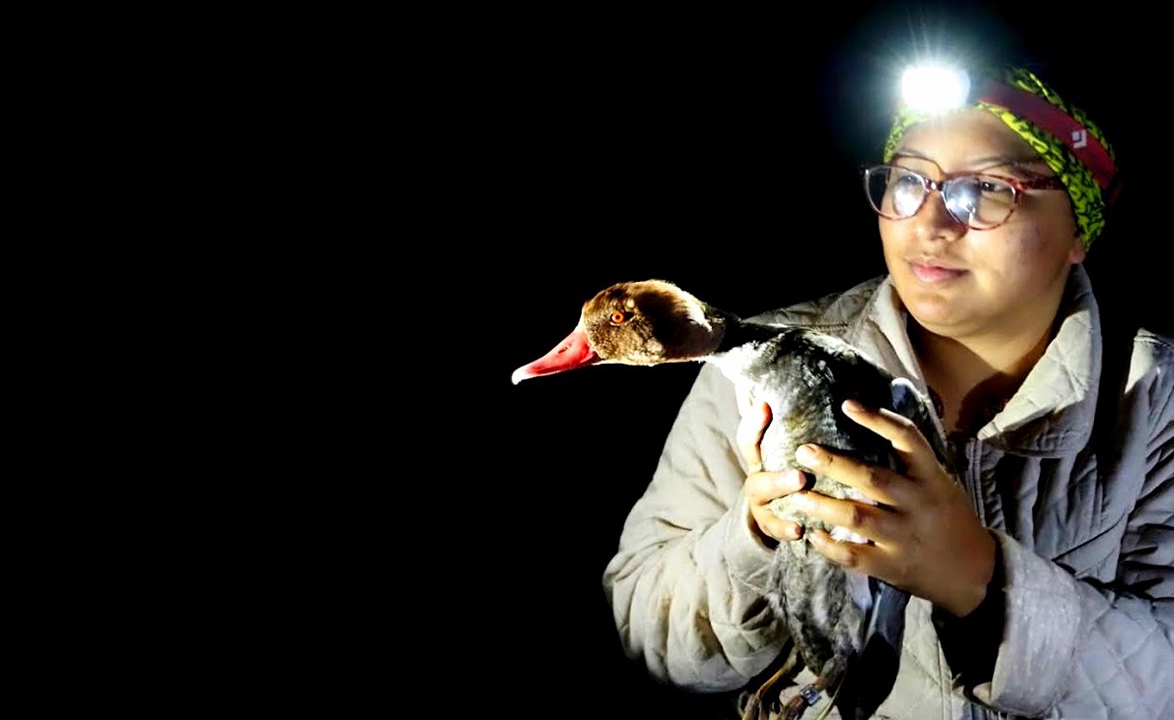
Kazi Zenifar Azmiri studied zoology at Jahangirnagar University and joined the Bangladesh Bird Club in her final undergraduate year, which led her to a career in wildlife conservation.Now at the IUCN as a program associate, she has worked in conservation for more than a decade, covering vulture rescue, migratory bird surveys, bird ringing, satellite tagging and conservation efforts on dolphins, crocodiles and turtles.In a sector where women remain underrepresented, Azmiri discusses her job and what conservation fieldwork in Bangladesh demands. For more than a decade, Kazi Zenifar Azmiri has played a crucial part in protecting wildlife in Bangladesh. Zenifar is a program associate at the International Union for Conservation of Nature (IUCN). Her work centers primarily on the rescue and rehabilitation of threatened vultures like the white-rumped vulture (Gyps bengalensis) and Himalayan griffon vulture (Gyps himalayensis). Bangladesh’s vulture populations have declined steeply over the years, largely because of exposure to veterinary painkillers that are toxic to the birds when they feed on the carcasses of treated cattle. Today, however, populations have shown signs of stabilization, aided by conservation efforts such as the establishment of vulture safe zones and a ban on drugs that can kill vultures feeding on the animals’ carcasses. Zenifar’s work involves tracking migratory birds, fitting them with identification rings and satellite tags that reveal their journeys. The collected data help researchers understand what threats the birds face. She also helps conserve ducks, dolphins, crocodiles and turtles across Bangladesh. From wetlands where these migratory birds gather to river systems and coastal areas that sustain these dolphins and crocodiles, she is often found doing fieldwork in remote corners of the country. On many of her trips, she says, she is the only woman in the group. In the local communities she works alongside, she has sometimes encountered attitudes that question her presence in the field. “I remember this fisherman we were working with locally,” she recalls. As they walked to meet a family she needed to interview, he asked why she had come to work in the field as a woman. It was neither appropriate nor good for her to be there, he told her. Why put herself through the hardship, he asked, when she could simply stay at home? Kazi Zenifar Azmiri handles a wild bird at a bird-ringing camp in Hakaluki Haor. Image by Shimanto Dipu, courtesy of Kazi Zenifar Azmiri. It was an attitude she encountered repeatedly during the early days of her work, Zenifar says during an interview with Mongabay. There are other challenges too. Women remain underrepresented in conservation leadership, she says, and they face questions about their authority even when they are carrying out their professional responsibilities. Despite all the challenges, Zenifar says nothing else compares to the work she does. In this interview with Mongabay, she shares candidly what first drew her to conservation, what it is like to work as a wildlife biologist in Bangladesh, and what she finds most rewarding about her work, even as she contends with fieldwork challenges. This interview has been translated from Bangla and lightly edited for clarity. Mongabay: How did your journey in conservation begin? Kazi Zenifar Azmiri: It started during my graduation year. I had always wandered in nature during my childhood, but when I started studying zoology, I got to know the vast field of wildlife. Little by little, I started my journey with bird ringing through a bird club. From then on, I became increasingly involved in and passionate about conservation work, particularly species conservation. Azmiri while conducting a coastal bird census in Bangladesh. Image by Shihab Khaledin, courtesy of Kazi Zenifar Azmiri. Mongabay: What first drew you to birdwatching? Kazi Zenifar Azmiri: It’s almost like an addiction, watching birds. I am trying to think of an example that explains the experience. When I was growing up, my mother sometimes talked about the idea that Allah places a veil over our hearts, preventing us from seeing our own mistakes or recognizing the right path. That veil is lifted when we want, and then we can finally see the right path all along. I am not sure this is the perfect comparison, but it is the example that comes to mind. For me, birdwatching felt as though there had been a veil over my eyes. Before I started, when I went somewhere, visited my village or spent time in a backyard, I would see trees, plants, people, the light and the sunshine. I would notice the environment around me, but I would not really notice it. I do not know whether there really was a veil over my eyes, but when I started watching birds, it felt as though that veil had disappeared. Suddenly, I could see everything more clearly. It was as if a new world had opened up. There is a world beyond our everyday lives that exists alongside us, even amid all the chaos of our own lives. But we do not see it. You need the right mindset and the right eyes to be able to see it. Mongabay: Which species do you work with, and what is their conservation status in Bangladesh today? Kazi Zenifar Azmiri: I started with bird censuses, particularly waterbird censuses, which mostly involve threatened bird species. I first started working with ducks through ringing and satellite tagging. The idea behind the project was to understand the movements of wild migratory ducks. We know that many migratory ducks come to Bangladesh. Some of the regions they visit, including areas where avian influenza outbreaks have occurred, are important in understanding the risks associated with their migration. Our haor wetlands are major concentration areas for these birds. At the same time, there are many domestic duck farms in the haor region. Farmers bring domestic ducks there. We wanted to investigate whether avian influenza was circulating among the migratory ducks and, if so, what the potential risks were. We studied their migration routes to understand where they traveled. We also captured the ducks, fitted them with rings and satellite tags and collected samples to test for avian influenza. Wild ducks are generally carriers of the virus. They can carry and transmit it without necessarily becoming ill themselves. Domestic ducks, however, are not immune to the virus in the same way. If they become infected through contact with wild ducks, an entire duck farm could potentially suffer devastating losses. In parallel, I work in vulture conservation. Vultures are critically endangered globally and in Bangladesh. There are very few vultures left in the country now, with numbers below 250. Apart from vultures and other birds, I also work with dolphins and saltwater crocodiles. Basically, my expertise is in satellite tagging, satellite telemetry and conservation work related to the data we collect through these studies. White-rumped vultures in the Sundarbans, Bangladesh. Image by Mahmudul Bari via Wikimedia Commons (CC BY-SA 4.0). Mongabay: What was your first experience working in the field, and what did it teach you about the realities of wildlife conservation that you hadn’t anticipated? Kazi Zenifar Azmiri: My very first experience was during my master’s thesis, when I worked on dolphins in the Sundarbans around 2010 and 2011. I started my thesis on Irrawaddy dolphins [Orcaella brevirostris] with Bangladesh Cetacean Diversity Project, which is now called Wildlife Conservation Society (WCS) Bangladesh. Although my thesis topic did not include any fieldwork, I wanted to get involved in fieldwork, so I requested that they include me in it. But if you ask where my journey really began, it was at a bird-ringing camp in Hakaluki Haor in 2012 with the Bangladesh Bird Club. I was staying in a remote place where there was no water, no electricity and not even a proper toilet. We were camping in the middle of the haor, catching birds and conducting research. There were some instructors who came from Britain to teach us bird ringing and satellite tagging. That was my most memorable experience at the beginning of my journey. Mongabay: What does a typical day at work look like? Kazi Zenifar Azmiri: There are two types of typical days for me: one in Dhaka and another in the field. When I’m in Dhaka, it’s very busy. Our office hours start early, around 8:30 a.m., and continue until 5:30 p.m. We start with meetings, preparing for fieldwork, discussing methodologies or developing ideas for future projects. These days, it’s mostly meetings. When I’m in the field, it’s very different. Fieldwork is a 24/7 job. Sometimes we also work at night or overnight. If we have to conduct bird ringing, camera trapping or other activities at night, we have to work through the whole night. So it varies depending on the work and the objectives of the fieldwork. Azmiri is often the only woman among the field team. Here, she is with colleagues during fieldwork in Sonadia, Bangladesh. Image by Shimanto Dipu, courtesy of Kazi Zenifar Azmiri. Mongabay: What are you currently working on? Kazi Zenifar Azmiri: Two very important, large-scale projects: The first is updating the Red List of Fauna of Bangladesh, a huge undertaking in wildlife conservation. It is an important tool because it helps us understand how threatened different animals are and how close they are to extinction. Without a Red List assessment, we cannot properly determine which species we need to conserve. We need to know their conservation status first. The government funded the previous assessment in 2015 through a World Bank project. This time, it is a revenue project owned by the government and funded by taxpayers’ money. Everyone working on it feels a strong sense of ownership because we know that we are using our own country’s money. We are assessing around 2,200 wildlife species across Bangladesh. Previously, the assessment covered approximately 1,675 species, so we are expanding it by around 700 species. The 2015 assessment resulted in seven taxonomic volumes and a summary volume, making eight books in total. The groups covered included amphibians and reptiles, birds, mammals, butterflies, freshwater fish and crustaceans, alongside the summary volume. The second project is Conservation and Restoration of the Sundarbans. It is funded by the French government. A few years ago, the French minister visited India and subsequently came to Bangladesh. There was a commitment involving the government of Bangladesh to encourage French investment in the country. That initiative eventually contributed to the development of this project, which focuses on the restoration of the Sundarbans. We are working on four main components. The first is a comprehensive faunal inventory of the Sundarbans. Although there are inventories of the forest’s trees, maintained by the Forest Department, there has never been a comprehensive inventory of the Sundarbans’ fauna. We need to establish how many species are present and their abundance. For example, how many frog species are there? What is their density? What is their actual population? It is similar to a census of people, where you establish who lives in which household. We need to determine which species occur in which blocks of the Sundarbans and how many there are. For this inventory, we cannot choose which animals to study. I cannot simply decide to look at vultures and eagles while ignoring king cobras or other snakes. We have to survey the entire forest and document all the species we find. It needs to be a comprehensive list. The second component is detailed population-level research on 16 selected species from within the broader inventory. The third component involves resource planning for the area surrounding the Sundarbans. We are looking at the land extending 20 kilometers [12.4 miles] inland from the Sundarbans’ boundary, which we call the impact zone. This area also includes the Ecologically Critical Area. We will analyze the resources available throughout this area and determine where conservation activities are needed, where plantations could be established and where industrial development might be appropriate. We will then develop a plan based on that analysis. The final component focuses on knowledge. We want to preserve and disseminate the knowledge generated through each part of the project and establish a Sundarban Knowledge Forum. Azmiri during fieldwork at Tanguar Haor. Image by Sakib Ahmed, courtesy of Kazi Zenifar Azmiri. Azmiri monitors vultures at Rema-Kalenga Wildlife Sanctuary in Bangladesh. Image by Sakib Ahmed, courtesy of Kazi Zenifar Azmiri. Mongabay: What aspect of your job do you like the most and find rewarding? Kazi Zenifar Azmiri: I find the awareness-raising aspect particularly intriguing because I get to know and interact with local people. I must mention one particular activity. Every year, we rescue Himalayan vultures [Gyps himalayensis], which are migratory, and release them after winter. The Himalayan vultures that come to Bangladesh are usually juveniles. As they travel long distances, when they land, they can be vulnerable. Some fall into trees and injure themselves on the sharp stalks. Others land in open areas, where people gather around them and sometimes capture them. Some are also killed by hunters. When we receive reports of injured or vulnerable vultures, our network of volunteers helps us rescue them. Once they have recovered under our volunteers’ care, we generally release them in late March or early April. As part of this work, we invite local people to watch the releases and organize small awareness activities. That’s one of the most interesting and enjoyable parts of my work: interacting with local people, especially students and schoolgirls. They are often surprised to see me working in the field and to see how I work and interact with them. I really enjoy those interactions. Mongabay: How has being a woman shaped your experiences during wildlife conservation fieldwork? Kazi Zenifar Azmiri: When I started, I was a fresher coming straight from university as a volunteer. There weren’t many women or girls working in this field, so there were many things I couldn’t ask anyone about. I had to learn by myself how to handle different situations. For example, what do you do when you get your period in the field? What do you do when there is no toilet but you’re on a boat for 24 hours a day? These were the kinds of challenges I had to explore and figure out on my own. Nowadays, I like to share these little lessons. They may seem like small things, but people don’t talk about them much at forums or on other platforms. Even among women, these issues aren’t discussed very often. So I try to share what I’ve learned with my female teammates who travel with me. One important thing is to maintain good communication with the people around you. If you encounter a problem, whether with your colleagues or someone at the place where you are working, you should feel comfortable asking for help without feeling embarrassed. Washroom access is another important consideration, so you need to be prepared to manage these situations. For example, when women accompany me on field trips, I guide them on what essentials to pack so they feel better prepared and more confident in handling the challenges that fieldwork may present. Preparedness is one of the most important things. It is about understanding and testing your own capabilities, anticipating challenges and being willing to ask for assistance when you need it. I also sought help from others. A friend of mine and I often traveled together to minimize these difficult situations. I would also say that when I go to the field, village women actually trust me. When I need help with something, such as using a toilet or finding a place to rest, they invite me into their homes. I think those rural women are a source of inspiration for me, and I am grateful to them. Azmiri participates in a bird-ringing camp at Tanguar Haor. Image by Raquibul Amin, courtesy of Kazi Zenifar Azmiri. At Tanguar Haor. Image by Tareq Onu, courtesy of Kazi Zenifar Azmiri. Mongabay: How have gendered expectations, safety concerns or restrictions on mobility affected your work or career opportunities? Kazi Zenifar Azmiri: Definitely, definitely. I have experienced situations where power structures become very apparent. In meetings, when a man speaks, everybody listens, but when a woman speaks, nobody seems to listen. I experienced this very strongly in the field. There was a time when a local Forest Department official wasn’t willing to give me a chance to speak or engage with him. But when my male colleague entered the room, the situation changed. That really bothered me. Another issue is safety and security. I feel extremely lucky that my male colleagues have been very considerate and have thought about my safety during fieldwork. For example, one colleague of mine is particularly considerate. He is like a younger brother to me. We joined the organization around the same time. During field trips, he often makes sure that I am comfortable, asks if I need help carrying my bag and checks whether basic facilities, such as washrooms, are available, along with safety considerations. These may seem like small gestures, but they make a difference when you are working in challenging field conditions as the only woman in the group. Besides that, there are some remote places where I am still struggling to find ways to work and overcome the obstacles to accessing those areas. Azmiri rehabilitates and releases birds as part of her wildlife conservation work in Bangladesh. This photograph was taken at Padmar Char in Rajshahi. Image by Mohsin Kabir Miron, courtesy of Kazi Zenifar Azmiri. Mongabay: What overall needs to change in Bangladesh’s conservation sector to make it easier for women to enter and build careers in the field? Kazi Zenifar Azmiri: Building a career in the field, or pursuing a field-oriented career, is very difficult. First of all, even from a broader perspective, there is very little funding in the wildlife and conservation sector. With such limited funding, there is always competition. I think women need to be more open to embracing fieldwork and willing to work in difficult situations. That’s something women and girls can work on themselves. Those of us already working in the field need to talk more about female leadership and discuss these issues on platforms like this one. You’re talking with me and perhaps with other women as well. This helps build our credibility and acceptance. When we speak with the authorities, they may acknowledge us more. I think it has to work both ways. We need to step forward ourselves and help other women too. Mongabay: What would you say to young women in Bangladesh and elsewhere in South Asia who are interested in conservation but feel discouraged by the barriers they might face? Kazi Zenifar Azmiri: It’s this mental barrier. Even now, I sometimes feel that barrier, but I think a lot of it is in my head. If you keep thinking about what other people will say, what you might do by going somewhere, or what might happen if you go there, you may never take that step. But if you are determined to go somewhere and do something, there is always a way. For example, if I want to go to Sherpur and work with elephants, there is always a way to make it happen. We have to be in the field to figure out what the problems are, what work needs to be done and what support is needed from others. First of all, you need the willingness to do anything and everything, and you need strong willpower. That’s the main thing: strong willpower. Banner image: Kazi Zenifar Azmiri participates in a duck satellite-tagging camp at Tanguar Haor, Bangladesh. Image by Dr. Niaz Abdur Rahman, courtesy of Kazi Zenifar Azmiri. Given a chance, women-led microenterprises uplift Nepali communities & conservation Is South Asia becoming inhospitable for migratory birds? Citation: Turner, J. C., Barman, S., Feeroz, M. M., Hasan, M. K., Akhtar, S., Jeevan, T., … Webby, R. J. (2021). Highly pathogenic avian influenza A(H5N6) virus clade 2.3.4.4h in wild birds and live poultry markets, Bangladesh. Emerging Infectious Diseases, 27(9), 2492-2494. doi:10.3201/eid2709.210819 Cite this articleUsraat Fahmidah (2026). ‘You need strong willpower’: IUCN’s Kazi Zenifar Azmiri on being a woman wildlife biologist. Mongabay Conservation news. DOI: https://doi.org/10.66709/news-335359 Credits Topics
‘You need strong willpower’: IUCN’s Kazi Zenifar Azmiri on being a woman wildlife biologist
Full Article
Original Source
Read the full article at News →KhanList aggregates and links to publicly available news content. We do not host full articles from third-party sources. Always verify important information with original sources.