
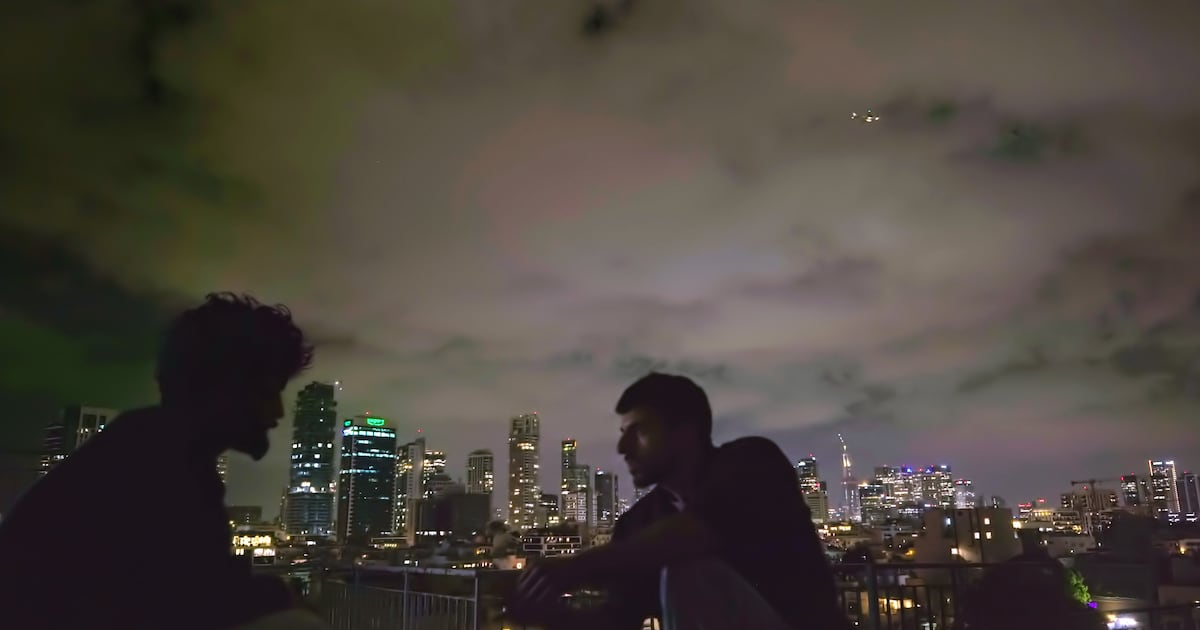
“We didn’t expect this backlash,” Yuval Abraham tells me. “We expected some backlash, but such an intense backlash from the highest levels of Israeli government has been not easy.”One can only imagine. A little over a month ago, Naza, a chilling documentary by Abraham and Rachel Szor, premiered to acclaim at Venice International Film Festival. Abraham, an investigative journalist raised in southern Israel, knew he was dealing with dangerous material. The formally daring film, comprising interviews with 24 Israeli military-intelligence officers and soldiers, investigates the systems behind the massed slaughter of civilians during the continuing assault on Gaza. It deals in horror throughout. We learn about the tapping of civilians’ phones. We learn about the computer programs that help determine targets. We hear about loose standards as regards the deaths of non-combatants in air strikes. “Naza” is an acronym, in Hebrew, for “collateral damage”.READ MOREMiki Zohar, the Israeli minister for culture, called for the directors’ citizenship to be revoked, accusing them of “treason against the state”. Protesters surrounded the home of Szor’s parents, waving banners that read “traitors”. Just this week, news emerged that Binyamin Netanyahu, the Israeli prime minister, had ordered his attorney general and the Shin Bet security service to uncover the interviewees’ identities and prosecute them for causing “harm to Israel’s diplomatic and security interests”.“On the one hand there is fear – fear for our families and for our ability to go back home to Israel, which is where our home is and where we derive a sense of meaning to our work,” Abraham says. “On the other hand, there is also a sense of power. “I think this unhinged reaction from the Israeli government – from Netanyahu – speaks to the fact they’re also afraid of the revelations.”Abraham, a fluent Arabic speaker who has spent much time among Palestinians in the West Bank, has been here before. In 2024, when No Other Land, the Oscar-winning film that he directed with Szor, Basel Adra and Hamdan Ballal on Israel’s destruction of Palestinian villages in occupied territory, took best-documentary prize at Berlin Film Festival, he delivered a speech noting a “situation of apartheid” and calling for a ceasefire in Gaza. A frenzied response in Germany saw some politicians accuse the film-makers of anti-Semitism.“You can disagree with anything that I say, but to weaponise anti-Semitism against me, the descendant of Holocaust survivors, felt sick to me,” Abraham says. “It felt wrong. It’s concerning because anti-Semitism is real. And it’s on the rise. It’s more relevant than ever.”Such is the nature of modern discourse that, after the awarding of a special jury prize to Naza at Venice, there was much complaining from people who had not seen a second of the project. Not all of it came from a pro-Israel direction. Some objected to the anonymity granted to interviewees revealing atrocity after atrocity. “This film would not have been made in any other way,” Abraham said last month. “Because the crimes are ongoing, we felt that it was important to make it. And we understand there is a complexity there.”Yuval Abraham. Photograph: David Levene There was also concern that the interviewees were asking for absolution or parading their own trauma (the so-called shooting-and-crying genre). There is none of that in Naza. Some contributors do express regret, but the tone is mostly one of icy, distanced analysis. The soldiers and intelligence operatives, interviewed on the roofs of Tel Aviv after dark, sketch the systems on sheets of paper, as if offering directions to a lost traveller.“You find in the same soldier an intuitive sense that they participated in something horrific – and that they should be speaking out about it and that they should be agreeing to answer my questions as a journalist,” Abraham says. [ Netanyahu faces fresh scrutiny over pre-October 7th warningsOpens in new window ]“But, on the other hand, the events are so recent that the same person, when you were talking to them, could just as easily put on their cap of intelligence officer or soldier and then speak not from a place of regret but in a place of being back in that chair in front of the screen, operating a drone strike or calculating how many innocent civilians will die in a house.”The film – and this may disturb as many viewers as it satisfies – is not much about how these operatives were feeling.“What is more interesting for me as a journalist and a film-maker is to investigate the opposite question: how can you do that and not feel regret?” Abraham says. “How can you do that and continue doing that? This is not shooting and crying, which is a genre of Israeli film. This is shooting and not crying.”Naza packs an enormous amount of information into its 77 minutes. A good portion of the film is about a computer program, called Lavender, that assists operatives, all at a safe distance, to select supposedly legitimate targets.The film – and this may disturb as many viewers as it satisfies – is not much about how these operatives were feeling. “Lavender is an AI-based program that gave almost every individual in Gaza who has a phone a rating of one to 100 that indicates how likely it is that this individual is a member of the Hamas or Islamic Shia military wings,” Abraham says. “The film really goes into the details we uncovered in the past in our investigative reporting about how it works and how this AI system makes decisions. “Soldiers speak about how it had an error rate. The Israeli army knew that in some cases they were marking people who had similar patterns to a Hamas operative but were not actually Hamas operatives.”Abraham speaks about a baker whose premises were near a Hamas training compound. He may have had numbers for Hamas operatives in his phone, but he was not a member.“You could see how it could mark this person as a target,” he says. “People marked by Lavender – just generally people who would be suspected of being Hamas operatives – would be bombed not while they are in combat, in most cases, but when they are inside their homes, killing not only them but their entire families.”[ In pictures: Three years of war in GazaOpens in new window ]The most disturbing parts of Naza concern the deaths of non-combatants, particularly children, in air strikes on Gaza. The phrase “Where’s Daddy?” creeps in to describe the intelligence services’ habit of tapping a child’s phone to discover when his or her father, a suspected Hamas operative, may be in the family home. “You hack her phone, and then you kill her,” one interviewee says about a 12-year-old. Another is content to use the word “genocide” about the mass killing. It is at moments like this that one wonders why we don’t see a little more unambiguous contrition. Surely nobody can happily live with such sombre responsibilities.'You hack her phone, and then you kill her,' one interviewee says about a 12-year-old. “It is definitely one of the only moments where intelligence officers – who largely view Palestinians as a number on an Excel sheet, or look at them from a drone as tiny little dots – had a more direct exposure to the people, to the children, to the families they were killing,” Abraham says. “A protocol that was often in place – not always but often – was, if possible, to open the microphones using spyware on cell phones that are in the house, in the building. And, before the room is bombed, to hear who is inside the room.”They hear civilian life. They hear a man talking to his wife before they go to bed. They might hear a baby crying.“It is one of the most horrific aspects,” Abraham says. “It breaks this image that we have of the intelligence officer as an individual who doesn’t necessarily know who is behind the screen. You do get into some kind of intimate knowledge of the people you are bombing.”[ ‘People afraid to say they are Jewish’: Dublin event marks October 7th attacks on IsraelOpens in new window ]Naza is, to some extent, a film about Tel Aviv. While Abraham and his sources talk on the moonlit roofs, the interviewees’ voices digitally altered, the camera peers through windows to find residents going about their typical evening business. One cannot help but think of Jonathan Glazer’s The Zone of Interest. That director was, indeed, an executive producer of this film.“That’s one way to look at it,” Abraham says. “Another way to think about it is that it’s an image of Tel Aviv as a city. Tel Aviv is considered to be Israel’s liberal centre. It’s a city that people usually do not associate with Netanyahu and not with the far right. “It’s like the Israeli centre of the secular population – the population that is more liberal, that is in opposition to Netanyahu. Many of the intelligence officers and soldiers, if they could choose a city that would be most associated with who they are, it would be Tel Aviv. They are also part of Israel’s liberal elite, intellectual elite.”That seems something of a contradiction. Here they are engineering slaughter on a medieval scale.Film directors Yuval Abraham and Rachel Szor. Photograph: David Levene “Gaza is primarily, first and foremost, the responsibility of Netanyahu’s far-right government, who was in power when this was all happening,” Abraham says. “So, this is not to let them off the hook, but what was so striking for me and really important to look at with this film is the extent to which Israel’s so-called centre left – the more liberal elements of Israeli societies – have played uncritically a role in the destruction of Gaza. “Most of the Israeli pilots and most of the Israeli intelligence officers and most of the senior commanders signing off on air strikes generally come from that liberal side of Israeli society.”These are insights you rarely get from news reports on this sprawling catastrophe. Abraham knows whereof he speaks. I had read that, at the age of 19, he was assigned to a position in the Israeli intelligence corps.“I was supposed to be there,” he says. “I was assigned in the mandatory military service, as it says online. That’s true. I left. It’s not something that I’ve done. I left very early on. I never assumed my role. “It was interesting for me also because, doing this film, it’s like the road not taken. This happened a long time ago. When I was 18 or 19. But when I was talking to some of these officers, it was, like, oh, I maybe could have become one of them if I hadn’t taken a different choice earlier on in my life.”There are alternatives.“There is always an alternative, even if it’s really difficult,” he says. “Israeli society is a very conformist society. When you grow up, it’s like the water you swim in, the military service. That’s part of why criticising the military, as we are doing in this film, is considered a taboo in Israeli society. That’s part of why the reaction against us is so harsh.”He leans into the answer.“But there is always a choice.”Naza is in cinemas from Thursday, October 15th[ Game over: Inside the ruins of Gaza’s football stadiumsOpens in new window ][ ‘We don’t talk about it much’: Three years after October 7th attacks, Emily Hand is rebuilding her childhoodOpens in new window ][ ‘It’s off the charts’: Satellite images show how three years of war have devastated GazaOpens in new window ]
‘You hack her phone, then you kill her’: Israel’s approach to a 12-year-old Gazan
Full Article
Original Source
Read the full article at Irishtimes →KhanList aggregates and links to publicly available news content. We do not host full articles from third-party sources. Always verify important information with original sources.