
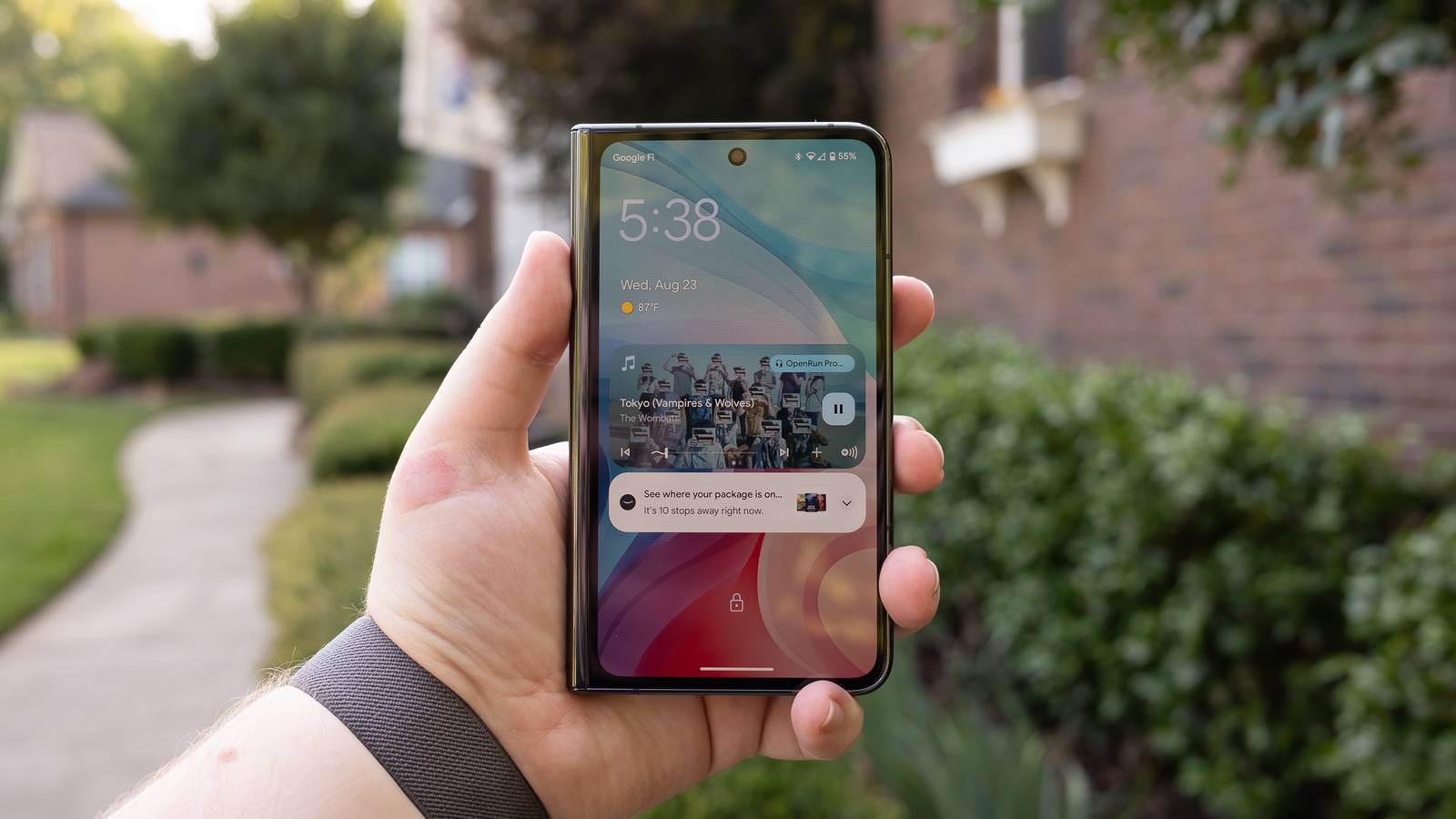
Published Aug 6, 2026, 10:00 AM EDT Bertel is a lifelong tech enthusiast with over a decade of experience writing thousands of articles about Android devices, Linux, and more. Before joining the How-To Geek team, Bertel wrote for the likes of MakeUseOf, MakeTechEasier, and Android Police—at the latter he wrote over 3,500 articles. He delights in helping others decide which tech to bring into their lives... and which tech to do without. Bertel graduated from the College of William and Mary in 2012 with degrees in History and Government. He has spent his entire career as a tech journalist covering Android, Linux, wearables, smart home devices, and more. The overwhelming consensus is that the Galaxy Z Fold 8 is the most exciting Samsung foldable in years. Its passport shape makes it very pocketable, but that new form factor comes in at around $2,000. If you're curious about this new shape, you can give it a shot today for a third of the price of existing book-style foldable phones. The original Pixel Fold was shaped like a passport before it was cool You can find used models today for under $600 The original Google e Pixel Fold was far from a perfect foldable. It was thicker and heavier than the competing Galaxy Z Fold 5 and the OnePlus Open. Like other foldables, it had an inferior camera to the existing Pixel 7 and Pixel 7 Pro. Google also did the bare minimum to adapt Android to the inner screen, introducing a dock and two-app split screen—but little else. I wrote at the time about the myriad different ways I managed multiple apps simultaneously on my Galaxy Z Fold 5. The Pixel Fold is basic by comparison. Yet even then, most reviewers appreciated the Pixel Fold’s passport size and shape. It was a smaller phone that opened up into an aspect ratio better suited for video. The extra breathing space was also good for reading ebooks with two columns. Using two apps side-by-side was less cramped than it was on Samsung's tall and narrow foldable. Admittedly, the phone's hardware is dated. Book-style foldables have gotten much lighter. The Galaxy Z Fold 7 wowed many with how thin it had become, and the Motorola Razr Fold that I am writing these words on is the first book-style foldable available in the US whose camera hardware is identical to that of its manufacturer's flagship slab phone (in this case, the Motorola Signature). This phone outscores all Pixel phones, including every slab Pixel Pro, on DXOMARK's smartphone rankings. Nonetheless, the OG Pixel Fold still works. It came with five years of software support, meaning Google will continue to support it at least until 2028. If you want to try out a passport-style foldable today for less than a third of the price of a Galaxy Z Fold 8, you can grab a Pixel Fold off eBay or Swappa for under $600. And while this is your best option, it isn't your only one. The OnePlus Open isn't a true passport-style foldable, but it's wider than most This is the foldable that most modern book-style foldables in the US started to emulate When the OnePlus Open launched a few months after the Pixel Fold, it blew many reviewers away. This was the first foldable phone from OnePlus, and it was in many ways the best option available, at least on paper, skipping the growing pains that had plagued Samsung and Google. It had more RAM, more storage, and a better camera. For the record, these specs all still hold their own against the Galaxy Z Fold 7 and top what you would get on today's Galaxy Z Fold 8. Plus, in an era of glass-backed phones, the OnePlus Open’s black vegan leather backing gives the phone character. The OnePlus Open was beloved enough that many were devastated when it never landed a successor. Pain only grows when you see how amazing the book-style foldables from Oppo, OnePlus's parent company, have been. OnePlus would have been the closest we in the U.S. would have gotten to a domestic launch of the Oppo Find N5. These days, you can snag a second-hand OnePlus Open for slightly more than the cost of an original Pixel Fold, so you can expect to pay between $600 and $800. That said, there's a bigger caveat here than if you opt for Google's foldable. OnePlus launched the phone with four promised years of software support, only for OnePlus to abandon the American market three years later. In its departure announcement, OnePlus promised that Oppo would keep the company's support pledges, but those phones must switch from Oxygen OS to Oppo's Color OS to receive ongoing updates. While there are many similarities between these two platforms, they are still quite different. So, if Oppo does supply the OnePlus Open with its last remaining year of software support, the experience would depart from what you see in OnePlus reviews from the time of its launch. I also cannot recommend buying this phone if you expect to be able to get it repaired in the event of an accident or hardware failure. Considering that Oppo doesn't have a presence in the United States either, it remains to be seen if newer OnePlus phones like the OnePlus 15 can get repaired in the US, let alone older devices like the OnePlus Open. The Galaxy Z Fold 8 will obviously be the superior phone Samsung's device is newer, smaller, lighter, and more durable. Plus, it comes with software support that will last until the mid-2030s. Samsung's foldable software is superior, and we can't forget the inclusion of Samsung DeX, which makes this phone a viable PC replacement. But at two grand, you may be better off purchasing a wider old foldable for now and waiting a year or two until the Z Fold 8 can itself be had for under $1,000.
You don't need the new Galaxy Z Fold 8 when these passport-style foldables are a third of the price
Full Article
Original Source
Read the full article at Howtogeek →KhanList aggregates and links to publicly available news content. We do not host full articles from third-party sources. Always verify important information with original sources.