
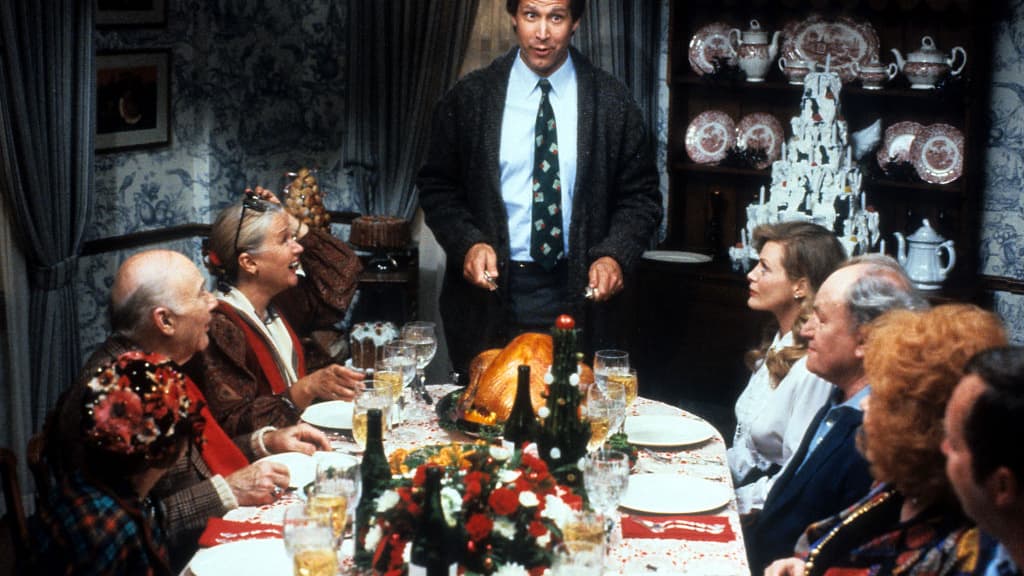
One of the first films I cast was the holiday classic National Lampoon's Christmas Vacation. I was one lucky 27-year-old when my bosses invited me to partner with them and help complete casting the Griswold family.In those days, we auditioned scores of actors in person. Almost everyone came through our doors to read for their roles, something now mostly done over Zoom or by offer only. In my humble opinion, casting has taken a nosedive because we've lost that intimate experience of sitting face-to-face, listening, observing, and discovering a character together. Sometimes it took several auditions, chemistry reads, callbacks, and director work sessions to get it right. We had to slow down and really see the person sitting across from us.Every holiday season, when millions of American families gather around their Thanksgiving and Christmas tables, I think about those wacky Griswold family dynamics. The relatives who arrive uninvited. The holiday disasters. The misunderstandings, the arguments, and the love beneath all the madness.In my husband Charlie's family, Thanksgiving was a beloved tradition. His parents divorced when he was 15, and the family learned to move between households and maintain a certain equilibrium. Everyone found ways to come together, but rarely did anyone dig deeper into what was happening beneath the surface. The family had learned to adapt and to compartmentalize their feelings.Thanksgiving 2019, in Charlie's hometown of Washington, D.C., should have been different.Charlie's mom had passed away years earlier, and a couple of months before traveling east, we had told his dad, stepmother, and siblings that Charlie, at just 57, had been diagnosed with early-onset Alzheimer's disease and was leaving his job as an art director at UCLA Magazine.But once we arrived, the diagnosis seemed to be swept under the rug. Charlie looked so well. His Alzheimer's was invisible to them.I remember worrying about a fancy dinner at the Cosmos Club because Charlie needed to wear a tie, and neither of us could quite manage to tie one. A small thing, perhaps, but one of those early signs of struggle.What his family might have noticed were the changes already taking place in our marriage. Charlie's short temper and his uncertainty about what kind of work he might pursue next. My super-sensitive artist husband had actually been the one to recognize that something was wrong and asked to see a doctor. I had simply hoped his mood would change and that further tests might reveal something else. We were on a kind of autopilot in those early days, and I was just beginning to realize there was little I could do to solve this problem.As always, I had my camera with me. I filmed the family around the Thanksgiving table, sharing the things they were grateful for. Looking back at that footage now is painful.Charlie's father, a distinguished writer and scholar who had spent nearly 50 years at a Washington think tank after serving in the White House, beamed with pride at his two sons, his beloved wife, stepchildren, and the grandchildren who made him so happy. He was finishing his final memoir and remained intellectually engaged with the world. Yet his oldest son's Alzheimer's diagnosis never entered the Thanksgiving conversation.Charlie himself was still hopeful about his next act. He was making art, walking the streets of Los Angeles with his camera, and building a website, walkingnla.com, to document his discoveries. His words were beginning to falter, but his wit, his agency, and his joie de vivre remained intact."Everybody gets something," he would say, accepting his diagnosis with a kind of courage and wry humor that I still marvel at.He certainly wasn't looking for a pity party. He wanted to enjoy his family, and perhaps for a few hours forget what was happening to him. But somewhere between respecting Charlie's wishes and avoiding the uncomfortable truth, we all managed to sidestep the elephant at the Thanksgiving table. I was part of that conceit, too.Perhaps that Thanksgiving we were all too frightened of what we didn't know. Fear of the unknown has a funny way of disguising itself as good manners.When COVID arrived, our world grew smaller. Uncertain about what either of us could do for work, I decided I needed to make a film, WALK WITH ME. Documenting four years of our lives became my way of coping, and a way to give Charlie purpose. I convinced my family to participate because our story belonged to millions of other families like ours, and that the film could confront the stigma and shame surrounding Alzheimer's disease. What I hadn't anticipated was that it would also document my own transformation into a caregiver. At the time, caregiving wasn't even in my vocabulary.I will always be grateful for the quiet conversations we had during that time. Making our documentary meant asking my family to bear witness on camera to some of the most difficult moments of our lives. It took years for all of us to work through what that meant. And it took me even longer to own up to adding "caregiver" to my identity.Watching that 2019 Thanksgiving footage now, I see a family functioning beautifully on the surface. But I wish I had asked the questions we were all avoiding.What would happen when Charlie could no longer manage everyday tasks? Who would help? How would we pay for that help? What would happen to my work, our marriage, and our independence?I wish I had understood sooner that living with a progressive disease meant grieving each loss while constantly readjusting and improvising so Charlie could remain in the lane of "normal."Today, I choose restaurants with quiet tables. In movie theaters, I sit beside him in an aisle seat near the exit in case the film becomes too loud or intense and we need to leave. Before flying, I find out where the family bathrooms are located at the airport. I have to pre-think and map out nearly every adventure because I still want Charlie to be with me, and I still want our lives to feel "normal."But the truth is, nothing is normal anymore. And I wish I had brought his family and friends into the conversation earlier rather than trying to manage so much of it myself. Perhaps if I'd spoken more openly about my fears, they would have understood sooner how much we needed them. Perhaps they would have prioritized showing up for Charlie, and for me. I can't know that. I was still struggling to understand what was happening myself.It took me nearly two years to confront Charlie's father and tell him how hurt I was that he continued to speak as though nothing was happening. I suspected he was afraid to acknowledge the changes in his son. What parent wants to imagine losing a child, even gradually, to a disease that steals so much?Seven years later, Charlie needs help with nearly every activity of daily living. I have become his caregiver, his advocate, his interpreter, and often his compass in a world that has become increasingly difficult for him to navigate.Our children have had to learn how to remain connected to a father who can no longer communicate as he once did. And I have learned that love, however deep, cannot replace the practical, emotional, and financial support that caregiving requires.This holiday season, millions of Americans will brave crowded highways and impossible airports to gather with relatives they may not have seen for months.And somewhere between the turkey, the football games, and the arguments about politics, someone may notice that something feels a little off.Grandma tells the same story three times. An uncle who was always the life of the party becomes irritated when the conversation gets too loud. Mom, who once managed the entire holiday dinner, now seems overwhelmed by the simplest preparations.It's easy to dismiss these changes as aging, stress, exhaustion, or eccentricity. Sometimes that's exactly what they are. Not every forgotten word or strange behavior signals dementia. But sometimes something more serious is happening, and the holiday table may be the first place everyone has an opportunity to see it.This holiday season, perhaps the greatest gift we can give the people we love is our attention. Put down the phone. Listen. Observe. Ask questions. And when something is changing, don't stop at acknowledging it. Have the awkward conversations about what care will require, who will provide it, how you'll pay for it, and how you'll show up for one another when things become more difficult. And please, don't stand on ceremony. Sometimes love requires a little less politeness and a lot more persistence.Which brings me back to the Griswolds.They never managed a perfect vacation or holiday, but boy, did they hang on tight. I loved helping cast that motley crew, and I suspect every actor brought a little of their own family lore to those gloriously ridiculous performances.The thing about casting is that you spend a great deal of time looking for the right person for the right role. Of course, you can't cast your own family. You don't get to choose who shows up, who disappoints you, or who rises magnificently to the occasion. But you can ask people to pay closer attention and take on a bigger role. You can insist that the family gather around the table not simply to give thanks, but to really see one another.And when it comes to caring for the people we love, I think we need to stop being so afraid of making a scene. After all, you may not be able to cast your own family. But you can demand a callback.
You Can’t Cast Your Family
Full Article
Original Source
Read the full article at Time →KhanList aggregates and links to publicly available news content. We do not host full articles from third-party sources. Always verify important information with original sources.