
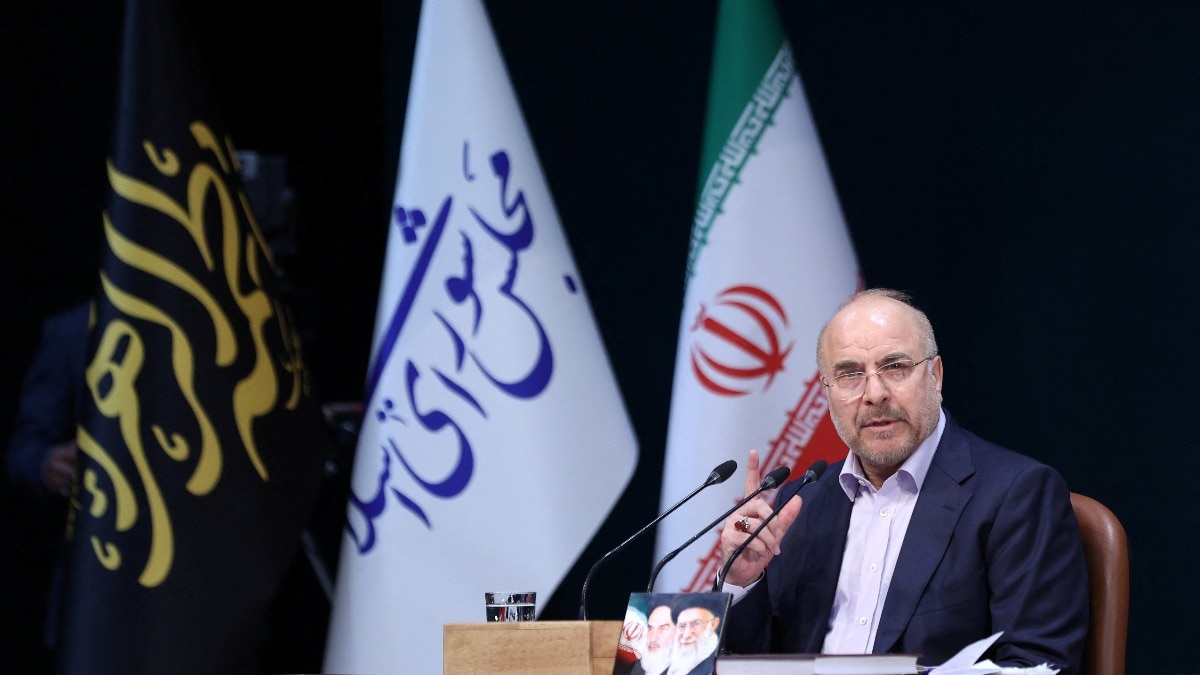
Iranian Parliament Speaker Mohammad Bagher Ghalibaf has mocked the US Federal Reserve's latest interest-rate hike, arguing that a central bank cannot use higher interest rates to fix an oil and shipping shock linked to the Strait of Hormuz.Ghalibaf made the remarks on X after the Federal Reserve raised its benchmark interest rate by 25 basis points on Wednesday, taking the target range to 3.75%-4%. It was the Fed's first rate hike since 2023.Ghalibaf responded by creating what he called the “Straits Taylor Rule” — a satirical version of the Taylor Rule, an economic formula that helps explain how central banks adjust interest rates based on inflation and economic activity.He added the Strait of Hormuz and Bab el-Mandeb to the equation before taking a swipe at the Fed's decision. “You can’t 25bp a chokepoint,” Ghalibaf wrote.He also asked whether a rate hike could “open SOH or produce a single barrel”, with SOH referring to the Strait of Hormuz.WHAT DID GHALIBAF PUT IN THE EQUATION? Straits Taylor Rule:i = r* + * + 1.5(*) + 0.5(yy*) + (SOHSOH*) + (BEMBEM*), , > 0Let’s see if a hike could open SOH or produce a single barrel :)You can’t 25bp a chokepoint and r* isn’t neutral. It’s SOH risk premium, and We set it.Stay unanchored !— | MB Ghalibaf (@mb_ghalibaf) September 16, 2026Ghalibaf's equation read: i = r + + 1.5(*) + 0.5(yy*) + (SOHSOH*) + (BEMBEM*), , > 0**The standard Taylor Rule links interest rates to inflation and economic activity. Ghalibaf's version keeps those variables but adds SOH, referring to the Strait of Hormuz, and BEM, referring to Bab el-Mandeb.The equation is not an actual rule used by the Federal Reserve. It is Ghalibaf's satirical way of arguing that disruption at major energy chokepoints should also be considered when thinking about inflation and interest rates.The underlying message is that if oil supplies are disrupted because ships cannot safely pass through key waterways, raising interest rates does not address the source of that disruption.WHY IS HORMUZ PART OF THE JOKE?The connection is oil.The Strait of Hormuz is one of the world's most important energy shipping routes. A prolonged disruption can restrict the flow of crude oil and other energy supplies, pushing prices higher and adding to inflation.Shipping activity through the strait has already fallen sharply.Only three commercial vessels crossed the Strait of Hormuz on Wednesday, down from 12 the previous day and well below the 10-day average of about 17, according to preliminary ship-tracking data cited by Reuters. Traffic through Bab el-Mandeb also fell to 21 crossings from 24 a day earlier.Oil prices have remained above $100 a barrel amid the disruption. Brent crude was around $104 a barrel on Thursday, while US West Texas Intermediate was around $101, although both benchmarks eased as concerns over supply disruptions moderated.That is the connection Ghalibaf is trying to highlight.The Federal Reserve can raise borrowing costs to cool demand. But it cannot increase oil production or physically make ships move through a disrupted maritime route.WHAT DOES “YOU CAN'T 25BP A CHOKEPOINT” MEAN?The 25bp in Ghalibaf's post refers to the Fed's quarter-percentage-point rate hike.You can say what you want about Iran but they're definitely pretty unique in their communication: never seen a country threaten another with a math equation before For those who didn't get it: there is a famous monetary policy formula used by the Fed called the "Taylor rule" https://t.co/y8n81e25a8— Arnaud Bertrand (@RnaudBertrand) September 17, 2026A basis point is one-hundredth of a percentage point, so 25 basis points equals 0.25 percentage point.The Fed raised its target range from 3.5%-3.75% to 3.75%-4% on Wednesday. It was the first increase since 2023.Higher interest rates can make borrowing more expensive, discourage spending and investment and eventually cool demand. That can help bring down inflation when prices are being pushed higher by strong demand.But an oil supply shock works differently.If fewer ships can pass through Hormuz, the amount of oil reaching global markets can fall. That can push crude prices higher even if consumer demand has not increased.A rate hike cannot produce more crude oil. It cannot make an oil tanker sail through a dangerous route. And it cannot physically reopen a shipping chokepoint.That is the point behind Ghalibaf's line that “you can't 25bp a chokepoint.”WHY DID THE FED RAISE RATES?The Fed's decision was driven by a broader inflation problem, rather than Hormuz alone.The central bank said economic activity was expanding at a solid pace, domestic spending remained resilient and productivity growth and capital investment were strong.But inflation remains elevated.The Fed's latest projections put 2026 PCE inflation at 3.7%, well above its 2% target.The Middle East conflict and energy prices are part of the inflation backdrop, but the Fed's monetary-policy decisions cover the wider US economy.That distinction matters because Ghalibaf's post makes a direct connection between the Fed's rate hike and Hormuz. The Fed, however, is responding to the overall inflation and economic outlook, even as geopolitical developments add another source of uncertainty.WHAT DOES “r* ISN'T NEUTRAL” MEAN?Ghalibaf also wrote that “r isn't neutral”*, calling it an “SOH risk premium” and adding, “We set it.”In economics, r* generally refers to the neutral real interest rate — a theoretical level at which monetary policy is neither stimulating nor restraining economic activity.Ghalibaf gives that concept a geopolitical twist.His argument is that the risk surrounding the Strait of Hormuz has become an economic variable because disruption there can affect oil supplies, energy prices and inflation.The phrase “We set it” is a political claim about Iran's influence over that risk. It should not be interpreted literally as Iran determining the Federal Reserve's interest-rate decisions.WHY DID HE SAY “STAY UNANCHORED”?Ghalibaf ended his post with another reference to central-bank language.“Stay unanchored!” he wrote.Central banks use the term “anchored” when talking about inflation expectations. If inflation expectations are anchored, households and businesses continue to expect inflation to eventually return towards the central bank's target.Ghalibaf flips that language around, suggesting that continuing disruption to energy supplies and shipping could keep inflation pressures unsettled.The broader economic point behind his joke is straightforward.The Fed can raise interest rates to restrain demand and try to prevent an energy shock from spreading into wider inflation. But if the original problem is a physical disruption to oil supplies and shipping, monetary policy cannot directly remove that disruption.That is what Ghalibaf's “Straits Taylor Rule” is designed to highlight — the Fed can change the price of money, but it cannot use a 25-basis-point rate hike to reopen the Strait of Hormuz.- EndsPublished On: Sep 17, 2026 14:31 IST
You can't 25bp a chokepoint: Iran mocks US Fed rate hike with equation linked to Hormuz
Full Article
Original Source
Read the full article at Indiatoday →KhanList aggregates and links to publicly available news content. We do not host full articles from third-party sources. Always verify important information with original sources.