
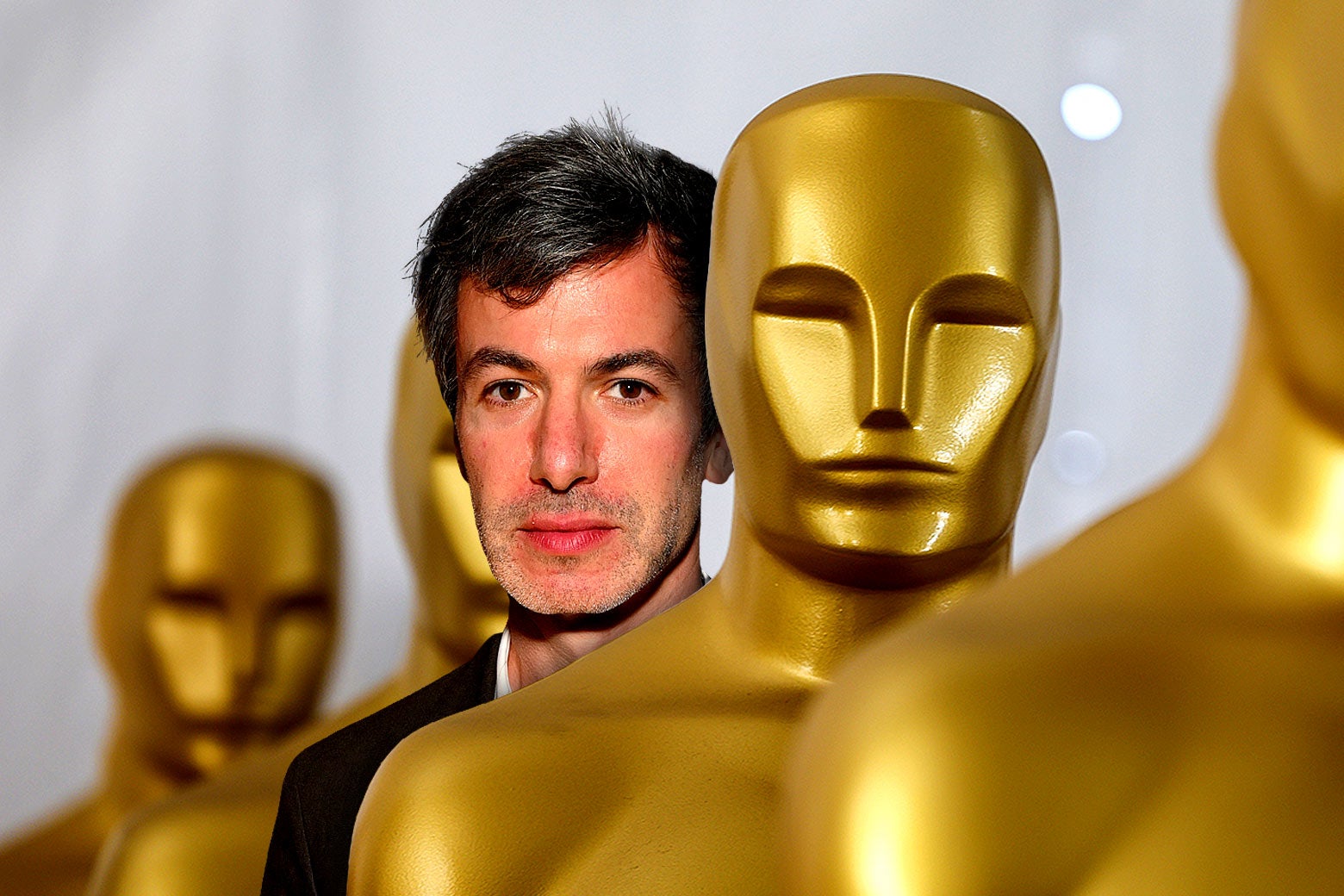
Movies The cinematic sensation could make history at this year’s Oscars, but one underexamined factor might stand in its way. By Enter your email to receive alerts for this author. Sign in or create an account to better manage your email preferences. Unsubscribe from email alerts Are you sure you want to unsubscribe from email alerts for Sam Adams? Oct 27, 20264:53 PM Photo illustration by Slate. Photos by Robert Gauthier/Los Angeles Times via Getty Images and Michael Kovac/Getty Images for Lucas Museum of Narrative Art. Sign up for the Slatest to get the most insightful analysis, criticism, and advice out there, delivered to your inbox daily. So, is You Can See Everything winning an Oscar or what? As someone who makes a point of seeing every movie that might be nominated for an Academy Award, I sometimes feel as if the best approach to predicting the awards might be to go in the opposite direction: see none of the movies, and make your guesses based on precedent alone. Last year, Michael B. Jordan was more or less counted out as a Best Actor contender until he won the Screen Actors Guild award two weeks before the Oscars. Timothée Chalamet had spent months running an aggressive and innovative campaign for his pyrotechnic turn in Marty Supreme, Leonardo DiCaprio did career-best work in One Battle After Another, and Ethan Hawke pulled off a theatrical tour de force in Blue Moon. But set all that aside, along with subjective judgments about who gave the best or most challenging performance, and “actor plays multiple roles in the same movie” emerges as the obvious favorite. The least-informed guess often turns out to be the best. Nathan Fielder and Lance Oppenheim’s playfully confounding three-hour Elizabeth Holmes documentary has become a phenomenon like few things I’ve ever witnessed. After less than two weeks in theaters, it’s already one of the highest-grossing documentaries of all time and, as it expanded into thousands of domestic theaters in its second weekend, came second only to a major studio comic-book movie. Evening screenings are still selling out in major cities, and even at a weekday matinee, I was in the company of more than a dozen others who reacted viscerally and vocally throughout the entire movie. It remains to be seen how it will play outside the U.S., but at least in certain stateside circles, it feels like the only thing anyone is talking about. Now for the bad news. No documentary has ever been nominated for Best Picture—nor for Best Director, despite the fact that documentary directors often do some of the most innovative and expressive work in the field. The academy has, on sporadic occasions, acknowledged that documentaries have editors, cinematographers, composers, and sound technicians—and, more recently, that a nonfiction film might be the best one to emerge from a particular country in a given year. (In 2022, Flee even became the first movie ever to be nominated for Best Documentary, Best International Film, and Best Animated Feature.) But historically speaking, Oscar voters have been overwhelmingly reluctant to acknowledge the simple fact that documentaries are movies and ought, at least in theory, to be considered for many of the same categories in which fiction features are eligible. Of course, documentaries, unlike fiction features, have their own Oscar category. (Though so do international features and animated features, and at least a handful of each have still earned a Best Picture nomination.) But even with that category, the academy has a long track record of ignoring some of the medium’s greatest filmmakers: Frederick Wiseman never got a single nomination, D.A. Pennebaker was nominated only once, and the Maysles brothers were nominated only for Best Documentary Short in 1974. (Wiseman and Pennebaker were at least given honorary Oscars before they died.) The nominees have improved by leaps and bounds since the process was handed over to a dedicated documentary branch in 2001: It’s virtually inconceivable that movies like the lyrical Hale County This Morning, This Evening, the essayistic Soundtrack to a Coup d’Etat, or the semi-metafictional The Act of Killing would have made it into the final five under the old system. But the academy as a whole has held back from celebrating movies that push against the boundaries of the form. (As with most awards, nominations are the province of a specialized branch, but final voting is open to all academy members, although they must now certify that they’ve seen every nominee in a category before casting a vote.) And while Oscar voters in general like to reward runaway hits, the documentary branch has proved, if not necessarily hostile, at least indifferent to popular success, shunning Fahrenheit 9/11—still the highest-grossing documentary ever made—in 2005, and more recently skipping over the crowd-pleasing Mr. Rogers doc Won’t You Be My Neighbor? Then there’s the matter of the academy’s changing makeup. Although much attention has been paid to the Oscars’ push to diversify its membership in terms of race and gender, less has focused on the fact that nearly a quarter of Oscar voters now live outside the United States, a transformation most dramatically signified in 2020, when Parasite become the first non-English-language film ever to win Best Picture. The internationalization of the Oscars is a permanent reality, and one that, for all the hype that American Oscar pundits have stirred up about You Can See Everything’s chances, few have explicitly taken into account. In the U.S. at least, the initial fervor about the movie had much more to do with the movie’s subject than with its makers—we are all Nathan Fielder–heads now, but up until a few weeks ago, he was still a cult figure—and while it’s a difficult thing to quantify, I don’t get the sense Elizabeth Holmes is as much a figure of long-standing fascination outside the U.S. The American reaction to the movie has reached such a deafening volume that it can be heard all the way across the pond, but until it starts to screen in other countries (like the U.K., where it’s not scheduled to open until Nov. 20), I’m wondering how it will play with audiences who haven’t already spent years trying to figure out just what Holmes’ deal is. One thing I can say for sure about You Can See Everything is that it plays incredibly well with an audience, even a small one. I sat three times in sold-out houses for Christopher Nolan’s Odyssey, with viewers who had made the effort to see it in his preferred premium format, and heard barely a peep, but people roar when Billy Evans takes a bowl of eggs away from Elizabeth Holmes, and they explode when a certain actress shows up to give him what for. (Speaking of, if that actress manages to pull off a Best Supporting Actress nomination, as also seems possible—A24 is pushing her in the category, where she’s been confirmed to be eligible—that too would be unprecedented, even by Maria Bakalova’s nomination for her always-in-character performance in Borat Subsequent Moviefilm.) As implausible as it seems for any three-hour documentary, let alone one almost no one knew existed two months ago, it’s a genuinely popular success, one that reconnects audiences with the pleasures of seeing a movie surrounded by other people. For that alone, it seems likely to sneak into the 10 nominees for Best Picture—more likely, even, than it is to make the Best Documentary cut. There’s a scenario, in fact, where getting left off the documentary short list actually boosts its Best Picture chances, spurring voters from the entire academy, all of whom get to vote on Best Picture, to rally behind the dark horse. A win in either category still feels like an extreme long shot: It’s too weird for Best Picture, and voters who’ve missed the past several decades of nonfiction filmmaking are already grumbling that it’s “not really a documentary.” (Take it up with pioneering filmmaker John Grierson, who coined the term documentary a century ago, defining it as “the creative treatment of actuality,” a definition You Can See Everything squarely fits.) But considering how likely it might have seemed a year ago that we’d ever see Nathan Fielder at the Oscars, you have to admit that anything is possible. Read more in Slate about You Can See Everything. Crime Fraud Movies The Oscars Documentaries You Can See Everything
You Can See Everything Seems Poised to Do What No Movie Has Ever Done Before
Full Article
Original Source
Read the full article at Slate →KhanList aggregates and links to publicly available news content. We do not host full articles from third-party sources. Always verify important information with original sources.