
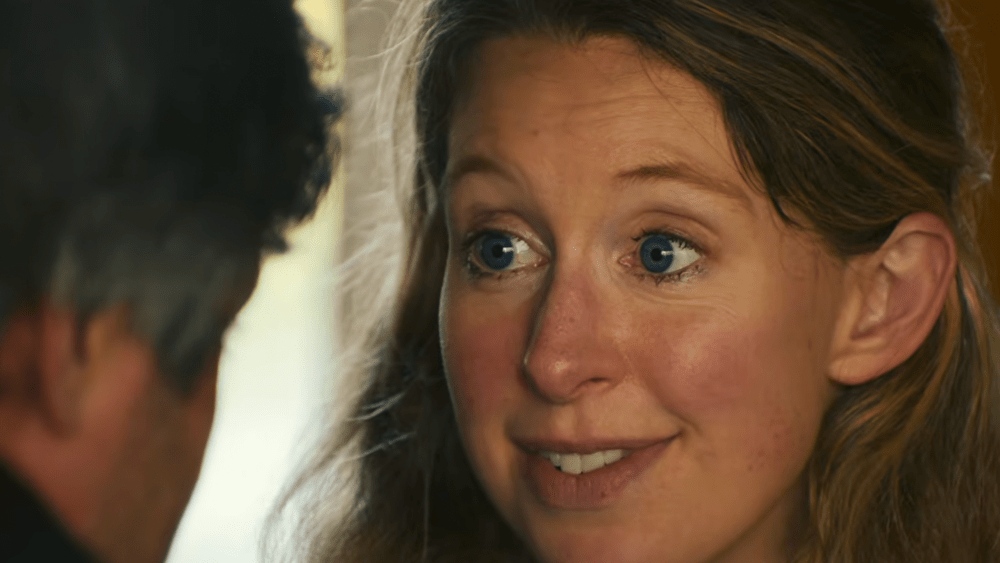
In a world where Lindsay Clancy can inspire an onslaught of sympathetic voyeuristic fascination, why not Elizabeth Holmes? Earlier tonight, the screening of an unannounced mystery movie at the Telluride Film Festival generated every bit as much pre-screening buzz as any of the major titles programmed here. And when the movie was revealed to be “You Can See Everything,” a 174-minute documentary, co-directed by the cult comedian Nathan Fielder, about Elizabeth Holmes, the former CEO of Theranos who is now serving an 11-year prison sentence after being convicted of defrauding her investors, the sensation of “WTF? I’ve got to watch this!” did not subside as the movie went on. It only intensified. “You Can See Everything” is just about the furthest thing from a “pure” documentary you’ve seen. That’s part of its appeal — it’s a one-of-a-kind reality-TV-as-hangout-movie psychodrama circus. Yet it’s been made with a spirit of true inquiry, driven by Fielder’s acidly quizzical personality (as an onscreen interviewer, he’s got the most drop-dead deadpan since Steven Wright), and it gets its hooks in you. Popular on Variety Fielder isn’t here to throw open the question of Elizabeth Holmes’ guilt. He wants to know what made her tick. But why, you may ask, is the comedian behind shows like “The Curse” and “The Rehearsal” making a three-hour movie about the woman who became America’s youngest self-made female billionaire by convincing the world that she’d created a revolutionary new means of blood testing? Holmes, after her conviction, stayed out of the public eye, but shortly before her prison sentence was set to begin she decided she wanted someone to document her last days of freedom. Maybe she wanted to have her say? Whatever the motivation, Fielder, who has often operated in a nether zone between fiction and reality, was looking for a project to collaborate on with Lance Oppenheim, a documentarian he’d become friendly with. And so, with the support of A24, and without quite knowing what they were after (or, by their own admission, what the hell they were doing), the two of them stepped into the breach. Thirty-five days before the start of Holmes’ prison sentence, in 2023, they brought a camera crew to the spacious wood-paneled beachside home in Del Mar where she was living with her partner, the California hotel heir Billy Evans, and their two children (including an infant daughter). Fielder was there to hang out, observe, and interview Holmes, trying to get inside her mind. That proved to be a weirder and wilder journey than anyone might have imagined. The Elizabeth Holmes we see has a winsome soft presence, with a Cupid’s-bow grin and eyes that beam without blinking too much. She resembles the ’80s and ’90s actress Kim Greist, and has a manner that’s disarming in its gentleness. Yet when Fielder asks about the crimes she was convicted of, she pleads a strange kind of ignorance. She claims she did nothing wrong, and it’s clear she believes it. But how is that possible? In 2015, Holmes had become a celebrity entrepreneur, based on the $9 billion valuation of her health technology company, Theranos — a company that turned out to have been built on a complete scam. For a brief time, Holmes convinced the world that she’d developed a revolutionary device for blood testing that required very small volumes of blood, such as the amount you’d get from a pinprick. She convinced top-drawer investors (including Rupert Murdoch and Larry Ellison) to pour millions of dollars into the company. For credibility, she assembled a board of directors that included such ancient luminaries as George P. Shultz, Henry Kissinger, and James Mattis. There was only one problem: the “revolutionary” technology didn’t exist. Numerous experts, starting with the Stanford medical professor Phyllis Gardner, told Holmes that her idea wouldn’t work; you couldn’t mine voluminous amounts of data from just a few droplets of blood. But Holmes, along with her business partner, Ramesh “Sunny” Balwani (who was also her romantic partner), sold the deception anyway. For a short while they were quite “successful” at it, though in hindsight it’s clear that the castle in the air they built — all spun out of the trendy idea that medical science could be democratized — was destined to crash and burn. Because it was all made up! Holmes had spun the pinprick idea out of her own fear of needles. This was her fantasy, elevated into an invention that didn’t actually exist. So how can she defend herself now? What she tells Fielder, with an implacable conviction that suggests a belief in her own narrative that’s nothing short of monomaniacal, is that the device patented by Theranos, which she sold as “the iPod of health care,” could, in fact, host any blood test that existed. The only thing they hadn’t quite worked out was the chemistry that would go into the tests. In other words, the device was based on the projection of a technology that didn’t exist yet. But the more Holmes talks to Fielder, the more he teases out her unhinged rationale, which is: The device works fine! We just had to figure out that pesky chemistry stuff! The strange thing is that Holmes has such a corporate mindset that she treats the chemistry stuff…that hadn’t been invented yet…as just another glitchy small problem that could easily be solved. (Have the solution on my desk Monday morning!) She believes her version of reality. But Fielder, who is not taken in by any of this (his questions remain rigorous in their skepticism), at one point gives vent to his impish side by showing Elizabeth and Billy the famous Abbott and Costello routine “Who’s on First?” When it ends, he tries to get Holmes to explain what the joke is (that “Who” is the first baseman’s name, but the name sounds like a question — hence the routine’s glorious verbal slapstick). And she can’t do it; she can’t grasp the joke. It’s not just that she lacks a sense of humor (though frankly, she kind of does). It’s that she’s got the malignant narcissist’s need to have words mean only what she decrees them to mean. She can’t hear any other meaning. Hence: her device did “work,” and still does (it can run any test!). That’s why she and Bobby, years after her conviction, are still pitching Theranos to other investors (as if anyone would go near her). This is a highly rarefied level of delusional thinking. Holmes says to Fielder that she’s never told a lie in her life. Her whole vibe is “sincerity.” (Though it’s also one of passive-aggressive unbroken-eye-contact creepiness.) The lesson of her legal case isn’t just that she was found guilty of defrauding investors, but that her faulty device, had it been put on the market, would have hurt people. That’s why the real question “You Can See Everything” is asking isn’t: Is she guilty? Rather, it’s: What makes people like Elizabeth Holmes tick? (And how many of them are out there?) Fielder and Elizabeth and Bobby sit down to watch the 2022 Hulu miniseries “The Dropout,” which was based on the case, with Amanda Seyfried giving a pointed performance as Holmes. Holmes suggests that the series is a TV-movie crock. But is it? The documentary’s first half ends with Holmes saying goodbye to her family and going off to the minimum-security Bryan Prison in Texas. The prison won’t allow anyone to interview her, so that’s more or less the last we’ll see of her. And we’ve pretty much gotten the skinny on her, which is that she has a brick wall standing between herself and the truth, and an indifference to the harm she might have caused, that borders on the sociopathic. So what is there left to discover? Plenty, it turns out. With Holmes out of the picture, Fielder needs someone to sustain her presence. So he calls Amanda Seyfried, who sits and watches the scene we’ve just seen of Holmes sitting and watching Seyfried portray her. Are you feeling the meta of it all? That sounds gimmicky, but as the documentary goes on, and Fielder creates transcripts of things that Holmes has spoken (including a phone chat he has with her in prison), who better to read the transcripts — to turn this reality into theater, and by doing so to turn it back into reality — than Amanda Seyfried? She gives an increasingly accurate performance as Holmes, getting inside her head, to the point that Seyfried starts to sympathize with her, at least when it comes to what a glowering aggro control freak Holmes’ partner Bobby is. As Bobby continues to make himself accessible to the filmmakers, exposing his dark side at every turn, I was afraid the movie might use him to create a kind of toxic excuse for what Holmes did. But part of the jaunty power of “You Can See Everything” is that the film never mounts an apologia for Elizabeth Holmes. Bobby may be repugnant in his cockiness, and in the way he takes control of Holmes’ image, allowing the iconic photograph of her making the “OK” sign to be used on billboards, tweeting out hostile tweets under her name, and striking a deal with the A24 executives — yes, there’s a meeting with them in the movie, at which point we’re either in meta heaven or hell — that will give him some of the profits from the movie. Does Holmes know about the deal? No. But she claims to want it that way. Her grand assertion is that she never cared about the money. And yet the money — the value of her company — became the very core of her identity. “You Can See Everything” overlaps reality, performance, deception, and mental illness, and by the end it brings you to the enigmatic space where every one of those things meet.
‘You Can See Everything’ Review: Nathan Fielder’s Documentary About Elizabeth Holmes Is a Shameless, Fascinating, Reality-TV-Eats-Its-Tale Look at Entitled Duplicity
Full Article
Original Source
Read the full article at Variety →KhanList aggregates and links to publicly available news content. We do not host full articles from third-party sources. Always verify important information with original sources.