
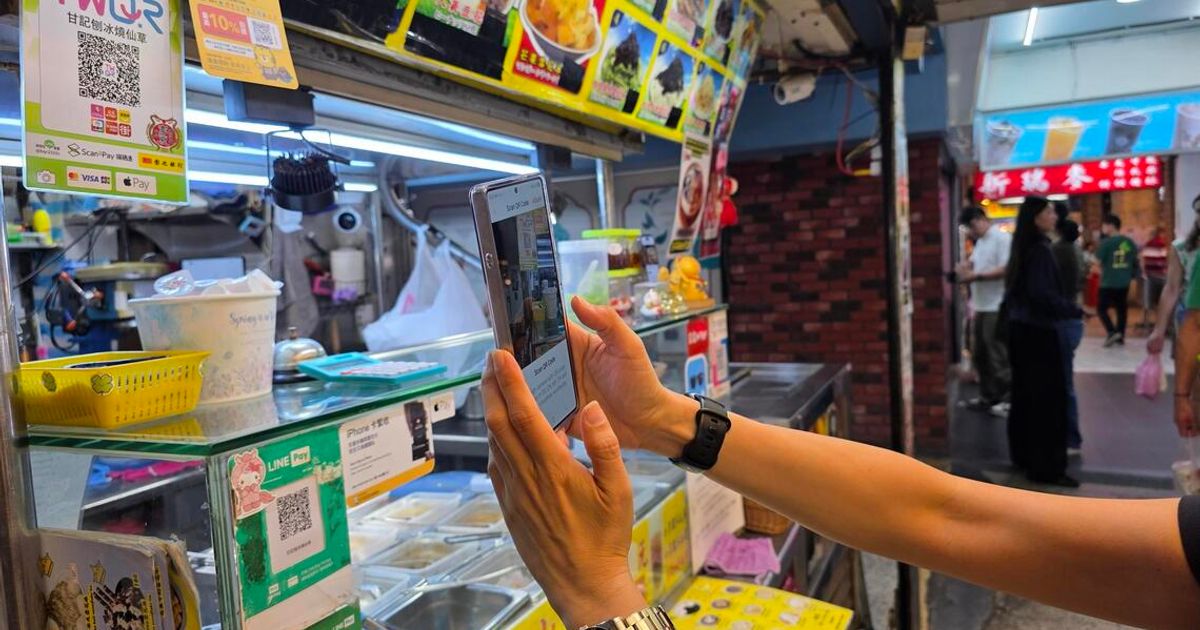
TAIPEI – With a quick scan of the TWQR, Taiwan’s unified QR code payment standard, I bought a cup of jasmine bubble tea using the DBS PayLah! app on my phone.Slurping my drink (zero sugar, 10% ice), I hopped over to the convenience store to get a snack, but that did not go as planned.The cashier asked to scan the barcode on my app as the shop did not have a TWQR for me to scan. But DBS will roll out this merchant-scan-customer payment option for Taiwan only in 2027.The next test was at the Shilin Night Market – a staple for tourists visiting Taipei. I found that the app worked at some stalls but not others.At a stall selling grilled beef, PayLah! worked for two out of the three TWQR displayed, each supported by a different local app provider.But when I tried to scan and pay for fishballs, an error message popped up: “Sorry. This service isn’t available right now. Please try again later.”I had to use cash to pay for the fishballs, oyster mee sua and fruit juice, as the stalls did not accept cards.DBS announced in October that Singapore travellers can use PayLah! at more than 250,000 merchants across Taiwan, or about two-thirds of the TWQR merchant network.My attempts to use PayLah! over a week showed that the cross-border payment system launched by Singapore’s NETS and Taiwan’s Financial Information Service Co, which developed TWQR, is still patchy in the early days.Cash is still kingCredit cards have been ingrained in Taiwan for decades, while mobile payments and digital wallets started gaining popularity around 2017 following a government push to expand the territory’s cashless economy. But at small shops and night markets, cash is still preferred.In Taiwan, 25% of point-of-sales payments are made with cash, according to the 2026 Global Payments Report. Digital wallets account for 36%, and credits cards 32%.In comparison, the use of cash has fallen to 12% in Singapore, 6% in South Korea, and 4% in China. In Japan, however, cash still accounts for 38% of payments in stores, according to the same report.“Compared with medium and large enterprises, small businesses in Taiwan are still more accustomed to collecting cash,” senior industry analyst Hu Tzu-Li from the Market Intelligence & Consulting Institute (MIC) told The Straits Times.Small businesses have been facing rising costs in recent years and lower profit margins, and mobile payments make sales revenue transparent, forcing them to face tax obligations, he said.“Besides being more concerned about tax issues, small businesses in Taiwan usually have less profit margin to cover processing costs for providing diversified payment methods,” he added.In my first few weeks of living in Taipei, before getting a local bank account and card, I ended up using more cash than expected. It is hard to exchange cash as there are few money changers in the streets, and not all banks accept Singapore dollars. I ended up borrowing money from a friend to tide me over.I have also found that it is common for small businesses, such as market stalls, provision shops and hole-in-the-wall eateries, to accept only cash.People walking through the Nanjichang Night Market in Taipei on Sept 24, 2026. PHOTO: REUTERSAt a smaller night market I visited, most of the vendors offered no digital payment options at all.I bought some persimmons from fruit seller Liu Ming Yi, who said cash is still preferred at traditional markets.“The customers here tend to be older, and it’s faster to use cash. The shops with younger customers take digital payments,” said Liu, who is in his 30s. “The store also needs to pay the suppliers with cash.”Fragmented mobile payment marketDespite that, the adoption of digital payment services is high in Taiwan, said Hu, the senior industry analyst. Citing an MIC survey, he said the proportion of Taiwanese consumers aged 18 to 65 who used mobile payments domestically was 90.1%, or at least 14.1 million people, in 2025.But he added that the proportion of Taiwanese mobile payment users using four or more apps is 43.3% – reflecting the fragmentation of the market here.LINE Pay, which links to a credit or debit card and has its own QR code to scan, is the most popular, with 13.6 million subscribers, followed by JKOPay – which can be linked to a credit card or bank account – with 7.3 million users.There are other providers too, such as iPASS MONEY, PXPay Plus, EasyWallet and the state-backed Taiwan Pay, all of which accept PayLah!, as well as NFC-enabled Apple Pay and Google Pay.QR codes by different mobile payment providers displayed at a grilled beef and seafood stall in Shilin Night Market. The many digital wallets in Taiwan have yet to be fully integrated. ST PHOTO: CHEW HUI MINWhile it is good to have options, there is no one app that works across all shops, such as China’s WeChat Pay and Alipay, or a service like Singapore’s PayNow.This can be confusing and frustrating for consumers, especially when they realise they do not have any of the apps preferred by a certain merchant and would have to download yet another new one. In such a scenario, cash solves the problem immediately.Hu said about a quarter (26.1%) of users have faced the problem of merchants accepting only specific bank cards – another sign of the fragmentation in the payments landscape. Local supermarket PX Mart, for one, only accepts credit cards from certain local banks.For tourists, another catch is that the digital wallets popular here, such as LINE Pay and JKOPay, require you to have a local Taiwanese phone number to sign up. Other than LINE Pay, local apps do not allow linking to foreign credit cards.The good news is that cross-border digital payments are picking up in Taiwan. South Korea’s Naver Pay has been accepted in Taiwan since late 2023 through a collaboration with China’s UnionPay, while Japanese tourists have been able to use PayPay since April 2026.In July, Taipei Metro introduced tap-to-pay for foreign credit cards, which also allows tourists to use Apple Pay, Google Pay or Samsung Pay to take the train.I am looking forward to more of such digital integration, but for now, I have gone back to stashing some bills in my wallet, just in case.
You can PayLah! in Taiwan, but here’s why cash is still very much needed
Full Article
Original Source
Read the full article at Straitstimes →KhanList aggregates and links to publicly available news content. We do not host full articles from third-party sources. Always verify important information with original sources.