
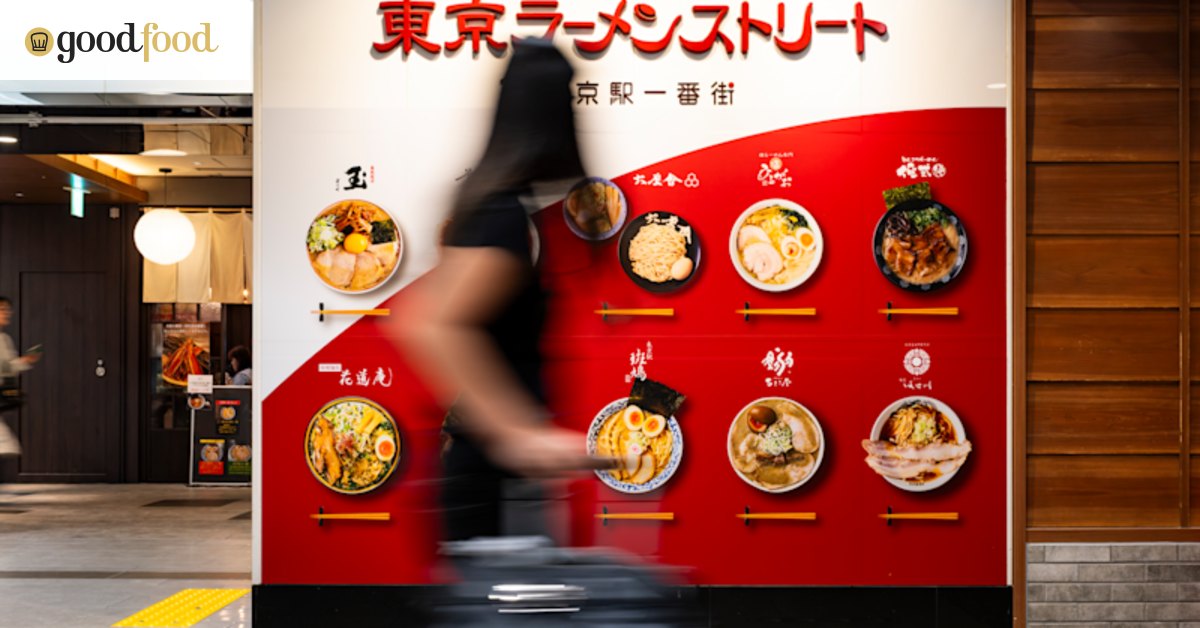
They’re like mini-cities with alleys devoted to ramen, “perfect” bento boxes that are more like an enduring cultural artefact than lunch, and vending machines stocked with sake, coffee and more.There’s a long history of people eating well at Japan’s train stations. You know the onigiri trend we’ve seen in Sydney and Melbourne lately? Passengers have enjoyed these rice balls since 1885: they were one of the first snacks Japanese commuters could buy. In Australia, railway food is often a last resort, but in Japan, a walk to your platform can take you past ramen-dedicated alleys, walls lined with vending machines selling sake and castella cake from a Nagasaki bakery that has hand-made this treat for more than 400 years.Vending machines at Tokyo Station.Andrew FaulkTokyo Station’s Ramen Street.Andrew Faulk“Japanese train stations are like mini-cities,” says chef Brendan Liew, who has worked at Tokyo’s fine-dining restaurant Nihonryori Ryugin and Melbourne’s Minamishima. “Many are attached to multiple office towers and department stores, and there are almost too many food options to choose from.” Commute northeast of Tokyo and you’ll discover one of his favourite stations: Sendai in Miyagi. “There’s a corridor of restaurants just outside the ticket gates serving gyutan, or grilled ox tongue,” he says. The local specialty can be served with a spicy miso condiment known as togarashi nanbanzuke, along with beef soup made with sweet green onions, and barley-studded rice with grated sticky yam. “It’s a unique and delicious meal,” says Liew. Restaurant reviews, news and the hottest openings served to your inbox.Sign upIt’s one of many ways to dine well at Japan’s transport hubs. Here are other ways. Tokyo Station’s Ekiben-ya Matsuri store famously sells around 200 kinds of bento boxes.Andrew FaulkEkiben meals worth unboxingRailway bentos, known as ekiben, are so wide-ranging that Tokyo Station’s Ekiben-ya Matsuri store famously sells around 200 kinds. They’re so regionally diverse that Liew’s latest book, Ekiben (Smith Street Books, $45), covers the phenomenon. In fact, Liew believes railway bentos unveil a station-by-station tour of Japan’s regional specialties: they’re not a disposable convenience food, but an enduring cultural artefact.People choosing lunch at Tokyo Station’s Ekiben-ya Matsuri.Andrew FaulkHe interviews Kenichi Fukuoka, who has documented over 11,000 railway lunchboxes on hisEkiben Museum website and personally sampled over 9000 – including Japan’s most expensive bento from Tobu Nikko Station, which was only available via reservation, cost up to 237,000 yen (AU$2121.88) and featured lavish crab and wagyu beef.Typical ekiben are more accessible, yet still meet a high standard – even for an on-the-go, mass-produced meal. “They’re always perfect,” says Liew. “When you open the box, there isn’t a grain of rice out of place – despite the vigorous shaking as you rush from one platform to the next, dragging suitcases behind you.”Tokyo Station’s Ekiben-ya Matsuri store. Andrew FaulkCommuters unboxing five-tier sea eel rice in Himeji (45-minutes shinkansen ride from Osaka) will encounter a bento resembling the local castle, while Musubi Maru Bento in Miyagi (in Japan’s northeastern Tohoku region) reveals onigiri shaped like the region’s samurai mascot (with a yuzu peel in place of his helmet). Passengers might encounter ekiben presented like lanterns, bullet trains or superheroes. Akashi’s specialty is sold in clay pots resembling the coastal city’s octopus traps. Liew’s favourite packaging evokes the past: Toyama Prefecture’s trout sushi bento is wrapped in bamboo leaves and pressed into a traditional magewappa (steam-bent cedar) box. “A large stone is placed on top to weigh it down, expelling air and helping to preserve the rice and fish,” he says. “Ekiben are fiercely local,” the chef adds. Hokkaido’s kakimeshi (oyster rice) reflects the area’s ingredients and cooking style, for instance. Some of the grab-and-go selection at Tokyo Station. Andrew FaulkTrain stations are great for local souvenirs, too“Foodstuffs at stations are so local that you almost don’t need a sign to tell you where you are. They are a way of tasting your destination, or … sharing it in the form of a gift [or] souvenir, known as omiyage,” says Jane Lawson, author of Secret Japan (Affirm Press, $35).Omiyage shops reflect Japan’s strong gift-giving culture, where you load up on regional souvenirs for friends or co-workers before getting the train home.Lawson runs Zenbu Travel tours and has been to Japan more than 50 times. She recalls a Sapporo Station visit where Hokkaido’s “extraordinary dairy culture” was exemplified by sweet cheese tarts baking in a small shop. The aroma inspired her to join the enormous queue. “Most customers were buying boxes of them as omiyage,” she says. Calbee’s chip shop at Tokyo StationAndrew FaulkFrom a station in Nagano’s grape-growing prefecture to Okayama train stops selling treats zesty with local Setouchi lemons, “stations can act as shop windows for the region and its producers,” she says. At a small Kyoto station, Lawson encountered a market selling fresh greens and locally grown rice, with pictures of the smiling growers and handwritten signs about their farm and ingredients. Even region-specific Kit Kats by multinational Nestle showcase Fukuoka’s Amaou strawberries or Kochi’s yuzu in omiyage stores. At Tokyo Station, Calbee’s chip shop celebrates different prefectures, including crisps seasoned with blended spices from Shichimiya, a Kyoto merchant originating in 1655. (Similarly, Fukusaya feeds commuters at Nagasaki station; its outlets have hand-baked castella cakes with perfect edges and evenly coloured surfaces since 1624.) Ramen at Rokurinsha. Andrew FaulkTokyo Station’s Ramen Street.Andrew FaulkCulinary convenience and ramen streetsLawson’s memorable ramen-eating experiences at railway hubs include noodle bowls filled with local butter, cheese and corn in dairy-rich Hokkaido, and standing shoulder to shoulder with commuters at a platform ramen bar in Gifu, slurping strands salty with local miso, before dashing onto the departing train. Rokurinsha at Tokyo Station’s Ramen Street.Andrew Faulk“Kyoto Station has Kyoto Ramen Koji, a whole ramen alley hidden up high in the enormous station building,” she says. Tokyo Station has Ramen Street, home to Soranoiro’s vegan tantanmen and gluten-free ramen as well as tsukemen dipping noodles by Rokurinsha, a ramen restaurant championed by Momofuku founder and American chef David Chang. In a video for his Lucky Peach magazine, he noted how Rokurinsha is so popular, there’s a line to join the line. Then there’s the coin-operated convenience. At Echigo Yuzawa station you can taste sake from more than 100 breweries via its vending machines. At Shin-Yamaguchi’s bullet-train stop, Lawson discovered one selling 60 different variations of coffee. “It was basically an entire roastery-cafe in a machine.”The lines are long at Rokurinsha. Andrew FaulkVending machine drinks. Andrew FaulkSake cars and dining on the tracks“Japan takes the relationship between food and railway travel even further with dedicated dining and sightseeing trains,” says Lawson. Niigata has its sake-tasting railway trips, passengers aboard Fukuoka’s Aru Ressha can savour strawberry tiramisu and tasting menus by acclaimed chef Yoshihiro Narisawa, and Lawson has joined the Tsugaru Stove Train across Aomori’s deep snow, where you can stay warm with squid grilled over coal stoves in an old-fashioned carriage.More:Food shops and specialty grocersFor subscribersFood travelGood Food recommendsFrom our partners
You can eat very well at Japan’s train stations – here’s how to do it like locals
Full Article
Original Source
Read the full article at Smh →KhanList aggregates and links to publicly available news content. We do not host full articles from third-party sources. Always verify important information with original sources.