
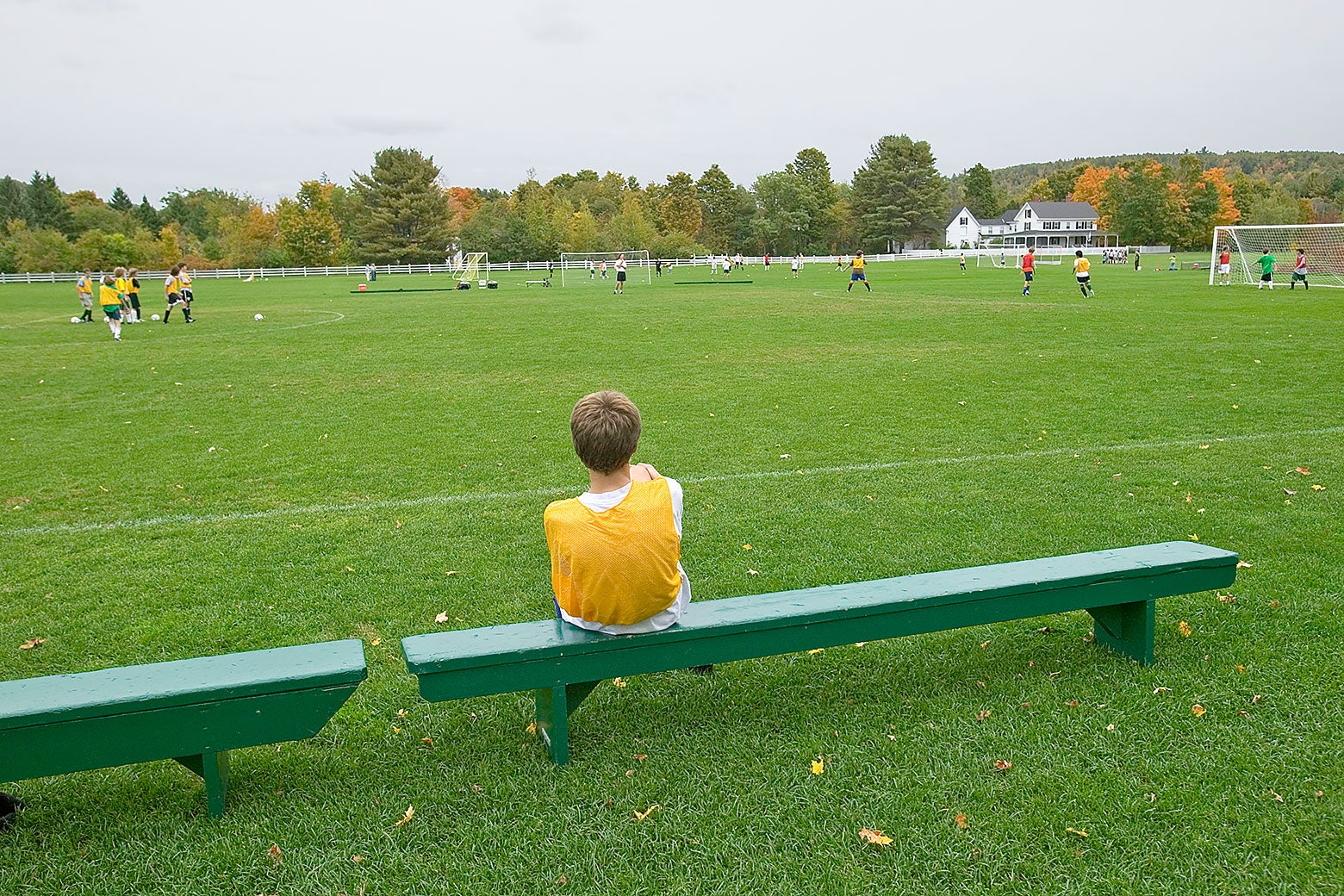
Family It’s almost impossible to maintain friendships with young athletes whose afternoons and weekends are full up with soccer—and driving to soccer. By Enter your email to receive alerts for this author. Sign in or create an account to better manage your email preferences. Unsubscribe from email alerts Are you sure you want to unsubscribe from email alerts for Rebecca Onion? Sept 10, 20265:46 AM Joe Sohm/Visions of America/Universal Images Group via Getty Images Sign up for the Slatest to get the most insightful analysis, criticism, and advice out there, delivered to your inbox daily. By now, lots of people know that private equity is changing everything about the world of youth sports, an arena where it’s currently making a killing. But when I read Caitlin Moscatello’s recent piece in New York magazine, yet another deft accounting of the ever-ballooning amounts of time and money the travel sports industry can demand from families who participate, I wondered what would happen if you were to look at the effects of this huge, very recent change in American childhood from the outside instead of the inside. What happens when you take about 5 million elementary- and middle-school-age children out of neighborhoods, friend groups, summer camps, and extended families for the number of hours travel sports consumes? Kids don’t hang out in person like we Gen Xers and millennials used to. It’s obviously the phones. Could it also be the travel sports? Let me preappease sports parents and nonsports-ers alike by saying I have no dog in this fight. My child is 9, we are ideologically committed underschedulers, and she is only just now starting with music lessons and swim club. (Yes, I have been told it’s already “too late.”) But even with her at this young age, we’ve already brushed up against the sports absence effect on numerous weekends, when we’ve tried to make plans with her friends to find they’re “out of town.” How much worse is this thing going to get? Anecdotally speaking, it’s a tough time to be a kid who doesn’t want to play travel sports, especially if you want to maintain friendships with young athletes whose afternoons and weekends are full up with soccer—and driving to soccer. “Our son is in the seventh grade, and one of his good friends can’t come to his birthday party because he has travel soccer practice and school practice on the same day. It is hard when your kid isn’t one of the sporty ones because so much of their friends’ time revolves around sports,” said Michelle S., a mom of one travel-sports kid and one no-travel-sports kid in New Jersey. “Not to mention if you’re friends with the parents—good luck planning a night out.” I asked Christopher Bjork, who co-wrote the book More Than Just a Game: How the Youth Sports Industry Is Changing the Way We Parent and What to Do About It, about the effects of youth sports on the kids around the athletes. Bjork said that when he and co-author William Hoynes interviewed parents, they found that time left over from sports is often used for schoolwork, not for hanging out. It was very rare, Bjork said, for parents to allow kids to skip sports commitments in favor of a friend’s sleepover or birthday party. Bjork, himself a recovering travel-sports parent, confessed he used to find himself calling the school and fibbing about his son being sick the day after a weekend soccer tournament, because he needed time at home to make up academic work. (“I felt horrible,” Bjork said.) Lisa, a mom in San Jose, reported that her now-18-year-old had seen this effect in action: “One of their high school friends missed just about every social gathering due to training for fencing, traveling for fencing, or making up work they had missed due to fencing.” Perhaps this is just an annoyance for an individual friend group, but multiplied across a local population, it starts to look like a major driver of social dynamics. Relatives, as well as peers, may feel as if travel sports leave them playing second fiddle. “I never see my cousins or their kids anymore because they all have slightly older kids who do travel soccer and travel Little League, plus school sports. We used to get together often when my grandma was alive, Sunday dinners, etc. Now I never see them, and I blame the sports,” Jessica Collins, a mom of a 4-year-old who lives on Long Island, said. “I feel like, when I was little, I was always with my cousins, and growing up we always hung out and we were together every weekend. Now I feel like the sports take over and we never see each other. … My niece and nephew are also in sports, but local town leagues, so we see them more.” The Aspen Institute’s Project Play found that families with kids in soccer and basketball are now spending an average of more than $1,000 per sport per kid, and that the figure can often “balloon well into five figures,” depending on the league, the area, and how many extras families tack on (coaching sessions, camps, and travel). For the families who are choosing to invest, the loss of connections to non-team-sports-playing friends, cousins, and random neighborhood scamps may not seem so grave, because these kids and parents are busy making friends with the other kids and parents on the team. A coach Hoynes and Bjork interviewed for their book summed this up: “When I grew up, on Sunday you went to church. And you were at your hometown and your community. And I think more and more people are traveling on the weekends, and I don’t know if that’s a good thing for our society, but that’s where you’re going to make your friends.” Chris Knoester, a sociologist at the Ohio State University, said in an email that in basic analyses of National Sports and Society Survey data, he found that parents of kids 6 to 17 who played private club or travel sports said that their kids had more close friends who were athletes than the parents of kids who didn’t. “The differences in having athlete friends, based on private club or travel sports participation histories, appeared to increase among the youngest generation,” he wrote. “This seems to speak to the increasingly all-encompassing nature of private club and travel sports participation, these days.” Surely jocks have eternally been friends with jocks, and that’s their prerogative? And, granted, travel sports seem to keep kids off YouTube Shorts, which is good. Bjork interviewed many sports parents who really like the friends their kids make while they’re on teams. (One dad described his daughter’s soccer friends as “more driven, better at time management, better at staying focused.”) But the intensity and cost of travel sports ramps up this sorting effect. Unlike school or local rec-league sports, it takes on a significant class dimension, because participation costs so much, in time, know-how, and money. It’s not just the theater kids and the “I inherited a certain lack of coordination” children who can feel excluded. Kids who might want to play on a travel team but who can’t swing travel sports, for reasons of money or time, can feel trapped on the outside. Hilary Strother, who lives in a suburb of Cleveland, described her 13-year-old stepson’s conundrum: “We just literally couldn’t make [travel sports] work logistically with our distance from his district and our custody schedule. As a result, he’s been in rec league every year, and every year we see it get worse and worse”—a negative effect of travel sports on local teams that the experts also describe. “My stepson has a good attitude,” Strother said, “but it’s hard to see him so frustrated with being one of the few motivated skilled players, and watching all his friends play travel.” It’s more unfashionable now than it was 10-ish years ago to point out that selecting a private school for your kids reduces the quality of education for others at your local public school. Maybe now we are all so resigned to the ways our lives are shaped by class that the fact that a bunch of kids whose families can afford it are basically withdrawn from the larger, more unpredictable, more socioeconomically diverse life of their schools and neighborhoods and transplanted onto faraway playing fields and hockey rinks for hours a week seems normal. But maybe we shouldn’t be? Ask me again if my daughter falls in love with swimming. Family Sports
Yes, the Youth-Sports Industrial Complex Is Bad for the Kids in It. It’s Even Worse for the Kids Left Behind.
Full Article
Original Source
Read the full article at Slate →KhanList aggregates and links to publicly available news content. We do not host full articles from third-party sources. Always verify important information with original sources.