
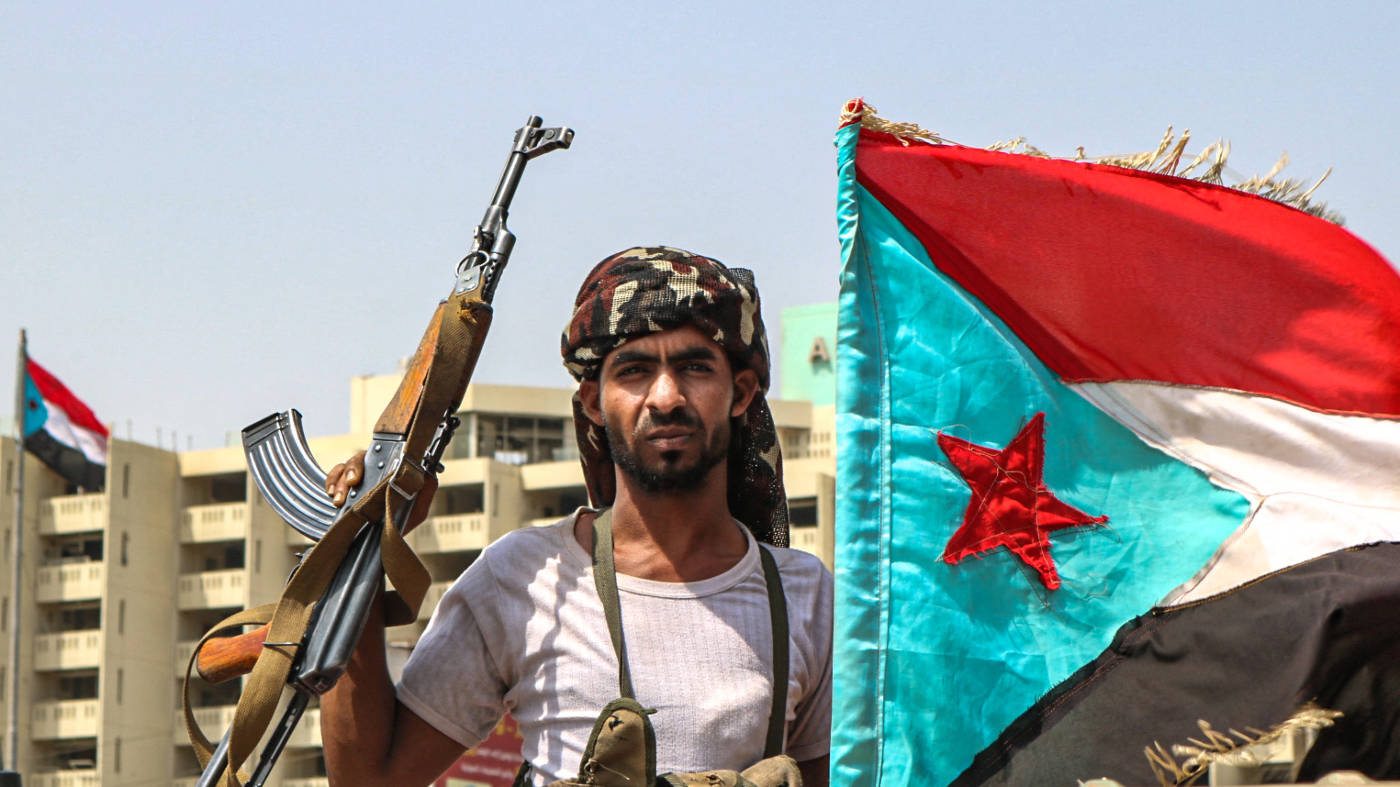
Yemen, where civil war broke out in 2014, has recently been rocked by the worst fighting in years. A truce agreed in 2022 between the Ansar Allah, better known as the Houthis, who control the north, and forces loyal to the government in the south disintegrated when Saudi Arabia bombed Sanaa airport in July. In August and September, the Houthis mounted a quick offensive, recapturing much of the western coast, including the port of Mocha, putting it within close range of ships passing the strategically important Bab el-Mandab strait. The Houthis are now targeting Aden, Yemen’s colosecond city and seat of its internationally recognised government since the group took the capital Sanaa 12 years ago. Meanwhile, the Houthis have tightened their decade-long siege of Taiz, blocking the road to Aden and raising the prospect of its capture. The Saudi-backed pro-government military coalition contains a variety of armed units and local militias, each with different goals, rival leaders and origins, leading to infighting and disorganisation. New MEE newsletter: Jerusalem Dispatch Sign up to get the latest insights and analysis on Israel-Palestine, alongside Turkey Unpacked and other MEE newsletters Allegiances frequently shift and evolve: the Giants Brigade and the National Resistance Forces were each previously backed by the UAE. The leaders of both, like much of the coalition, are now bankrolled by Riyadh amid its fallout with Abu Dhabi. With fighting spread across multiple front lines, here’s an overview of the most important military and political parties involved in the conflict. The Presidential Leadership Council alliance Yemen has been officially administered by the eight-member Presidential Leadership Council (PLC) since 2022, chaired by politician Rashad al-Alimi. It is recognised internationally as the government of Yemen, and backed by Saudi Arabia. Several PLC members lead their own military units, which nominally make up Yemen’s armed forces but are ultimately accountable to their commanders and their external backers. The Giants Brigades (Al-Amaliqa), mostly drawn from southern Salafi and tribal fighters, are estimated to number 20,000–30,000 fighters. Their leader is Abdulrahman al-Muharrami, better known as Abu Zaraa, a Salafi cleric turned military commander from Lahij governorate who sits on the PLC. The units were originally armed, trained and funded by the UAE and were long affiliated with the STC, but have been on the Riyadh payroll since Abu Dhabi pulled back from Yemen earlier this year. Andreas Krieg, associate professor at King's College London's School of Security Studies, told Middle East Eye that "Riyadh has been able to co-opt individuals such as Abu Zaraa, but it has not been able to absorb their entire networks. The Giants retain their southern identity and longstanding Emirati relationships." The force is among the coalition's best-equipped: it was key to the recapture of the western coast from the Houthis in 2017 (albeit with aerial support from the UAE), and is integral to the current government's defence of Aden. Many of the Giants’ fighters identify as southerners and are reluctant to defend territory beyond southern Yemen. Islah (formally known as the Yemeni Congregation for Reform) is a Sunni political movement with historic ties to the Muslim Brotherhood. It also includes Salafi and tribal fighters. Despite its ideological affiliations, it is crucial to Riyadh's political and military network in Yemen. The UAE, however, has long opposed Islah, and has lobbied abroad for it to be classified as a terrorist group. Islah is especially influential in Taiz, where it dominates the government's security operation, including the Taiz Military Axis, which coordinates the military units defending the city against 11 years of Houthi siege. Homeland Shield (Quwat Dira al-Watan, also known in English as the National Shield Forces) is led by commander Abdulrahman al-Lahji. It was established in 2022 and formalised as a military unit the following year with the backing of PLC chair Rashad al-Alimi. Its estimated 30-40,000 fighters principally come from Salafi and tribal communities in the eastern Hadramaut and al-Mahrah governorates. Homeland Shield was key to the recapture of Hadramaut from the STC-affiliated forces in January and is now fighting the Houthis along the eastern frontline. It has also been used as a police force to quell internal discontent, including in crackdowns on rallies of STC supporters. The National Resistance Forces are led by Tareq Saleh, nephew and former aide of President Ali Abdullah Saleh, who was driven from power in 2012 and killed by the Houthis, his onetime allies, in 2018. Many of its fighters come from the remnants of the former president's Republican Guard, who were backed by the UAE until the STC’s failed putsch in January. It has subsequently shifted allegiances - and its payroll - to Riyadh. Unlike the UAE-backed STC, it nominally supports a unified Yemen. A Giants Brigades fighter fires from the back of a pickup truck during clashes with Houthis in Taiz province in October 2026 (handout/AFP) From its HQ in Mocha, the NRF’s estimated 50,000 fighters controlled much of the Red Sea coastline until their position collapsed dramatically amid the Houthis’ August-September offensive. Saleh fled to Riyadh on 12 September, and some NRF troops have since been redeployed to remote regions of Hadramaut. Krieg said that the loss of Mocha meant that the NRF had lost "its principal territorial, logistical and political base," leaving the force "severely degraded. The forces retain experienced personnel, but I would no longer regard the NRF as a credible independent offensive force in the short term." The Hadramaut Tribal Alliance (HTA) is a coalition that wants greater autonomy for the governorate, home to much of Yemen’s modest oil reserves and where there has long been resentment against Aden’s political and military control. Founded in 2015, its leader is tribal sheikh Amr bin Habrish, who has called for greater local control over natural resources, security forces and politics. Its armed wing, the Hadramaut Protection Forces, sits outside government control but has been courted by Riyadh to counter UAE-backed southern fighters. In December 2025, the HTA tried to take Hadramaut’s oil fields, sparking the STC’s failed putsch later that month. Bin Habrish travelled to Saudi Arabia in January amid clashes between his forces and the UAE-backed STC. In July, Saudi authorities prevented him from returning to Yemen without explanation. The Houthis and allies The rebel alliance is dominated by the Houthis or Ansar Allah ("helpers of God"), which emerged from the Saada governorate in northern Yemen during the 1990s. It currently has an estimated 350,000 fighters, wants international recognition as the government of Yemen, and an end to the ongoing Saudi blockade, which has caused devastating hunger. The group is rooted in Zaydism, a minority branch of Shia Islam that is concentrated in the northern highlands. Amid demands for northern autonomy, the Houthis repeatedly fought the Saleh government between 2004 and 2010. The group, now led by Abdul-Malik al-Houthi, brother of founder Hussein Badreddin al-Houthi, seized Sanaa in September 2014. Six months later, Saudi Arabia led a military coalition to restore the government. In 2022, a UN-brokered informal ceasefire left the Houthis with 30 percent of Yemen, containing 80 percent of the population. Houthi supporters raise their rifles as they chant slogans during an anti-Israel rally in solidarity with Gaza and Lebanon in Sanaa, Yemen, in October 2024 (AFP) The group has received extensive military and tactical support from Iran, including shipments that allow them to build some of Tehran’s most sophisticated missile and drone systems. It has also received support from Hezbollah. Although the Houthis claim to be Yemen's government, they are only recognised as such by Iran. The group, whose slogan is “God is the greatest, death to America, death to Israel, curse the Jews, victory to Islam", has attacked Israel since October 2023, as well as vessels linked to Israel and Saudi Arabia that navigate the Bab el-Mandab strait. The Houthis have also repeatedly hit Saudi Arabia, including Riyadh’s airport. Throughout its decade running northern Yemen, the Houthis have forged alliances with local tribal leaders, but have also faced discontent from local sheikhs and tribal groups that have been strong-armed by the Houthi leadership in Sanaa. The Southern Transitional Council The Southern Transitional Council (STC) is no longer the force it was 12 months ago but its influence is still felt. It was a political body that emerged in April 2017 amid longstanding calls for a separate southern Yemeni state, which existed between 1967 and 1990. During the war, it had the political and financial backing of the UAE, which helped it seize Aden in 2019 and become the dominant power across much of the south. It was allied with the government against the Houthis: three STC leaders, including founder Aidarous al-Zubaidi, held seats on the PLC. In December 2025, its Hadrami Elite Forces seized territory in Hadramaut and al-Mahra governorates, which would have given it control over almost all of the former state of South Yemen. Fighters of the UAE-trained Security Belt Force, dominated by members of the Southern Transitional Council, ride atop a tank in Shuqrah, east of Aden, on 27 August 2019 (AFP) This sparked fury from Riyadh, which launched air strikes against the STC and backed a counteroffensive led by the Homeland Shield and others. STC forces retreated and were then forced to disband. Zubaidi fled to Abu Dhabi, was forced to leave the PLC and charged with treason. The UAE pulled all resources from Yemen, cutting military funding as well as its provision of public services, including hospitals. The STC now lacks its previous military and political power. Many of its affiliated fighters are now allied with the pro-government bloc and paid by Saudi Arabia. But support for the goal of an independent South Yemen remains strong in Aden and surrounding areas, where there have been pro-STC protests, prompting violent crackdowns from pro-government security forces. The group has also reopened branches across the country. "The Saudis succeeded in dismantling much of the STC’s institutional architecture in January, but they have not dismantled the social, political and military networks on which it was built," Krieg says. "The southern question remains unresolved, and Saudi Arabia’s inability to deliver security, economic stability and effective governance has arguably reinvigorated southern separatism." Al-Qaeda in the Arab Peninsula Al-Qaeda in the Arab Peninsula (AQAP) still has a presence in parts of southern Yemen, despite years of counterterror operations. It wants to establish an Islamic emirate throughout the Arabian Peninsula, and is known for its mass casualty attacks on civilians. AQAP fighters, pictured here at an undisclosed location in Yemen in March 2014, no longer wield as much influence as a decade ago (AQAP videograb/AFP) But the group is far weaker than it was a decade ago, when it seized and ruled the port of Mukalla for a year, as well as parts of southern and eastern Yemen. Today it has bases in mountainous outposts, from which it conducts a low-level insurgency, targeting southern government-aligned forces. AQAP hasn't had direct clashes with the Houthis since 2022, with whom it has conducted prisoner exchanges and has been accused of coordinating smuggling operations.
Yemen war: How do the rival alliances and armed factions stack up?
Full Article
Original Source
Read the full article at Middleeasteye →KhanList aggregates and links to publicly available news content. We do not host full articles from third-party sources. Always verify important information with original sources.