
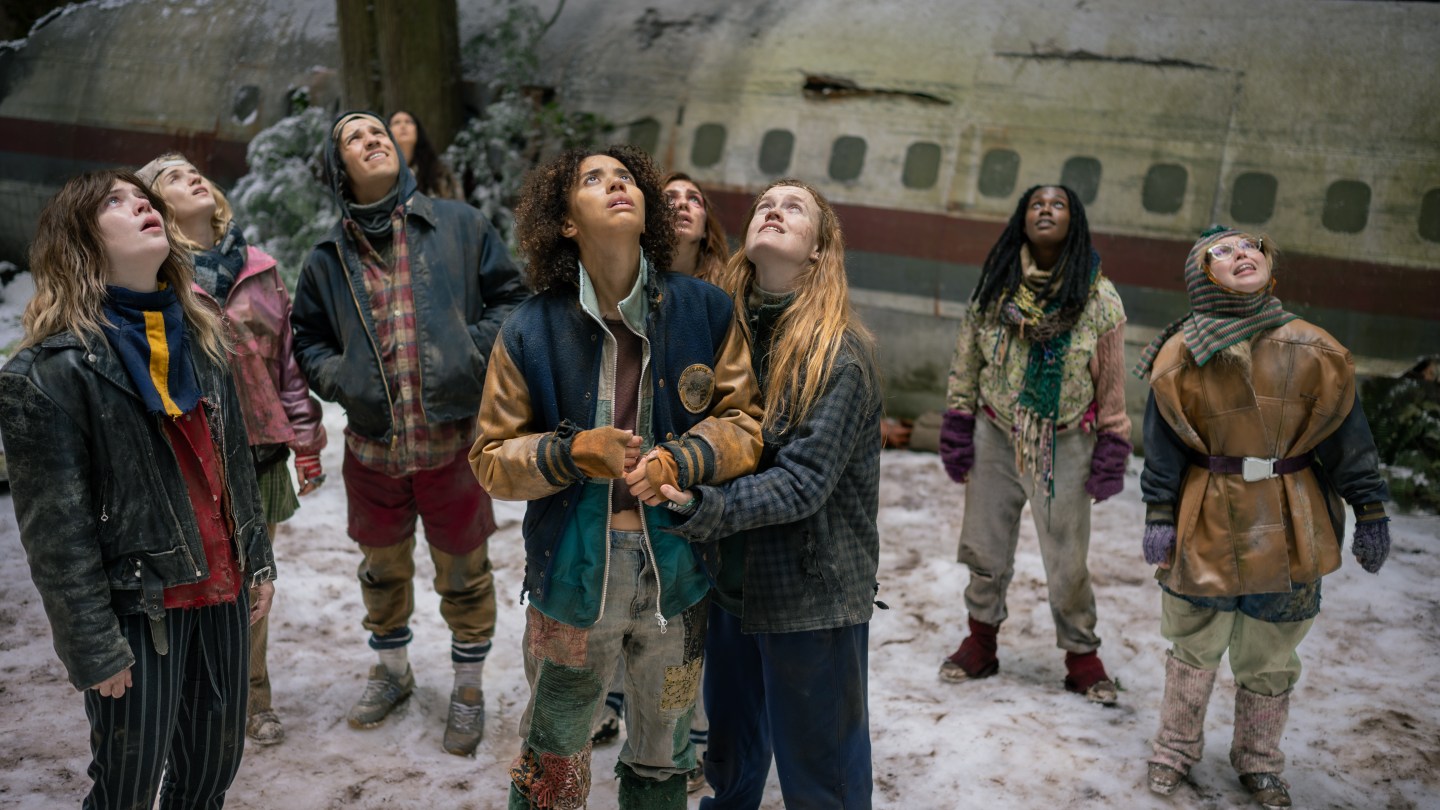
Logo text [This story contains mild spoilers from the premiere of Yellowjackets season four.] The end is near for Yellowjackets. The fourth and final season of Showtime‘s hit survival story has begun, and the weekly drop of final episodes will send viewers on a wild ride as they ruminate on life, death — and the meanings behind those bizarre post-Yellowjackets dreams. If it’s any consolation, the creators have those dreams, too. “Life just keeps getting wider, and the show has been part of that. It’s been an expression of that width and an agent in creating that width,” Bart Nickerson, chatting with his co-creator wife, Ashley Lyle, tells The Hollywood Reporter of the last near-decade making the hit Showtime series. The pair initially planned for five seasons, but when the Paramount renewed Yellowjackets for a fourth and final season, the creators pivoted. “For us,” says Lyle, “it was about storytelling momentum and, with the uncertainty of the industry right now, let’s just finish a story if we can. We took a good, hard look at it. If we had felt like we couldn’t get it done, we probably would have taken the chance. But it felt like we could.” What they deliver is what viewers have been waiting for when the survivors of the Yellowjackets plane crash that began the series are rescued and returned home in the season four premiere. Following the teens as they reassimilate into life in New Jersey — while learning how to live with the murders and cannibalistic acts they harbor; the things they did to survive those months in the wilderness — delivers a fascinating watch and full-circle return to where this story began. Below, Lyle and Nickerson dive into making the final season and what to expect, including the pain of killing off characters while always knowing who would survive in the end. They also explain why they aren’t interested in spinoffs — because they’re ending the story with a period, not an ellipses: “We do feel like this closes the book, and I think that’s important. I think that’s part of the contract with the audience — that you’re telling a complete story.” *** We have been waiting for this rescue season. When we spoke with you two way back in the beginning of all of this, in your heads, you had envisioned Yellowjackets as a five-season show, and here you are ending with four seasons. ASHLEY LYLE Twist! How big of a pivot was this to wrap up the show earlier than you planned? LYLE Ultimately, as we were breaking this season, we realized that it was workable. It came down to: Do we potentially overstay our welcome? Of course, when you’re making television, there’s always a risk that you will not get another season. So we realized at a certain point that there was a much more high-octane version of this season that could accomplish all the things that we really hoped to accomplish when we first conceived of the show. Coming off of the third season, we always knew we wanted to get the girls back home. Then we always knew in the adult timeline that we wanted things to start turning in on itself amongst these women in their relationships. And it did feel like we had hit that pivot point at the end of season three. So we just ended up going full steam ahead; burden the hand. The ability to tell a complete story, to finish it on our own terms, is something we’re incredibly grateful for. We hope everyone feels a sense of satisfaction with this final season. Given the narrative of viewers dropping off after two seasons of a show, did you feel like season three was the hardest point to keep your audience, and did that affect what you wanted to do going into four? BART NICKERSON To be honest, I didn’t know that was a thing — that audiences drop after two season. I think, in some respect, through the entire run of the show, there is, as it turns out, a gift in being, tremendously insecure and scared. (Laughs.) Every script we’ve ever written, even if we’re just going to our writers group, you have so much of your personal self-worth and the quality of that script, you kind of live and die on every piece of feedback. Although it sounds insane, the stakes of making a season of television are almost a little intellectual — you don’t ever stand in front of the audience and hear them reacting to your thing. Because the stakes are always so high, it wasn’t about: How do we keep this going? Or: People didn’t like this, how do we address that? At the end of the day, you just have to make the story you’re trying to make for better or for worse. And some may say for worse! (Laughs.) LYLE I don’t really understand the metrics of how they’re counting viewership at this point. I’m not sure anybody does. I think they said season three was the most watched, but some of that, I’m sure, is people catching up on Netflix. For us, it was about storytelling momentum and, with the uncertainty of the industry right now, let’s just finish a story if we can. And we took a good, hard look at it. If we had felt like we couldn’t get it done, we probably would have taken the chance. But it felt like we could. The Yellowjackets after rescue in season four. Darko Sikman/Paramount+. As the storytellers, you have a huge ensemble. So many stories to tell. What were some of the biggest challenges knowing that this was it? That you had a finite number of episodes left. NICKERSON Yes, just that in and of itself [is the challenge]. We love television. We love telling television stories, and we love our characters and want them all to have a full, complete arc. Then there is the reality only having so many pages and so many minutes on screen. So it’s about how to be as efficient as possible, and that has always been a challenge. We’ve always wanted each episode, each season, each scene to have a beginning, middle and an end. So it’s about, how do you tell these stories with efficiency but also arc? That has always been an incredible challenge. Did it leave more things on the cutting room floor? Anything you can share now that didn’t work or make the show? LYLE Not necessarily in a macro sense for this season. Every episode, we’re always over time. We’ll sit with the editors and pull out 10 seconds at a time to get it under 60 minutes. You’re always cutting. That was the case in season one. That was the case in season two. Sometimes you go back and go, “Remember when that scene existed?” And the fact is that it was sort of telling you that it didn’t need to be there. So I think the process kind of works itself out as you go. Does it leave more room for spinoffs? LYLE That’s a question for Paramount Skydance! NICKERSON Having one less season [I don’t think changes that], because we came to an end that was meant to be the final end. There are always ideas you haven’t had yet. So, never say never. But there isn’t something where it’s like, because we had one last season, we could come back and revisit that. Do you two feel like you are closing the Yellowjackets book with this ending? No ideas for a tangent or a right turn in any way? LYLE We do feel like this closes the book, and I think that’s important. I think that’s part of the contract with the audience — that you’re telling a complete story. I suppose in this day and age, there’s a never-say-never quality to this question, but at the same time, we wanted to tell a complete story. We wanted it to feel like the audience had been on the full ride. And hopefully, that there’s a lot of emotional satisfaction in the resolution that we find. NICKERSON At the end of the day, there’s a level on which, if you’re telling a story about survival, you’re telling a story about death, and that means there has to be an end, because that’s what you’re confronting — the end-end. And, what does it mean when it’s over? I don’t think it would be possible to tell a satisfying ending if it didn’t feel like the ending … of everything … ever. (Laughs.) You come out swinging with the season four premiere jumping right into the rescue timeline. You could have built your way up to it. Can you talk about why you wanted to lead with it, and fill in the gaps from the past as the season goes? LYLE That is a storytelling paradigm we’ve always been drawn to: not necessarily the “what happens” but the “why.” That was a big part of season one with the question of whether or not they engage in cannibalism. There were people who said, did you ever consider teasing that out? And we’re like, “No.” We wanted to put it in the pilot, because to us, the most interesting thing wasn’t whether or not they’d do it. It was, why did they do it? How did they get there? What is the context for it? Similarly, with this season, it was a clearing of the decks, a reset in a way that could set up this season as a standalone season. And again, it wasn’t if they get rescued, it’s how and why, and what happens in the aftermath? We would talk in the writers room, now that we’ve got four timelines or (let’s just make things a little more complicated for ourselves!), in terms of post-rescue, pre-rescue and present day. And it felt like what happened in the interim between Natalie’s distress call and them getting rescued could serve much more effectively as a little bit of mystery. Because to us, the more important emotional heartbeat of this season was going to be the post-rescue: how they were coping with and the different ways they would personally strategize how they would handle the reintegration. That was a much more interesting question for us at this point. So much has happened to these characters over the course of the series, but it’s also been almost a decade since you two started developing this show. Do you feel like you also have grown with the show, in terms of how you wanted to end it and what you want to say in the end? NICKERSON Speaking for myself, yes, tremendously. It would be difficult for me to fully articulate what I mean, but so much of this story is a result of stuff that’s been churned up and has continued to churned up. I always say the best compliment that people will give us about the show is, “I just started watching Yellowjackets. My dreams have been so messed up!” This idea that there is a deepness to the show. I’ve had some bizarre dreams while watching these screeners! NICKERSON (Laughs.) That’s been our life for nine years! Just weird dreams. (Laughs.) I feel like life just keeps getting wider, and the show has been part of that. It’s been an expression of that width and an agent in creating that width. This show is about surviving and about death. There have been so many big deaths along the way. We still feel Juliette Lewis’ exit and last season, you took so many of them away! Fans are always reacting. How much did you take the fans into account when you thought about who is going to survive this season? LYLE We didn’t. I don’t think we can, because, ultimately, if we were trying to please some segment of the audience, we’re going to displease another. We have to write it for ourselves and use that as a guiding light and principle. It’s a fool’s errand to try to do fan service, especially when you’re planning how to end a show. NICKERSON The first time we met with Julie Plec, who gave us our first job in television, it was a couple days after a big character death in Vampire Diaries. It was like, “Oh, my God. I can’t believe you killed this person!” She got very serious and was like, “It’s my job to service the story before I service what the fans think they want.” Because, ultimately, when I’m rooting for a character, I have this relationship with them. I’m not really thinking about the story. I’m thinking about the character and my relationship to them. In order to give the fans something of value, you have to keep your eye on what you’re trying to build and not necessarily on how it’s going to be received. Tawny Cypress and Melanie Lynskey in season four. Darko Sikman/Paramount+ Your characters are like your babies. Is there a death that still sits with you or any character you wish you still had around to play with? LYLE I think that speaks to what Bart was saying. They’re all difficult. But one that always comes back around as being rough for everybody involved on set was when we killed Coach Scott last season. Steven [Krueger] knew very early on — we go way, way, way back. He was like, “It’s time. I’m surprised I lasted this long.” There are moments where, man, you miss the character, you miss having that actor on set. But at the same time, it had to happen. NICKERSON And that’s one of the moments I am most proud of. Every time we watched, it was such an incredible performance by both of them [Krueger and Sophie Thatcher]. It was amazing. The whole thing to watch the Natalie character born in this ultimate sacrifice that she’s making for somebody else, but it’s also a grisly, violent act. I so miss that character. But, what are we doing if it’s not trying to create those moments? I know those calls to your departing actors have been difficult along the way, but I imagine dying in the final season is different. You probably get some cheering. It’s like a badge of honor. LYLE It’s easier the last season! Did you always know who would be the final girl(s), or did it change along the way? LYLE It didn’t change. NICKERSON My only hesitation is that, on the path, you investigate different things. But, no, it was at the beginning. At the beginning, this was how we were going to do it. LYLE We kicked the tires a lot. But we really ended up in the place we thought we would. NICKERSON Yeah. Some of the particulars changed. Ultimately, the meaning of it has, for me at least, shifted. But yeah, we actually did end up where we thought we would. I know you can’t talk spoilers. But is there anything you want to tease… will dead characters return? Will we ever see that lost episode? Any surprises in store? NICKERSON We’re not allowed to say! We want to reveal everything. We just want you to see it! You have always talked about having big beats you knew you wanted to hit throughout the show: Pit Girl, the scientists, rescue. Anything you can’t wait for us to see, in broad terms? NICKERSON I don’t think it’s a spoiler to say that them coming back to New Jersey has always been a huge thing we wanted to do, and, in some sense, is the show. LYLE There are a few things. There’s a scene in episode five that we’ve been talking about for many seasons. NICKERSON Oh yeah, that is going to be really good! We’ve been talking about for a really long time. There have been more than one scene that made your actors unwell — and even had them throwing up. For example, the Jackie feast … the Pit Girl reveal. Was there any filming experience in this final season that’s comparable to that? LYLE I think they toughened up a little bit. NICKERSON I mean, eating Jackie was rough. That was a tough day! LYLE That was really, really rough. I don’t know that we could ever top that, in terms of torturing our actors. NICKERSON Because that thing [Jackie’s edible body] looked good. I mean, not tasty, but, oh man. Just to have what they were going to eat like around is tough. LYLE There was a moment on set this season when Melanie [Lynskey] brought her daughter to set and sort of regretted it immediately. Like, “Oh, just kidding! Go into the trailer.” I was like, “That’s not real. It’s okay!” She seemed fine. I mean, we don’t have to pay for her therapy! (Laughs.) *** Yellowjackets is now streaming the first episode of season four on Paramount+ Premium.
‘Yellowjackets’ Creators on Closing Their Survival Story, Killing Characters and Thoughts on Spinoffs: “This Was Meant to Be the Final End”
Full Article
Original Source
Read the full article at Hollywoodreporter →KhanList aggregates and links to publicly available news content. We do not host full articles from third-party sources. Always verify important information with original sources.