
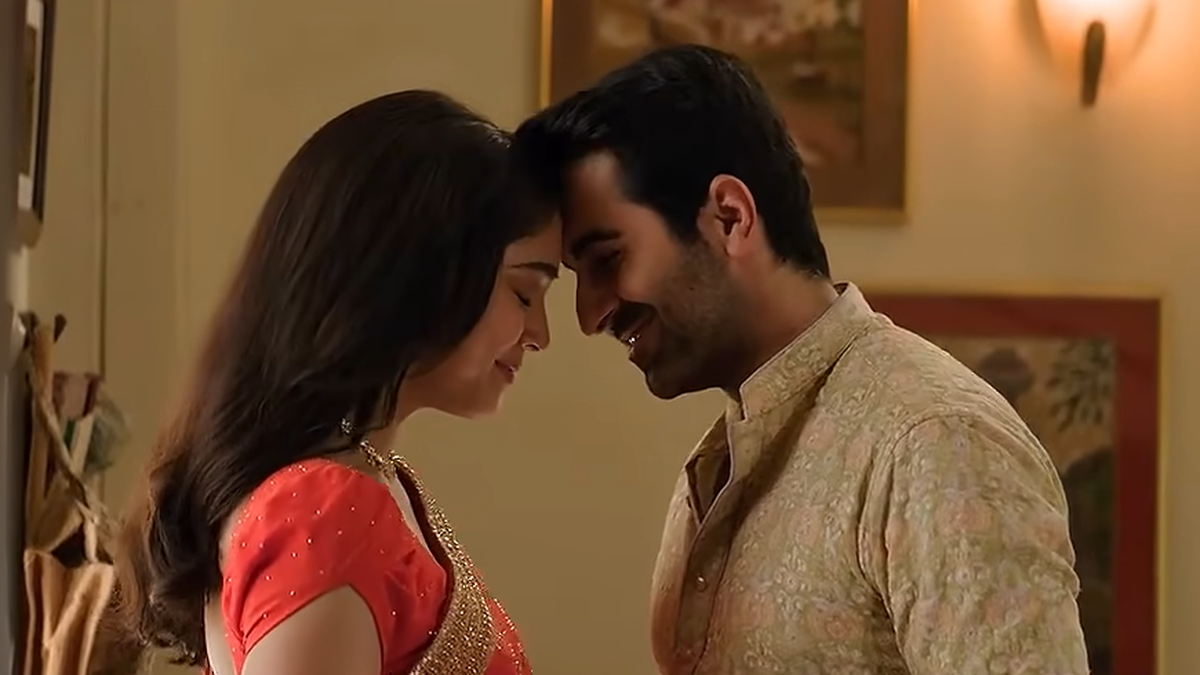
For decades, Hindi cinema has measured a bride’s devotion by the distance she leaves behind at her father’s doorstep. In Yeh Prem Mol Liya, Sooraj Barjatya gently turns that threshold around, asking his conservative audience what happens when love does not demand an uprooting and the age-old border between maayka and sasural dissolves.At a moment when filmmakers are busy expanding what women can be outside the home, Barjatya stages a gentle intervention by reimagining their place within it. Pausing romance’s physical urgency, he lingers on the quiet devotion that makes love whole.Cloaking contemporary relationship pangs in the sugar-coated aesthetics of 1990s family dramas, where even courts somehow have all the time in the world to sit through sprawling flashbacks, the film’s rushed courtship and idealised wholesomeness, pushed through the quaint belief that love follows marriage, initially come across as overly earnest before its sincerity and willingness to challenge marital conventions build into a degree of genuine emotional weight.Yeh Prem Mol Liya (Hindi)Direction: Suraj BarjatyaCast: Ayushmann Khurrana, Sharvari, Anupam Kher, Supriya Pathak, Seema Pahwa, Swanand Kirkire, Geeta AgarwalRuntime: 173 minutesStoryline:When journalist Purva refuses to leave behind the ageing women who raised, Prem convinces his family to move in with her instead leading to a gentle tug-of-war between tradition and modernity.In Barjatya’s universe of families such as Hum Aapke Hain Koun..! and Vivah, marriage typically revolves around the bride leaving her maternal home to adapt to her husband’s household. Here, Purva (Sharvari), a journalist, refuses to leave the six women dependent on her in her ancestral home. She has grown up in the embrace of her daadi (Seema Pahwa) and naani (Supriya Pathak) and doesn’t want to leave them behind in their twilight years.The seemingly last women of a Mumbai mansion searche for a male tenant to take over Purva’s plumbing errands when a young musician walks into their lives with a song on his lips and quiet devotion to their daughter. Prem (Ayushmann Khurrana) persuades his traditional Bihari family, living in a rented accommodation, to move in with her family instead. His grandfather (Anupam Kher) happily breaks with custom, while his caustic father (Swanand Kirkire) digs in his heels, leaving the mother (Geeta Agarwal) torn between a rigid husband and a progressive son.Unlike Salman Khan’s iteration of Prem, who operated largely within patriarchal traditions, Ayushmann’s Prem actively questions societal expectations. By extending the live-in son-in-law dynamic to the family without ego or resentment, the narrative reframes masculinity around empathy, partnership, and adaptability, drawing on cultural tradition to reclaim rituals like Dulhe Raja touching the toran (sacred doorway wall hanging) with a sword at the bride’s doorstep as an act of responsibility rather than conquest.One wonders how smoothly this arrangement would have worked if Purva’s family had a male relative, or if Prem had an ancestral home of his own. True to form, however, Barjatya keeps deeper complications and thorny nuance off his simple syllabus, even when the lesson plan is headlined ‘social change.’Ayushmann infuses Prem with his familiar everyman vulnerability, rendering his progressive choices both endearing and slightly performative. Sharvari steadies the dynamic with quiet resolve, anchoring Purva between traditional duty and gentle defiance. She embodies the spirit of the quintessential Rajshri bahu, even as she nudges the role’s rules. Around them, led by the ever-reliable Geeta Agarwal, a seasoned ensemble plays along predictable yet comforting beats.Once the stage is set, Barjatya slips into nostalgia mode, letting the middle stretch get bogged down by repetitive domestic squabbles over TV remotes, monthly expenses, and kitchen duties – a TV-serial aesthetic that tests patience. While he clearly wants to remind us that the simplicity of yore still holds charm and that stolen moments of romance inside a bustling joint family remain endearing, relying on the same storytelling tools to deliver a modern message doesn’t quite hold.ALSO READ: ‘Gunmaaster G9’ movie review: Emraan Hashmi’s pulpier action-hero turn hits more than it losesPromoted as a Himesh Reshammiya musical, it is strange that Barjatya could not carve out a situation for the title track within the film itself. While a couple of songs genuinely lift the emotional quotient, hearing Reshammiya’s signature nasal twang pass for the voice of Ayushmann Khurrana, a singer in his own right and playing a musician, feels jarring. The passing nods to classics from Saudagar and Chitchor serve as a bittersweet reminder of effortless magic Rajshri Productions used to weave.Yet in between the familiar tropes lie fleeting moments that stir a quiet emotional upheaval. Whether it is Prem and Purva asking each other, “Yeh nahin kiya toh kya hi pyar kiya,” after selflessly standing up for one another. Or the film capturing how every girl silently yearns for her mother-in-law’s nod of grace. The tender beats remind us that when a daughter leaves her home, she arrives at a new doorstep carrying an unspoken void in her heart. It gently wakes us up to both the unseen value and weight of tradition.One agrees with the judge as he observes towards the end, ‘it is a peculiar but relatable case.’Yeh Prem Mol Liya is currently running in theatres
‘Yeh Prem Mol Liya’ movie review: Ayushmann and Sharvari anchor a romance that is radical by half
Full Article
Original Source
Read the full article at Thehindu →KhanList aggregates and links to publicly available news content. We do not host full articles from third-party sources. Always verify important information with original sources.