
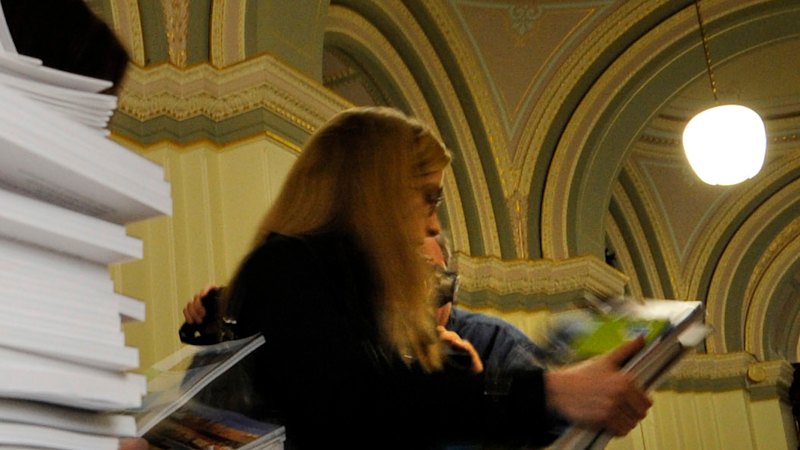
October 30, 2026 — 7:45pmVictoria’s sickest mental health patients are waiting more than a year for a hospital bed and ambulances are reaching priority response targets in just 66 per cent of cases as state parliament’s annual “dump day” reveals the dire state of our health system.The revelations were contained within some of the 192 annual reports and reviews tabled to parliament on Friday afternoon, part of the government’s yearly tradition – which has been criticised for reducing scrutiny on unfavourable documents.Dump day slay: It is an annual tradition for the government to release masses of reports on one day to shirk scrutiny. Penny StephensThe practice has been criticised by integrity advocates, who say deliberately holding back reports until they can all be published at once has no place in a healthy democracy.“Releasing hundreds of reports at once, particularly late on a Friday before a long weekend, acts as a smokescreen and limits accountability,” said Transparency International chief executive Clancy Moore.Here are some of the key takeaways:HealthVictoria’s health and emergency services are under intense pressure from the state’s growing and ageing population.Ambulances are missing key response targets, with just 66 per cent of critical code 1 emergencies responded to within 15 minutes.This is significantly below the benchmark of 85 per cent, but a 4 per cent improvement on the previous year.Ramping also continues to be a problem at the state’s hospitals. Only 71 per cent of patients were transferred from ambulances to emergency departments within 40 minutes, missing the target of 80 per cent.Ambulance Victoria met its 15-minute response time benchmark for code 1 emergencies just 66 per cent of the time. Wayne TaylorAmbulance Victoria revealed that it was exposed to “significant liquidity risk” and had just seven days of available cash, or $30.9 million, in reserves.Triple Zero Victoria is also feeling the heat. Just 80 per cent of code 1 ambulance cases were dispatched within the 150-second benchmark, against a benchmark of 90 per cent.The agency said it was regularly managing more than 3000 ambulance calls a day, with “no relief in sight”.The Royal Children’s Hospital’s grim financial outlook was overturned in June when it received a one-off $12.6 million payment from the Department of Health. It had previously faced a deficit due to employee overheads, overtime and escalating medical supply costs.The health service revealed that it had written off $9.13 million of capital expenditure for an expansion of its emergency department that was suspended in March 2023 after the original design was deemed “not fit for purpose”.Mental healthForensic mental health patients, including those found not guilty of murder and manslaughter due to mental impairment, are waiting a year or more to gain a secure mental health bed as the operators of Thomas Embling Hospital push to try to secure operational funding from the state government to open its new beds.Forensicare revealed it was now dealing with Victoria’s longest delays on record for securing a bed for people found not criminally responsible by reason of mental impairment.Its annual report confirms there are 19 men awaiting admission to Thomas Embling, with an average wait of 374 days. One severely unwell man has been waiting 638 days.The 136-bed forensic mental health hospital is undergoing a $515.7 million expansion to eventually deliver an additional 82 secure beds. However, it has so far only been provided funding to begin opening 40 beds this financial year.Faced with high rates of mental illness among people entering custody and intensified pressure following bail changes, an average of 16 people a month were recommended for compulsory treatment at Thomas Embling last year. Only half of those were able to be admitted, due to capacity constraints.There were more than a dozen instances of occupational violence and aggression a week reported during the first year of operation at Victoria’s flagship new youth mental health service. Staff at the troubled Parkville Youth Mental Health and Wellbeing Service reported 634 violent incidents last year – meaning there were 135 incidents reported for every 100 full-time equivalent staff.In its annual report, the newly established youth mental health service acknowledged it had a high rate of reported hazards and incidents – of which 92 per cent related to violence and aggression – which it put down to a strong culture of reporting.“The rate of incident reporting across [Parkville Youth Mental Health and Wellbeing Service] during the year reflects strong staff engagement with reporting processes rather than high levels of workplace risk or incidents,” it said.In August, The Age revealed strong concerns by senior clinicians at the service, including claims of rising violence, an exodus of staff and widespread drug use in secure wards. Those concerns came after four people forced their way into the reception area at the service’s Sunshine campus and assaulted two people and fled before police arrived.The service stated it was now permanently relocating its Sunshine services to a new “safe, fit-for-purpose environment” in Spotswood.FinanceSince the May budget, the state government has committed $2.75 billion to fund previously unannounced policies over the next four years, far surpassing savings identified over the same period.This included $275 million to support hospitals and patients, $164.6 million for additional PSOs and police reservists, and $50 million for the royal commission into the Big Build. Just $471 million was identified in savings.“That’s not what one would reasonably expect of a government which saw putting Victoria’s finances on a sustainable footing as a major priority,” economist Saul Eslake said on LinkedIn.Some $5.1 billion has been wiped off the government’s revenue over the forward estimates, mainly due to falling house prices slashing expected income from stamp duty.The government recorded a $2.7 billion surplus, according to an annual financial update published earlier this month, largely due to higher-than-expected income from Commonwealth grants.But surpluses over the forward estimates, which started at $1 billion a year when outlined in May, have been pared back to as low as $300 million.Economist Saul Eslake.Alex EllinghausenThe Victorian Auditor-General in a separate report tabled on Friday warned that blowouts, interest payments and employee costs continued to threaten the government’s plan to pay down debt and repair the state’s finances.The auditor-general said current fiscal strategy was focused on the short term, and recent attempts by the government to address debt “do not go far enough”.Greater Western WaterBeleaguered utility Greater Western Water will receive a $250 million lifeline from the Victorian government if needed over the next year as it continues to post deficits created by its botched IT upgrade.The utility launched an upgraded billing system in May 2024, but it couldn’t create bills automatically, leading to major delays and incorrect bills.The 2025-26 annual report for Greater Western Water reported a $202.5 million operating cash loss over the last financial year, largely driven by revenue it lost because of these issues and the cost of fixing their billing system.In 2024-25, it posted an operating cash loss of $191.7 million.To support its recovery, the Victorian government has approved $250 million in equity funding for 2026-27, contingent on need and the organisation’s financial performance.The number of customers on flexible payment plans has risen by 23 per cent, to 35,669 households. Complaints about payment issues rose by 48 per cent and now represent one in every 100 customers.Australian Grand PrixVictorians subsidised the Australian Grand Prix a record $119 million this year, up from $102 million last year.The Australian Grand Prix Corporation’s annual report shows the grand prix brought in $159 million in revenue but spent $279 million, leaving a shortfall of $119 million for the Victorian government to pick up.In March, The Age reported taxpayers were on the hook for an extra $115 million to rebuild the Formula 1 pit facilities at Albert Park after asbestos was discovered in the building – pushing the total cost of upgrades to $395 million.EducationChild safety has been a major focus of the Department of Education over the past 12 months, according to its secretary, Dr David Howes.It delivered changes in line with the rapid child safety review, which began after more than 70 charges of child abuse were laid against a former childcare worker Joshua Brown in 2025.It also launched the Victorian Early Childhood Regulatory Authority (VECRA), which started operating in January this year.“We have also developed clearer guidance for all Victorian schools on identifying and responding to child abuse, including grooming,” Howes wrote.There were 876 reportable allegations made, with 307 claims of physical violence in Victorian government schools and early learning centres.During its first six months, VECRA issued 15 prohibition notices and six suspension directions, a total of 21 actions aimed at preventing potentially unsuitable individuals from working in early childhood services.And Victoria’s Institute of Teaching suspended 29 teachers on an interim basis for teachers assessed as posing an unacceptable risk of harm to children.There were 67 school upgrades in the previous financial year, with an additional 205 major capital projects under way and due to be completed by late 2029.Get the day’s breaking news, entertainment ideas and a long read to enjoy. Sign up to receive our Evening Edition newsletter.From our partners
Years-long waits for hospital beds and missed ambulance targets: The secrets revealed in 192 documents quietly released
Full Article
Original Source
Read the full article at Smh →KhanList aggregates and links to publicly available news content. We do not host full articles from third-party sources. Always verify important information with original sources.