
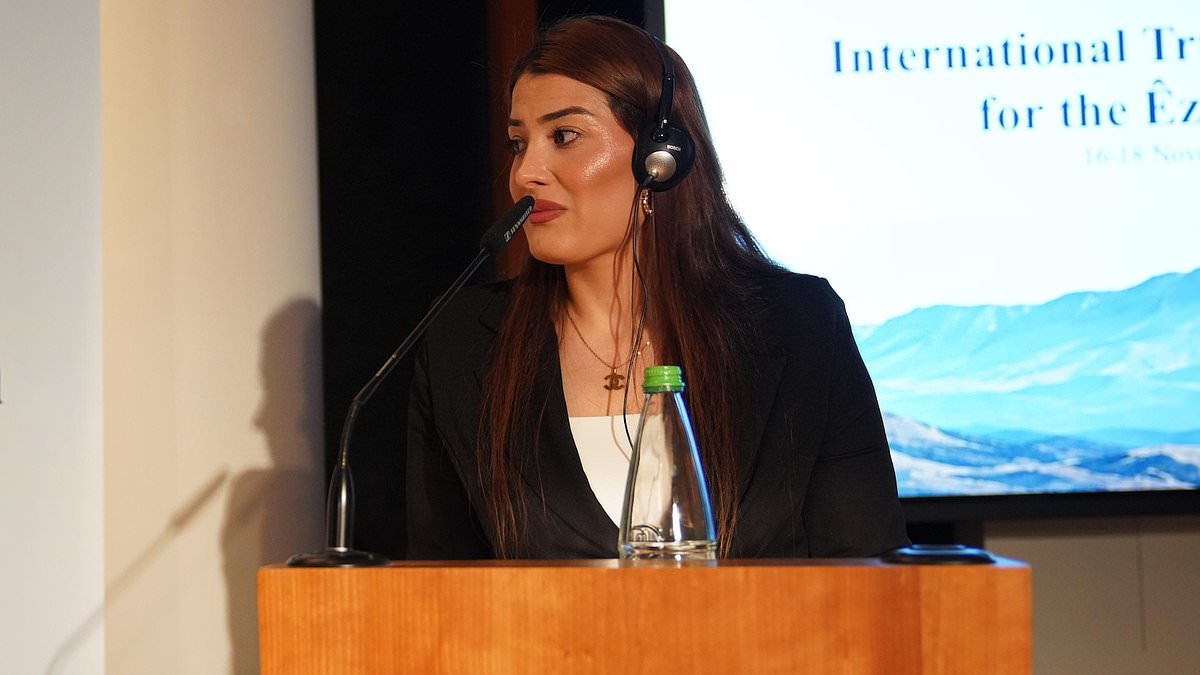
Sameera Alsilo was just 15 years old when she was snatched from Iraq to Syria and made to work as a sex slave.Feared ISIS leader Abu Bakr al-Baghdadi handed her to his 70-year-old father-in-law as a 'gift'. He tortured and raped her until she 'couldn't take any more'.Now 27, she has described how the ISIS leader personally selected her from a group of seven Yazidi women held captive in a Syrian prison, before taking them to a house where he lived with his three wives.She says he told one of his wives 'that the girls should shower because they smelled of Yazidism'. She was subsequently passed between ISIS fighters, enduring repeated rape, beatings and abuse.In one of the homes of her captors, he had a photo of himself with a severed head.Another survivor, Ekhlas Bajoo, was just 14 when she was taken to a slave market and forced into sexual slavery after being purchased by a 34-year-old man.She previously told the UN that she was ‘raped, beaten and humiliated’ every day.She said the abuse became so unbearable that she begged her captor to kill her, but he allegedly told her that death was too good for Yazidis. Sameera Alsilo delivered harrowing testimony at a first-of-its-kind Truth Commission in Berlin on Monday, in a landmark bid to secure justice for the Yazidi people Another survivor, Ekhlas Bajoo, was just 14 when she was taken to a slave market and forced into sexual slavery after being purchased by a 34-year-old man Women and children walk at Camp Roj, where relatives of people suspected of belonging to the Islamic State (IS) group are held, in the countryside near al-Malikiyah (Derik) in Syria's northeastern Hasakah province, on March 28, 2021 The extraordinary allegations have emerged as Sameera, Ekhlas and around 30 survivors gather in Berlin on Monday to give harrowing testimony at a first-of-its-kind Truth Commission, in a landmark bid to secure justice for the Yazidi people.Their accounts describe the horrors inflicted by ISIS: people slaughtered because of their Yazidi faith, children snatched from their mothers' arms, girls and women sold into sexual slavery and trafficked between fighters, and boys forced to train as child soldiers.Twelve years later, thousands of devastated Yazidi families are still waiting for news of their missing children, sisters and mothers.The atrocities formed part of one of the most horrific campaigns of genocide carried out by Islamic State, which swept through Iraq and Syria in 2014, massacring an estimated 5,000 Yazidis and enslaving an estimated six thousand more.On June 29, 2014, ISIS leader Abu Bakr al-Baghdadi declared a so-called Islamic caliphate across territory controlled by the group in Iraq and Syria. The organisation carried out public executions, persecuted religious minorities and used terror to control civilian populations.Al-Baghdadi had taken over leadership of the Islamic State of Iraq (ISI) in 2010, later expanding the group into Syria and rebranding it as ISIS, also known as ISIL.He died in October 2019 after detonating a suicide vest during a US special forces raid in Syria ordered by President Donald Trump.After giving evidence to the commission, Sameera, 27, spoke to the Daily Mail about her captivity and her encounters with al-Baghdadi.'I was in a prison in Syria. I had been brought from Iraq. We were in the prison for about a week, and then one evening al-Baghdadi arrived with many other ISIS fighters,' she said.She described how he wore black, his face was completely covered and she could only see his eyes. 'He selected seven women, including me. Then he told us to go outside. They took us to another apartment where nobody was living,' she said.The captives were transferred to a neighbouring house, where al-Baghdadi was present with his three wives. 'That very evening, when he selected us, we went over there. Then he uncovered his face, so we could see him. I recognised him from his eyes. He was the same person who had selected me from the prison.'I had seen a leaflet in Mosul, in the hall where we were at the beginning. There was a picture of him on it, wearing the same clothes he had on that evening when he took us away.'On Sameera's first day in the house, al-Baghdadi told the women they could not sleep and that they would have to pray until 5am in the morning.'He told his wife that the girls should shower because they smelled of Yazidism,' she said.'He told us to pray. He read verses from the Quran and we had to repeat them. Then at five o'clock in the morning he stopped and said: "I'm going to sleep."' Ekhlas previously told the UN that she was ‘raped, beaten and humiliated’ every day Displaced Yazidi people from Sinjar flee violence from ISIS in August, 2014Sameera recalled how an aircraft subsequently bombed two nearby houses, prompting an angry reaction from neighbours who blamed the presence of the captive Yazidi girls.They told the household: 'You have the unbelievers in your house. That's why we're being bombed by aircraft.'The captive women, al-Baghdadi with his three wives fled the house to another property, owned by his relatives.'We stayed there for a week. Every day he sent his wives to us, and they prayed with us five times a day.'He kept coming upstairs and taking Yazidi girls away. The girls he took never came back,' Sameera said.She describes one day when there were only two of the girls left. Al-Baghdadi told them to go downstairs.'There were two ISIS fighters downstairs. One was about 30 or 35, and the other was in his mid-70s.'They asked us how old we were. I was 15 and the other girl was 16.'The older man said he wanted the younger one. Then al-Baghdadi said: "I am giving you Sameera as a gift."'Sameera said the older man was related to al-Baghdadi through marriage, with his daughter reportedly being the ISIS leader's youngest wife, Nour.The man took Sameera 'far out in the desert'.'During the entire drive to his house, he touched me, insulted me and hit me. I started crying and asked him what I had done and why I deserved this,' she said.'He said I was his property, his slave, and he could do whatever he wanted with me.'Sameera said she remained in the man's captivity for approximately two months, during which she was subjected to repeated violence and rape.'His entire family treated me like dirt, even his children.'When we arrived at his house, his youngest wife asked whether I was a Yazidi slave. He replied: "Yes, she's a Yazidi slave."'The cruellest thing he did was rape me, despite all my efforts to fight him and run away.'She testified that he broke her jaw and she was threatened with gang rape if she didn't do what he said.'He smashed my head and face against the stairs...I fainted,' she testified.'There came a point when I couldn't fight anymore because I was only 15. He was big, tall and strong. The last drop of energy left me, and I couldn't do it anymore,' she told the Daily Mail.'He tortured me and raped me until I couldn't take any more.'In the end, I was like an object that was no longer needed in the house. Then he sold me on.'She identified the man who held her as Abu Ali and said he eventually sold her to another ISIS fighter called Abu Zarqawi whom she described as being from Australia.She insists she would always be able to recognise him and that he had a wife and five children, who had all joined ISIS.'Abu Zarqawi used me as protection for himself. He also used me as a slave and raped me. He used me as a human shield. Whenever he left the house, wherever he went, he took me with him,' Sameera said.'I asked him why he did that. He said: "If I take you with me, then the aircraft can't bomb me."'She was then sold again.Despite the years that have passed, Sameera said her overriding hope remains that those responsible for the atrocities will finally face justice.'I want to feel one day that these people have been punished for the crimes they committed,' she said.She also spoke of the anguish endured by families who still have no idea what happened to their missing relatives, including three of her own cousins, whom she does not know whether they are still alive.'There are still more than 2,600 women and children in ISIS captivity, even though some people say ISIS no longer exists, that somehow it isn't there anymore.'I believe ISIS is still enslaving and abducting people, because otherwise so many people wouldn't still be missing.'In another harrowing testimony, the commission heard how a Yazidi girl was torn from her mother and subjected to repeated sexual violence while in ISIS captivity.Aged 14, she described being bound and raped after which she tried to take her own life.The abuse continued for months, and she became pregnant. Following a failed escape attempt, she was hung upside down and beaten with a stick.She eventually managed to break the lock of the place where she was being held and flee. She lost her baby and was covered in blood, but her friends helped carry her until they reached safety on the mountain, where she was reunited with her family.Another survivor, Aradwan Abdem, 26, was just 14 when ISIS fighters stormed his village and took his entire family captive. Islamic state fighters on the border between Syria and Iraq During his six months in captivity, Aradwan Abdem witnessed killings, the enslavement of women and girls, and the indoctrination of boys who were forced to train as fightersSeparated from his parents, he had no way of knowing whether they were alive, while they had no idea what had happened to him.Speaking to the Daily Mail, he recalled the ordinary childhood he had enjoyed before the genocide shattered his family's life.'Before Islamic State, before the genocide, we were living an ordinary life, and I was a child. I had friends. We were financially okay. We had a house. We were together, and we were basically just happy with our life, living and playing as kids, going to school, all this before Daesh,' he told the Daily Mail.Daesh is another term for the Islamic State.As ISIS advanced towards his village in the south of Shingal, the family attempted to flee towards the mountains, where thousands of Yazidis were seeking refuge.'On a zigzag road, three cars of Daesh came and stopped us from getting into the mountain. They brought us to a prison in Shingal, and then they transferred us to the neighbouring town.'Then they took us to Mosul, and then they brought us back to Tel Afar, and Tel Afar was where I managed to escape.'His parents and other family members had also been taken captive, but they managed to escape before him.During his six months in captivity, Aradwan witnessed killings, the enslavement of women and girls, and the indoctrination of boys who were forced to train as fighters.Describing the horrors he witnessed, he said: 'Within the six months, I saw they were killing people, and they took women. They were raping women. They were selling and using women in slave markets.'He said the ISIS fighters considered Yazidis non-believers, which legitimised their killing, raping and imprisonment.'On my side, as a boy in captivity, we were trained how to use weapons and how to fight. We were taught religious ideology, and sometimes we had no food, so it was a miserable situation under harsh conditions,' he said.The psychological impact of what he witnessed has remained with him long after his escape.'I was separated from my family, my father and my mother. I witnessed crimes. I witnessed people being killed, and as a young person at that time, it is still impacting me psychologically. It stays with me.'Aradwan eventually escaped in February 2015, aged 15, after his uncle managed to contact a smuggler operating inside ISIS-controlled territory.Later that year, he was resettled in Europe under a special programme for survivors. Speaking to the Daily Mail, Aradwan recalled the ordinary childhood he had enjoyed before the genocide shattered his family's life'I am working and attempting to try to restart my life,' he said.His message to the international community was simple: 'We are a minority community. We should not be forgotten.'The survivors are among those giving evidence over three days at the Truth Commission in Berlin, where victims, some with their identities withheld for protection, are recounting atrocities including murder, torture, rape, sexual slavery and forced marriage.Their testimony is being heard by seven international commissioners, including Nobel Peace Prize laureate Oleksandra Matviichuk, former UN human rights chief Navi Pillay and leading British lawyer Baroness Helena Kennedy KC.The commission aims to expose the failures that have left thousands of victims without justice and to increase pressure on governments to bring those responsible to account.A central demand from survivors is the establishment of an international tribunal capable of prosecuting those responsible for the crimes committed against the Yazidi people.Despite international recognition of the genocide, efforts to secure accountability have been limited.The United Nations concluded that ISIS had committed genocide against the Yazidis. In 2017, it established the UN Investigative Team to Promote Accountability for Crimes Committed by Da'esh/ISIL (UNITAD), but it ended in 2024.Helena Kennedy, the commission's head commissioner, said the closure of the investigative body reflected the wider failure to deliver justice.'International recognition of this genocide has not been matched by accountability, and the dismantlement of UNITAD in 2024 as the principal mechanism for investigating these crimes reflects this,' said head commissioner Kennedy, a Scottish barrister.
Yazidi girls abducted as ISIS sex slaves aged 15 reveal horrors they endured: One was raped and tortured by man, 70, for months, another hung upside down and beaten while pregnant
Full Article
Original Source
Read the full article at Dailymail →KhanList aggregates and links to publicly available news content. We do not host full articles from third-party sources. Always verify important information with original sources.