
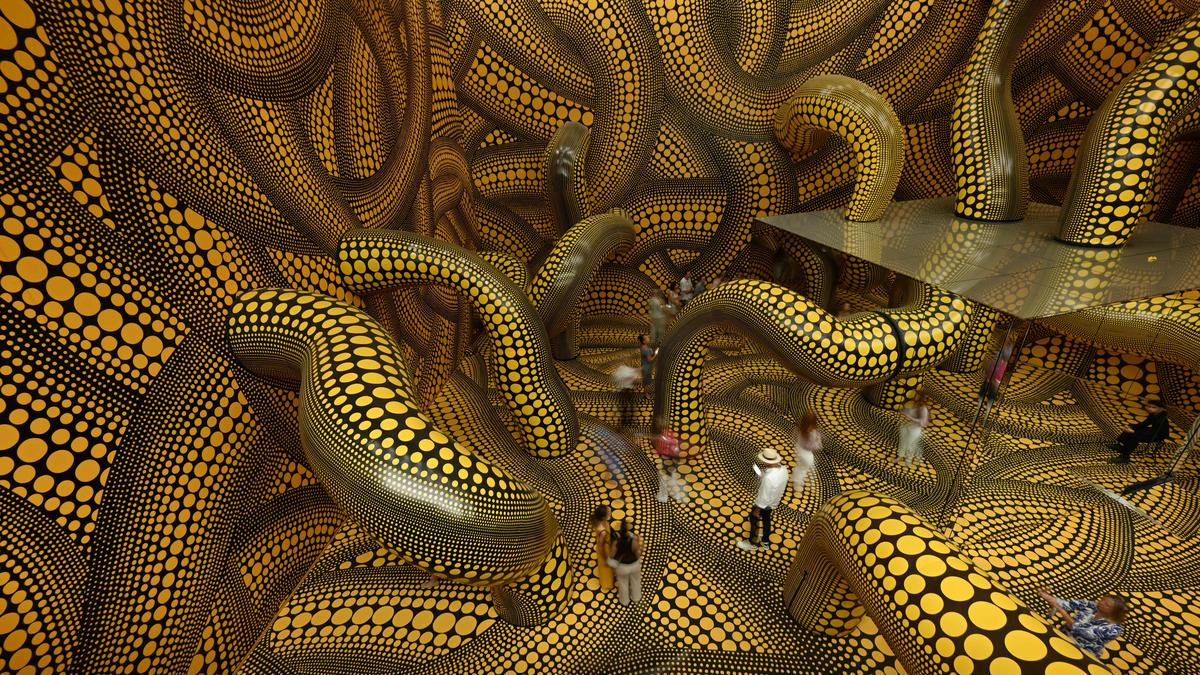
I have this memory of walking into a Yayoi Kusama Infinity Mirror Room in Mumbai’s NMACC back in 2024, when it had just opened. You purchased a nominal ticket, queued up, and had about 20 minutes of viewing (immersing) time, surrounded by glowing lights, mirrors, no beginning and no end. You kind of felt like you were floating between room, floor, mirror, and light. Then you came back out of the black box, into reality, after being consumed by what felt like the cosmos. “Our earth is only one polka dot among a million stars. Polka dots are a way to infinity,” the late Japanese artist once said. The Yayoi Kusama Infinity Mirror Room at NMACC A polka dot, an almost cheerful, innocuous thing — hardly the obvious starting point for ideas about infinity, disappearance or the universe — became a preoccupation of Kusama’s. She spent a lifetime making the dot carry far more than decoration. It spread across her paintings, climbed over giant pumpkins in parks, covered bodies and rooms, and multiplied endlessly in mirrored spaces. In her world, the simplest of shapes could open out into something much larger, a way of thinking about where the self ends and everything else begins. Artist Yayoi Kusama poses inside her Infinity Mirrored Room installation titled The Souls of Millions of Light Years Away in New York | Photo Credit: REUTERS The dot, of course, has its own long art history, from the optical illusion of Pointillism to S.H. Raza’s meditative Bindu, Damien Hirst’s regimented spots and John Baldessari’s bright circles obscuring faces. Closer home, Bharti Kher has made the bindi a recurring motif.Private made universalOver a career spanning more than seven decades, Kusama developed a distinct artistic language rooted in these concepts. “She explored them consistently across different mediums and decades,” says Doryun Chong, artistic director and chief curator of M+ in Hong Kong. The museum’s exhibition, Yayoi Kusama: From 1945 to Now, co-curated by Chong four years ago, was the largest retrospective of the artist in Asia outside Japan, and explored the more Eastern philosophical undertones of her works. Particularly of the Buddhist concept that speaks to transcending the self, and embracing a more open and inclusive relationship with others and the world around us. Doryun Chong, artistic director and chief curator of M+ in Hong Kong Her predilection for some of these motifs in her works stemmed from her own upbringing and interior world. Born in Matsumoto, Japan, in 1929, she grew up near her family’s plant nursery and spoke often of childhood hallucinations in which flowers, patterns and dots seemed to spill beyond their edges.Then there were the more tumultuous inner conversations, mired by a complicated home life. She later wrote and spoke about her father’s infidelities, her mother’s volatility, and an early discomfort around sex that would eventually find its way into her work (furniture covered in soft, stuffed phallic forms). Crippled by anxiety and depression, the urge to create circles on everything from soft sculptures (she learnt sewing growing up making military parachutes during war time in Japan), to sketches of her mother (made at the age of 10), and later, drawn on naked bodies, animals, and of course nets and pumpkins, was the artist’s way of overcoming her anxious mind. Kusama’s Self ObliterationBut by doing so, Kusama showed her unusual gift for taking something intimate — fear, obsession — and giving it a shape other people could enter. “I think the more personal an artist is, the more universal the work can become,” says designer Vikram Goyal, an early admirer of Kusama’s artworks. “When an artist creates from a place of honesty rather than trying to appeal to everyone, the work often finds a much wider audience.” And therein lies Kusama’s ability to proliferate mass culture as much as rooms occupied by high art. “There is a real depth of engagement with contemporary art in India, and Kusama’s work seems to resonate especially strongly with Indian audiences [through its exploration of infinity, repetition, spirituality and the relationship between the individual and the universe].”James GreenAssociate partner and head of London, David ZwirnerThe artist as imageIt is also perhaps why her ideas were unable to remain contained, and needed to travel across mediums. Kusama moved restlessly between painting, sculpture, installation, performance, film, literature and fashion. Who can forget her collaboration with French luxury fashion house Louis Vuitton in 2012, and then again in 2023. Her dots scattered across Neverfulls and Speedy bags, and the design and doors of entire flagship stores. She had a fashion company selling radical garments in New York in the 1960s. Think hand-painted nets and dresses with strategically placed cut-outs. She’s even written poetry, made films, and performed art (in the early days of her career). An installation of Japanese artist Yayoi Kusama peering over the Louis Vuitton flagship store on Champs Elysees avenue in Paris | Photo Credit: AP What is especially fascinating is how unapologetically Kusama wanted to be seen. Writing letters to then another rare fellow woman artist, Georgia O’Keefe, Kusama arrived in the U.S. via introductions from the American artist. New York was hardly easy. Kusama wrote of surviving on a diet of potatoes, onion and black coffee, and often being the only woman in any group, let alone the only woman of colour. “I think we underestimate how much scope sits in the simplicity of a circle, and how it can become a signifier based on what context it is placed in. For her [Kusama], the polka as form was like a challenge to see the possibilities of what can be done with it, and how a whole world can be created from it. For us, it began as a graphic decision and turned into a value.”Gursi SinghCo-founder of contemporary fashion label Lovebirds, which also works with polka dotsWhat I find most intriguing is how unapologetically she pursued fame. In an age that treats self-fashioning as second nature, that instinct was perhaps remarkably contemporary — and may be part of why Gen Z recognises something of its own culture in her (she was one of Instagram’s favourite artists). She fashioned herself into an image of red wig and polka dots. At the 1966 Venice Biennale, despite not being officially invited to exhibit, she installed Narcissus Garden — 1,500 mirrored spheres on the grass — and, dressed in a gold kimono, sold them under the sign ‘Your Narcissism for Sale’. It was self-promotion and a critique of the art market, neatly tied into one. By 2019, Kusama was being described as the world’s top-selling living female artist.Before ‘viral’ was a wordHer work has long occupied that unusual space between serious contemporary art and mass cultural phenomenon. “It’s a tension I find genuinely interesting rather than uncomfortable,” says Fatema Oomerbhoy, art advisor and cultural strategist, who was part of the NMACC team involved in bringing Kusama’s work to Mumbai. “The work has always possessed a fantastical, almost hallucinatory quality — one reason it can be so compelling on a phone screen.”It is a sentiment Jaya Asokan, director of India Art Fair, recognises too. Ultimately, Kusama has to be experienced. At the 2026 art fair, the artist’s work, brought to the halls via international gallery partner David Zwirner, drew serious collectors, students and families. The monumental polka-dotted pumpkin, spotted from across the hall, had everyone gravitating towards it, almost instinctively. “There is an accessibility to her work that I think is very powerful,” says Asokan. “I don’t think we should underestimate the importance of that immediate visual connection.” Yayoi Kusama’s PUMPKIN (2015; stainless steel and blue urethane paint) at the India Art Fair earlier this year | Photo Credit: Courtesy India Art Fair And this is true. As Chong notes, Kusama’s art has the ability to bend the traditional notions of art, viewer and space. Where does the artwork begin and where does the viewer end is something she deliberately flipped the script on. In London’s Regent’s Park, I’ve witnessed the giant yellow pumpkin — as you walk closer, you are part of the pumpkin, you are a polka dot. Depending on where you view it from, it’s a pumpkin on a park’s pumpkin patch, or it is meeting the blue sky overhead. The Kusama pumpkin at London’s Regent’s Park | Photo Credit: Akanksha Kamath “A Kusama has an extraordinary ability to create that first moment of connection,” concludes Chong. “The colour, repetition, scale and recognisable forms draw people towards the work, and then there is an opportunity to discover the much longer and more complex practice behind it.”The writer is an independent journalist based in London, writing on fashion, luxury and lifestyle.
Yayoi Kusama: the woman behind the infinite dots
Full Article
Original Source
Read the full article at Thehindu →KhanList aggregates and links to publicly available news content. We do not host full articles from third-party sources. Always verify important information with original sources.