
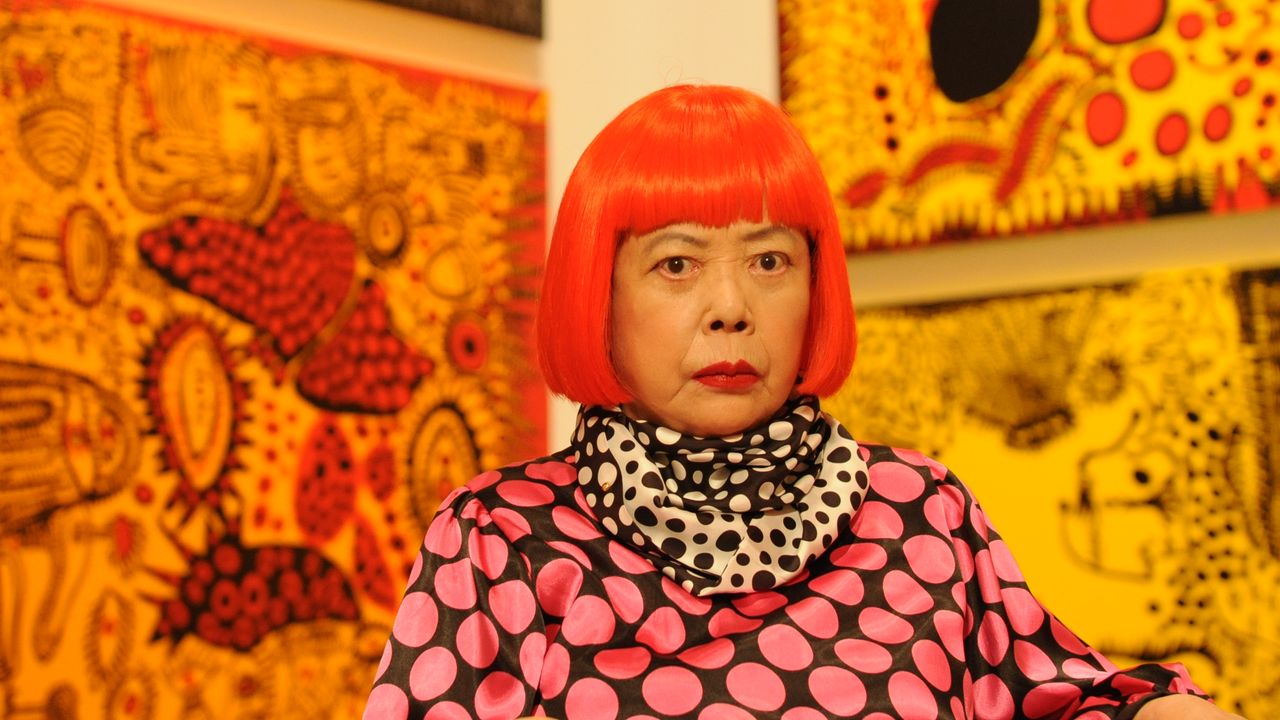
Yayoi Kusama, the Japanese contemporary artist internationally renowned for her polka dots, pumpkin sculptures, and Infinity Mirror Rooms, has died at the age of 97. A statement published yesterday on the artist’s website announced that the creative had passed away on August 14 at a Tokyo hospital.Born in Matsumoto in 1929, Kusama spent her childhood working in a military factory, where she sewed parachutes for Japan’s Imperial Army during World War II. As she grappled with an abusive household, she began to experience hallucinations, her vision flooding with the polka dots that would one day become her artistic signature.Kusama was famous for her polka dot motif. Photo: Jose-Fuste RAGA/Gamma-Rapho via Getty ImagesAfter briefly studying the nihonga style of painting in Kyoto, Kusama immigrated to America in 1958 at age 27. She began experimenting with her Infinity Net paintings, which depicted her hallucinations through layers of frenetic loops. Inspired by Abstract Expressionism, Kusama’s meticulous brushstrokes—which she sometimes painted for 60 hours straight—subverted the gestural processes of the movement’s male pioneers. The collection, which translated her mental health battles into a universal visual language, became her largest and most renowned body of work. “I was always standing at the center of the obsession, over the passionate accretion and repetition inside of me,” she wrote in her 2011 University of Chicago Press autobiography Infinity Net: The Autobiography of Yayoi Kusama.Kusama’s exploration of the infinite would evolve into three dimensions in 1965 with the debut of her Infinity Mirror Rooms, which offer an entry into Kusama’s mind. Exhilarating, sublime, and unsettling, these installations—which often incorporate polka-dot balloons, pumpkins, LED lights, and soundtracks—immerse the viewer in infinite reflective surfaces, exploding even small spaces into endless expanse. Her Infinity Mirror Rooms sent ripples all throughout the design world, shaping experiential design in contemporary museums, galleries, hospitality spaces, and interiors.The Instagram-friendly artist's work will be on view at two David Zwirner galleries in New YorkAs she became a key figure of the avant-garde in the 1960s, exhibiting alongside Andy Warhol, Donald Judd, and Claes Oldenburg, Kusama expanded beyond painting and installation into soft sculpture, surreal film, literature, and performance, transcending genre and challenging the boundaries of Pop Art and Minimalism. She emerged as a leading voice in 1960s counterculture, staging “happenings” wherein she painted naked bodies, including her own, into dotted canvases as political statements. At one such happening, the Church of Self-Obliteration, she hosted events promoting the sexual revolution and challenging heteronormative social structures. At another, she distributed her Letter to Nixon, writing, “You can’t eradicate violence by using more violence,” and offering him sex in exchange for ending the Vietnam War.Narcissus Garden has been installed in Miami’s Rubell MuseumKusama returned to Japan in 1973. She voluntarily checked herself into Seiwa Hospital for the Mentally Ill in 1977. The facility would be her home and art studio for the rest of her life. In the 2000s, Kusama’s work rose dramatically in value, amassing $190.5 million at auction in 2023 alone. Her Infinity Mirror Rooms have been exhibited at museums and galleries worldwide, from London’s Tate Modern to Crystal Bridges in Arkansas, while her David Zwirner exhibitions have drawn multi-hour lines and gone viral on social media. Kusama’s popularity continued to surge in the 2010s and 2020s, with her ubiquitous pumpkin sculptures as well as with fashion collaborations, including two with Louis Vuitton. Deep into her 80s and 90s, she remained one of the most trailblazing names in fashion, design, and art.Kusama’s “All the Eternal Love I Have for the Pumpkins,” part of the “LOVE. Contemporary Art Meets Love” exhibition in Rome, 2016. Photo: Xinhua/Jin Yu via Getty ImagesThe Japanese artist’s immersive Infinity Rooms and other whimsical works resonate for millions coast-to-coastAs a Japanese woman challenging the male-dominated, Western-centric postwar art establishment, Kusama paved a path for diverse global voices to gain elite institutional acclaim. “She continued to paint until her final days,” per the statement on her website, “never setting aside her brush, and continued exploration of forever love and eternal soul.”
Yayoi Kusama, Avant-Garde Icon, Has Died
Full Article
Original Source
Read the full article at Architecturaldigest →KhanList aggregates and links to publicly available news content. We do not host full articles from third-party sources. Always verify important information with original sources.