
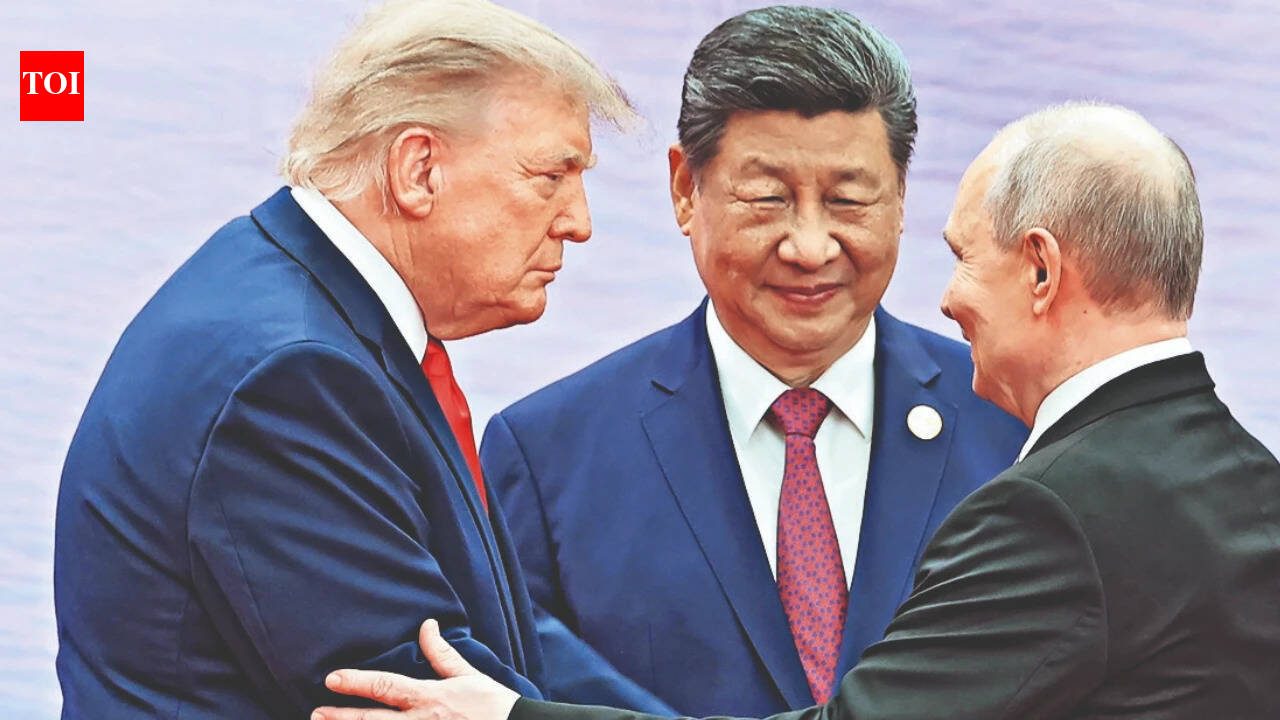
Trump greets Putin and Xi before a welcome banquet in ShenzhenIn a meeting that could reshape the global geopolitical order, US President Donald Trump, Chinese President Xi Jinping and Russian President Vladimir Putin are set to hold historic trilateral talks in China on Thursday, bringing together the leaders of three of the world's most powerful countries at a time of escalating international tensions.The meeting on the sidelines of the Asia-Pacific Economic Cooperation (APEC) summit in Shenzhen comes against the backdrop of two ongoing wars, the expiration of a key US-Russia nuclear arms control treaty, growing competition over artificial intelligence (AI) and unresolved trade disputes. The discussions could also test whether personal diplomacy between the three leaders can translate into concrete agreements on some of the world's most pressing security challenges.The gathering has drawn comparisons with the 1945 Yalta Conference, when the leaders of the United States, the Soviet Union and Britain came together towards the end of World War II to discuss the defeat of Nazi Germany and the political future of post-war Europe. However, unlike Yalta, where the three Allied powers were negotiating the future of a continent devastated by war, the Shenzhen meeting brings together leaders whose countries are competing for influence across multiple regions.The symbolism is particularly striking. Nearly eight decades after the Yalta Conference, the leaders of Washington, Moscow and Beijing are meeting at a time when the international system is increasingly shaped by great-power rivalry, competing security interests and questions over the future of the existing global order.Trump, who has repeatedly projected himself as a dealmaker capable of negotiating with rival leaders, has presented the meeting as an opportunity to discuss nuclear arms control and explore ways to end the wars in Ukraine and Iran. However, expectations of an immediate breakthrough remain limited, with major differences separating the three countries.From Yalta to Shenzhen: Are three powers preparing to shape the world order?The comparison with Yalta is rooted in the strategic importance of the three countries represented at the meeting and the possibility that decisions taken by their leaders could have consequences far beyond their borders.The Yalta Conference, held from February 4 to 11, 1945, brought together US President Franklin D Roosevelt, Soviet leader Joseph Stalin and British Prime Minister Winston Churchill in Crimea. The meeting took place as the defeat of Nazi Germany became increasingly inevitable.The three leaders discussed the final military campaign against Germany, the occupation of the country after its surrender, the establishment of the United Nations and the political restructuring of Europe. They also reached understandings on the division of Germany into occupation zones and the Soviet Union's role in the post-war European settlement.However, the agreements also exposed competing visions for Europe's future. Differences over the political direction of Eastern European countries, particularly Poland, contributed to tensions between the Western powers and the Soviet Union. These disagreements eventually became part of the broader confrontation that developed into the Cold War.The Shenzhen meeting is not a formal equivalent of Yalta. The geopolitical circumstances are different, and there is no indication that the three leaders intend to negotiate a comprehensive division of territories or spheres of influence.Nevertheless, the presence of the American, Russian and Chinese presidents at the same table carries considerable strategic weight. Together, their countries possess the world's largest nuclear arsenals, hold permanent seats on the United Nations Security Council and exercise considerable influence over international security, trade, technology and energy markets.The central question is whether the meeting will produce a framework for cooperation or reinforce the idea that global affairs are increasingly being shaped through negotiations among major powers, sometimes without the direct participation of countries most affected by their decisions.Nuclear arms control: Can Trump bring Washington, Moscow and Beijing together?Nuclear arms control is expected to be one of the most consequential issues discussed during the meeting.The last remaining nuclear arms control treaty between the United States and Russia, known as New START, expired in February 2026. The agreement placed limits on the two countries' deployed strategic nuclear warheads and delivery systems and provided mechanisms for transparency and verification.Its expiration has removed a key framework governing the world's two largest nuclear arsenals.Trump has expressed interest in negotiating a new agreement that would include China alongside Russia and the United States. He has described his proposal as a "new, improved and modernised" deal.However, bringing Beijing into a trilateral nuclear arms control framework presents a major challenge.China's nuclear arsenal is estimated to contain more than 600 warheads, considerably fewer than the more than 5,000 warheads believed to be held by each of the United States and Russia. Beijing has therefore been reluctant to accept restrictions designed around the much larger arsenals of the other two countries.From China's perspective, agreeing to numerical limits at its current level could constrain its ability to expand its nuclear deterrent while Washington and Moscow retain substantially larger stockpiles.For the United States and Russia, meanwhile, the absence of a binding framework raises concerns about transparency, strategic stability and the possibility of an unrestricted nuclear competition.Daryl Kimball, executive director of the Arms Control Association, said Trump's diplomatic initiative could potentially provide the starting point for more sustained negotiations, but warned against expecting immediate results."We need more than diplomatic theater and photo opportunities between Xi, Putin, and Trump at APEC," Kimball said. "And one meeting will not likely produce dramatic breakthroughs."The challenge is therefore not simply bringing the three leaders together. It is finding common ground between countries with different nuclear capabilities, strategic priorities and perceptions of security threats.Ukraine and Iran wars: Can three leaders negotiate an end to two conflicts?The wars in Ukraine and Iran are also expected to feature prominently in the discussions.Trump has indicated that he wants to use his relationship with Xi and Putin to explore ways of ending both conflicts. Kremlin foreign affairs adviser Yuri Ushakov said Putin, Trump and Xi would likely discuss the war in Ukraine, although the agenda had not been finalised.For Moscow, the meeting offers an opportunity to discuss the Ukraine conflict directly with Washington and Beijing. Russia has faced extensive Western sanctions since its 2022 invasion of Ukraine, while China has continued to maintain economic relations with Moscow.China's economic engagement has provided Russia with an important source of support as it seeks to withstand Western pressure.The presence of Xi could therefore be important to any diplomatic initiative involving Moscow, although Beijing's interests do not necessarily align with Washington's approach to ending the conflict.The diplomatic significance of the meeting is also shaped by the recent deterioration in relations between Washington and Kyiv. Trump has rejected additional sanctions against Russia, while disruptions in satellite support for Ukrainian military operations have raised questions about the continuity of American assistance.Elon Musk, whose company SpaceX operates satellite systems used by Ukraine, is also accompanying the US delegation, although he has so far maintained a low profile.The Iran conflict presents another complicated challenge. Trump has taken military action against Iran, while China and Russia have maintained economic and strategic engagement with Tehran.The three countries therefore approach the conflict from different positions, making a common diplomatic framework difficult to achieve.A further concern is the absence of the countries directly involved in these conflicts from the negotiating table. Ukraine is not part of the trilateral meeting, even though its territory and security are at the centre of discussions about the war with Russia.Similarly, the absence of other regional stakeholders could limit the scope of any understanding reached on Iran.This approach reflects Trump's preference for direct negotiations between powerful leaders. However, it also raises questions about whether agreements reached without the participation of countries directly affected by a conflict can translate into lasting settlements.Trump, Xi and Putin: Personal relationships versus strategic interestsTrump has repeatedly argued that his personal relationships with world leaders give him an advantage in international negotiations. His meetings with Xi and Putin are an important test of that approach.Xi made a high-profile gesture ahead of the trilateral meeting by personally greeting Trump as Air Force One arrived at the airport on Wednesday. The two leaders shook hands and exchanged a one-armed hug on the airport tarmac.The Chinese president also held separate discussions with Putin, whom he addressed as "my old friend". Putin responded by describing Xi as his "dear friend".Their exchanges reflected the closer strategic relationship between Beijing and Moscow, which has strengthened amid Western sanctions against Russia."China-Russia relations have remained steadfast through storms while taking a long-term view," Xi said to Putin. "They have brought greater stability and certainty to a world marked by intertwined changes and turbulence."The two leaders also discussed the Ukraine conflict and Trump's diplomatic representatives attempting to negotiate an end to the war, Kremlin spokesman Dmitry Peskov told Russian state news agency RIA Novosti.The relationship between Xi and Putin is based on shared strategic interests, including opposition to what both governments describe as Western dominance of the international system. Their cooperation has expanded across trade, energy, military engagement and diplomatic coordination.Trump, meanwhile, has sought to cultivate relationships with both leaders despite the strategic competition between their countries and the United States.The distinction is important. Personal rapport may help facilitate communication, but it does not necessarily overcome differences in national interests.For Trump, the meeting provides an opportunity to demonstrate that Washington can engage directly with Beijing and Moscow. For Xi, hosting the leaders offers an opportunity to project China's diplomatic influence. For Putin, direct engagement with the US president provides an opportunity to demonstrate that Russia remains an important player in international affairs despite Western isolation efforts.US-China trade tensions and the AI race add another dimensionBeyond security and military issues, trade and technology competition are expected to shape the discussions between Trump and Xi.The United States and China remain locked in a broader economic contest involving tariffs, rare earth minerals, advanced semiconductors and artificial intelligence.The trade truce reached between the two countries last year, following a series of reciprocal tariff increases, is due to expire by January 10 next year.Before the APEC summit, US Treasury Secretary Scott Bessent and US Trade Representative Jamieson Greer held discussions with Chinese Vice Premier He Lifeng.Following the meeting, American officials said China had not fully honoured commitments made during last year's Trump-Xi meeting. These included increasing purchases of American agricultural products and easing restrictions on the export of rare earth minerals used in electronics manufacturing.Rare earth elements have become a major source of geopolitical leverage because they are essential for producing advanced electronics, electric vehicles, defence equipment and other high-technology products.The artificial intelligence race has added another layer to the rivalry.Washington has sought to restrict China's access to advanced American semiconductors that can be used to develop sophisticated AI models. Beijing, meanwhile, is attempting to strengthen its domestic semiconductor industry and reduce dependence on American technology.The dispute has also involved Nvidia, one of the world's leading AI chip manufacturers, and questions surrounding China's access to advanced computing hardware.Trump has so far held back from imposing tougher restrictions on China's access to advanced chips, suggesting that he does not want to aggravate relations with Beijing ahead of negotiations.The competing interests make the technology issue particularly sensitive. Both countries recognise the strategic importance of AI, but neither wants to give the other an advantage in a technology race that could influence economic growth, military capabilities and global influence.Trade has also become a foreign policy instrument in Trump's approach to Russia. His administration has considered the possibility of easing restrictions on trade with Moscow as an incentive for ending the Ukraine war.China and Russia, meanwhile, have continued economic engagement with Iran despite American military action against the country. The conflict has also affected global energy prices and economic growth.What the Shenzhen meeting means for the global orderThe meeting between Trump, Xi and Putin comes at a time when the post-Cold War international order is facing growing pressure from geopolitical conflicts, economic competition and the weakening of traditional diplomatic arrangements.The three leaders represent countries with considerable influence over the global security architecture. Their decisions on nuclear weapons, regional conflicts, trade and technology could have consequences extending well beyond their bilateral relationships.The Yalta comparison is therefore relevant not because the Shenzhen meeting is expected to produce a formal division of the world, but because it brings together three powerful leaders at a moment when the rules governing international relations are being contested.There is also a fundamental difference between the two gatherings. At Yalta, the Allied leaders were negotiating the arrangements for a world emerging from a devastating global war. In Shenzhen, the three leaders are attempting to manage conflicts and rivalries within an international system that remains deeply interconnected.Whether the meeting becomes a turning point or remains largely symbolic will depend on what follows the diplomatic exchanges.A breakthrough in nuclear arms control would require sustained negotiations and mechanisms for verification. Ending the wars in Ukraine and Iran would require agreements addressing the security concerns and political interests of the countries involved. Similarly, reducing trade and technology tensions would demand compromises that go beyond personal assurances.For now, the significance of the Shenzhen meeting lies in the fact that Washington, Moscow and Beijing are engaging directly at a time when their decisions carry consequences for the rest of the world.The question is whether this gathering will mark the beginning of a new framework for managing global power rivalries or become another high-profile diplomatic encounter without lasting agreements.
Yalta 2.0 in making? Nuclear arms, two wars on the table as Trump, Xi and Putin meet
Full Article
Original Source
Read the full article at Timesofindia →KhanList aggregates and links to publicly available news content. We do not host full articles from third-party sources. Always verify important information with original sources.