
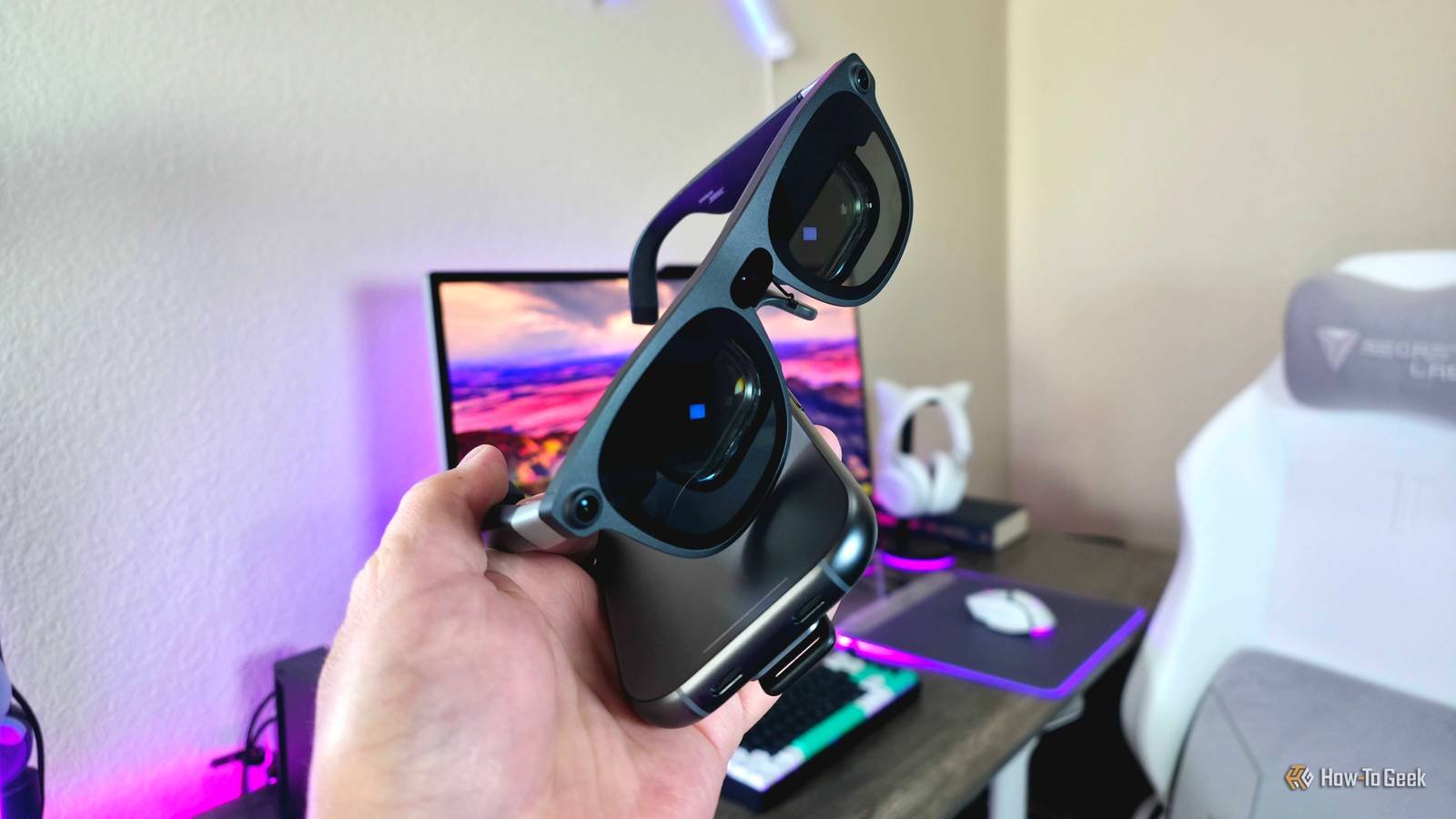
Between smart glasses and VR headsets, only one company is striking the right balance Published Nov 18, 2026, 4:30 PM EST Zachary Boddy is a seasoned journalist with over six years of experience covering technology and video games, and is now contributing to How-To Geek. Zachary's career began at Windows Central, where their long-running, deep-rooted passion as a tech and gaming nerd fueled thousands of published articles, including reviews, guides, interviews, editorials, and so much more. When Zachary isn't writing, they're playing video games, reading books, listening to music, and spending time with their family, a very food-motivated cat and an exceptionally creative daughter. Sign in to your How-To Geek account Virtual reality headsets, minimal smart glasses, and augmented reality glasses have historically fallen into separate categories and targeted different use cases, but the borders between these devices are shrinking by the day as companies race to create the ultimate all-in-one mixed reality headset. XREAL, one of the leaders in AR glasses, has joined the fray with its new Aura glasses, powered by Google's growing Android XR platform. It's an ambitious (and massive) step forward for XREAL as a company, and spending hours with the Aura has convinced me XREAL has struck the best balance between the virtual and real world, more so than the Apple Vision Pro or the Samsung Galaxy XR my colleague reviewed. Squeezing so much technology into such a tiny package comes with inevitable drawbacks — especially for this first generation — but the combination of XREAL's hardware and Android XR's intuitive software has sold me on this mixed reality vision. XREAL Aura 7.5/10 Functions Native 6DoF tracking, 5-tier electrochromic lens, auto transparency, hand tracking Speakers 2x spatial speakers, tuned by Bose Weight 95g (glasses), 265g (compute puck) Refresh rate 72 (Android XR), 120Hz (external) XREAL is firmly and boldly stepping into a new category with the Aura, its latest glasses that combine everything the company has learned with the growing Android XR platform. I firmly believe the XREAL Aura is closer to the ideal than Apple or Samsung's more isolating VR headsets, with its lightweight, comfortable design, surprising capabilities, and ability to immerse you in a virtual world or keep you grounded in reality. There's only so much you can squeeze into a pair of glasses, though, so you do have to accept some compromises, like inferior controls and lower-resolution displays. Pros & Cons Premium and lightweight design Immersive displays with class-leading optical transparency Android XR is intuitive and capable Can still be used as basic AR glasses Hand and spatial tracking deteriorate in low-light Android XR still has plenty of awkward edges 1200p resolution per-eye is behind the competition Price and availability The XREAL Aura retails for $1,279 with 12GB of memory and 256GB of storage (the configuration I'm reviewing), with a 16GB/512GB variant available for $1,499 and two sizes depending on your IPD measurement. XREAL is also doing a limited-time launch offer to get the Aura for $1,099 or $1,299; the Aura looks like an especially good deal in this market with that discount. In addition to the Aura itself, which includes the glasses, compute puck, USB-C cable, cleaning cloth, belt clip (and lanyard for the 16GB/512GB version), replaceable nosepads, and prescription lens frame, XREAL also sells two official accessories. There's the $99 XREAL Game Controller, built off the incredible (and overkill) GameSir G7 Pro 8K, and the foldable $79 XREAL Keyboard Specifications Display type Micro-OLED, X Prism optics Resolution 1920 x 1200 (per eye) Field of view 70-degrees Refresh rate 72 (Android XR), 120Hz (external) Max brightness 1,058 nits Processor XREAL X1S (glasses), Qualcomm Snapdragon Reality Elite (compute puck) RAM 12GB/16GB Storage space 256GB/512GB Functions Native 6DoF tracking, 5-tier electrochromic lens, auto transparency, hand tracking Camera 2x tracking cameras, 1x RGB camera Speakers 2x spatial speakers, tuned by Bose Microphone 4x microphone array Connectivity USB-C (DP Alt), Wi-Fi 6E, Bluetooth 5.3 Sensors ALC/CCT light, proximity, fingerprint, GPS Battery 35Wh, 57W USB-C charging Weight 95g (glasses), 265g (compute puck) Included accessory Carrying case, belt clip, nose pads, prescription lens frame The best of XREAL's hardware, plus a hefty puck XREAL didn't break the mold with the Aura's design, and that's a good thing The XREAL Aura is effectively two devices that work in tandem: the glasses and the compute puck. The glasses are extremely similar to previous XREAL glasses like the One Pro, or the ASUS ROG XREAL R1 I reviewed, with a nondescript black-and-silver design, XREAL's flat lens for industry-leading optical transparency, familiar dual Micro-OLED displays, flexible stems, an array of controls, and excellent Bose stereo speakers and microphones. XREAL's X1S co-processor for spatial tracking also makes a return in the Aura's glasses. There are some upgrades, of course. The displays gain some vertical resolution (1200p instead of 1080p) and a much larger field-of-view (70 degrees compared to 57 degrees); there's now an integrated high-resolution RGB camera instead of the optional XREAL Eye add-on, and there are two additional cameras for spatial and hand tracking. It's a subtle but natural evolution from XREAL's previous glasses. Most of the new excitement lies with the Aura's other half, the reassuringly hefty all-aluminum compute puck. It's powered by Qualcomm's Snapdragon Reality Elite chipset, which combines a CPU, GPU, NPU, and various sensors and radios to create an all-in-one mixed reality platform. Dual USB-C ports connect to the glasses and external devices, the onboard controls integrate a fingerprint sensor for biometric authentication, and the entire front of the compute puck is a capacitive touchpad-like surface for interacting with Android XR (with a helpful LED indicator for charging, power, and more). It's a clever approach to a mixed reality headset, taking most of the weight and heat out of the headset and putting it into a puck that you can hold, clip to your belt or pocket, or hang from your neck. That does mean your glasses are still tethered to the puck at all times, but the trade-off is that the XREAL Aura only weighs 95g on your face, making it far more comfortable and less obtrusive than all-in-one headsets. One of the best parts of this approach is that the XREAL Aura is a full-featured pair of AR glasses without its compute puck, able to connect to basically any device with a DisplayPort-capable USB-C port and give you a massive virtual display that unlocks the full 120Hz refresh rate. It even retains native 6DoF tracking with its built-in co-processor and sensors, and you get an On-Screen Display to manage all your device settings with the on-board controls, just like other high-end XREAL glasses. I was afraid of another Googlebook OS, but Android XR feels right at home After my Lenovo Googlebook 15 review, I was understandably skeptical about another brand-new Google operating system, but my overall thoughts on Android XR are far more positive. Android XR immediately feels intuitive to navigate and control, especially after the beautifully animated and perfectly thorough tutorial during the setup process, and the experience overall has been stable. It's a clean, fluid interface that looks great in a mixed reality environment, and Android XR benefits from the entire Google Play Store to augment its admittedly tiny (but growing) ecosystem of native XR applications and games. Unlike Googlebook OS, standard touch-optimized Android apps work well in Android XR and its hand tracking input, and you can always use the compute puck's touchpad or connect Bluetooth accessories like keyboards, mice, and controllers. Just like regular Android, using those Bluetooth accessories can be awkward with the touch-first interface, but Android XR's core input method generally works great and feels natural. The compute puck supports USB passthrough, too, so it's easy to connect other devices and have them appear as virtual windows within Android XR (I wrote this review on my laptop inside my XREAL Aura workspace, for example). Built on Android 14, there's also a strong foundation of integrated features, including security and privacy settings, notification management, built-in screen capture tools, vast support for modern media types, local file management, cross-device features like Quick Share, and more. Of course, the selling point of Android XR is the ability to have multiple apps and windows suspended wherever you want in your 3D environment, and the basic flow of moving, resizing, and managing these windows feels fantastic, with reliable spatial awareness even as you move around and away from your virtual workspaces. In general, Android XR is off to a very solid start as an emerging platform, and access to (almost) the entire Google Play Store catalog is a genuine strength in this case. That being said, there are still some oddities and weaknesses, like some apps not supporting resizing, or other apps not playing well with the default multi-window view (including XR-optimized apps like the Google Play Store itself, for some reason). Some entertainment apps, like Crunchyroll, may play videos in a fully immersive VR theater that you can't disable, so you can't have your show playing on one side while you work elsewhere in your virtual space. I also have two complaints/suggestions for Android XR. For one, there should be a way to immediately minimize all open windows to quickly return fully to the real world (and then immediately restore your windows in their previous locations afterward). I also want to be able to create virtual desktops, so that one pinch or tap opens a group of apps I often use together (for example, my laptop mirror, Tidal, Slack, and Gmail) in the same general positions at any point. The combined experience is immersive without being isolating The Aura proves other mixed reality headsets are too close to the virtual side The $3,500 Apple Vision Pro and $1,800 Samsung Galaxy XR are both fully immersive virtual reality headsets, and rely on a complicated array of external cameras to enable a "passthrough" view, painting your virtual world with the external video feed. By contrast, the XREAL Aura is a pair of glasses optically transparent enough that you can comfortably move through the world, read fine print, use your phone, and do everything else. The "virtual" aspect are tiny displays projected onto the lens that only you can see, with spatial tracking that keeps those displays seemingly suspended in the real world. The XREAL Aura is smart enough that it knows where you leave your virtual apps and windows even when you leave the room, boasts multi-level electrochromic lens tinting so you can control how much of the real world you see, and can automatically disable that tinting when you look away from your virtual environment. Other mixed reality headsets feed you a digital version of the real world, while the XREAL Aura is the only viable option right now that truly brings the virtual world into reality, making it far easier to casually reach for when you want to effectively multitask across the virtual and real worlds. The Aura also feels like the only mixed reality headset that doubles as a great pair of smart glasses, thanks to its lightweight design, optical transparency, and the Gemini assistant built into Android XR. Hold a single button, and Gemini will begin and open dialogue in the background, answering all your questions and obeying all your commands until you shut it down or tell it to leave. I don't personally care about AI companions, but Gemini performs fantastically on the XREAL Aura with quick responses, a built-in catalog of information on Android XR and the XREAL Aura, and the ability to simultaneously see your virtual and real environments (when you explicitly give it permission) to analyze, organize, and even help navigate to specific settings or apps. The XREAL Aura's approach to the mixed reality space does have some drawbacks, though, mainly in how well it can truly immerse you in full VR experiences and in how much technology you can realistically shove into a pair of lightweight glasses. While I was extremely impressed by the XREAL Aura's performance when exploring VR games or interactive VR experiences, the 70-degree FoV and 1200p per-eye resolution are still far lower than other high-end headsets, and there's a significant amount of space around the lens for the real world to leak in. Aside from wanting sharper screens, though, this compromise is largely acceptable. More concerning is how the XREAL Aura only boasts three external cameras for spatial and hand tracking, and zero internal cameras for eye tracking. I get it; this is a 95g pair of glasses, and there's only so much space. Still, the Aura's hand tracking is considerably less precise and consistent than other headsets, and completely stops working once your environment becomes dim enough. Spatial tracking also starts to slip in severe low-light conditions, simply because the XREAL Aura can't get enough information, especially when it's separated from the compute puck and used as AR glasses. Despite most of the internals being relegated to the compute puck, the Aura glasses can still get warm enough directly above your eyes to draw sweat after a while, too. Speaking of heat, the puck can get very warm after extended use, and the large vents blow out a ton of hot air. As long as you don't shove the puck into a pocket, though, overall performance (even while streaming games over Xbox Cloud Gaming or playing intensive full VR games) has been consistently great, and XREAL's claims of 4–5 hours of battery life feel very realistic. As a final note, the XREAL Aura can capture photos and videos of what you currently see, but the camera's performance doesn't particularly impress even compared to other (usually far more affordable) smart glasses. Should you buy the XREAL Aura? You should buy the XREAL Aura if: You want a lightweight alternative to full VR headsets. You want a mixed reality headset that puts the real world first. You want AR glasses that can also deliver a full VR experience. You should not buy the XREAL Aura if: You plan to mostly stay in full virtual experiences. You need the best hand/eye tracking for gaming and beyond. You want the sharpest displays in mixed reality headsets. There's no denying that the Apple Vision Pro and Samsung Galaxy XR are more technically impressive and capable than the XREAL Aura, but their significantly higher prices also come with a major caveat: when you put them on, you're committing yourself to a fully virtual world, even if passthrough can provide a convincing real-world view. The XREAL Aura compromises on complete immersion, but its lightweight glasses provide a more grounded and grounded mixed reality experience — and at a much lower price point. I am interested to see how the upcoming Meta VR headset will compare at its expected $1,300 price point, though. Most of my criticisms of the XREAL Aura feel like first-generation setbacks that can be resolved with future releases, like the imprecise hand tracking that deteriorates as the light does and the lower-resolution displays that fall behind the competition. As a complete package, the XREAL Aura is the mixed reality headset I'd reach for more often because—despite being less impressive on paper—it feels more flexible and versatile. If I don't want the full Android XR experience, the Aura works just as well as a high-end pair of AR glasses for all my devices. XREAL Aura 7.5/10 Functions Native 6DoF tracking, 5-tier electrochromic lens, auto transparency, hand tracking Speakers 2x spatial speakers, tuned by Bose Weight 95g (glasses), 265g (compute puck) Refresh rate 72 (Android XR), 120Hz (external) XREAL is firmly and boldly stepping into a new category with the Aura, its latest glasses that combine everything the company has learned with the growing Android XR platform. I firmly believe the XREAL Aura is closer to the ideal than Apple or Samsung's more isolating VR headsets, with its lightweight, comfortable design, surprising capabilities, and ability to immerse you in a virtual world or keep you grounded in reality. There's only so much you can squeeze into a pair of glasses, though, so you do have to accept some compromises, like inferior controls and lower-resolution displays.
XREAL Aura review: The right balance between smart glasses and VR headsets
Full Article
Original Source
Read the full article at Howtogeek →KhanList aggregates and links to publicly available news content. We do not host full articles from third-party sources. Always verify important information with original sources.