The Chinese Communist Party (CPC) Congress scheduled for autumn 2027 could be one of the most delicate and significant in its history. President Xi Jinping will extend his power for a fourth five-year term and bring up an entire generation of younger cadres. They will be people born in the 1960s, roughly ten years younger than him, who will join the Standing Committee (five to seven people) or the Politburo (21-25 people). In the three previous Congresses, Xi, who was born in 1953 and rose to power in 2012, had to navigate among officials his own age or older. He succeeded with clearly brilliant results. A Politburo composed of younger people who owe everything to him will further increase his clout in the country. He has over a year to prepare, with no challengers on the horizon. He has completed an unprecedented purge of the military without any pushback from any party organization. The CPC was practically born out of the People’s Liberation Army (PLA), and the military had always been the political kingmaker. By zeroing out the PLA’s political power, Xi has concentrated a degree of authority that none of his predecessors, including Mao Zedong, ever had. Mao’s power rested on the PLA’s support and his success in surviving and winning the Civil War against the KMT nationalists. Xi’s power apparently came from fighting and winning a vast, mysterious internal party struggle against all other factions. He can claim some strong accomplishments. For the first time in almost two centuries, he confronted the US and forced it to yield in a delicate tariff dispute with broad political implications. He waded through a dangerous Covid outbreak while keeping the country steady. None of his predecessors in China (not only in the CPC) can boast of anything similar in well over a century. He did it by shifting the paradigm by which ruling performances are judged. In Mao’s time, it was only “politics”, ideological purity and adherence to the Maoist official creed. Officials were promoted or demoted based on their adherence to “communist orthodoxy.” Under Deng Xiaoping, it was about the economy and growth. Officials went up or down depending on the business data they provided. Now it is a new mix. There is economic growth, but it is not the sole gauge. It must be tempered with party loyalty and political wile. This paradigm has enabled Xi to position China as a direct competitor to the existing superpower, the US. Long term: democracy, neighbors, arms … Yet, despite these results, China still faces a set of long- and short-term problems. The long-term ones should not affect the 2027 Party Congress. The short-term ones might. China has four long-term issues: 1. democracy, 2. relations with its neighbors, 3. excess of armed forces, 4. public debt. 1. Democracy is a lingering headache, straining China’s internal and external vulnerabilities. Being undemocratic cripples China’s external position and its international voice. Its media have no weight in the global debate, and are seen just as Xi’s loudspeakers. This undermines its potential influence. To be an undemocratic world leader when most other major countries are democratic is, to say the least, odd. Internally, China needs to create a genuine domestic consumption market, and to do so, it needs a better welfare state and a fiscal overhaul. Yet these are all agencies for controversial political reform. In many democratic countries, there’s growing annoyance with democratic rule, and this, in time, could obscure China’s democratic faults, but internal economic pressures will continue to mount. 2. China has strained relations with almost all of its neighbors. It doesn’t have any allies or friends, and the situation isn’t improving. Without going into the reasons for this, the situation complicates all commercial and political ventures. In the short term, nobody has an interest in exacerbating tensions and rocking the boat. But in the long term, this pressure could lead to unpleasant outcomes for China. It creates an atmosphere of isolation, fear, and suspicion around China that has no advantages for anyone. 3. China has massive and growing armed forces, worrying everyone and fueling a regional arms race. The US also has massive armed forces, but they are aimed at US enemies (which can vary). Still, the US has a vast network of allies. No ally believes the US will attack them, and officially, the US military has goals beyond US interests. It serves global security. The problem is the opposite of China’s: Allies complain that the US armed forces aren’t used enough, or aren’t used against their own enemies. But no country, near or far from China, feels secure that Chinese forces won’t be used against its own state. Moreover, the Chinese military serves only Chinese security, not anyone else’s. In reality, there are only two large, comprehensive military apparatuses: the US and China. For instance, Japan not only will not attack the US militarily, but it also couldn’t, because it’s tied to the American defense platform. … and debt 4. And then there’s the most complex issue – internal debt. Screenshot The first graph shows that China’s economy is faltering, and it has been doing so since well before Xi came to power. China is pouring money, almost three times its GDP, into the economy to achieve growth of less than 5% per year. The money is not wasted; the results are clear: massive construction, extensive infrastructure, unparalleled industrial capabilities and almost 30% of all the world’s industrial output[1]. No other country comes close to matching China’s combination of scale, breadth (from steel and textiles to EVs, robotics and semiconductors) and integrated supply chains. No single country yet matches China’s full industrial range. But there is a relatively modest economic return for all of that. Many are monuments, cathedrals, beautiful things with little or no economic sense. In these numbers could be hidden one of the largest public debt black holes in human history, capable of crushing China and taking the whole world with it. China’s difficulties are even more evident when compared with the second graph. The US has a smaller money supply in absolute and relative terms and produces more growth. The US economy is far more efficient. The two graphs show that China has built a wall of concrete and steel that yields little return for itself and has accumulated substantial internal debt. Plus, the simple upkeep of all these industries and infrastructure could be an important drain on the state’s coffers. On top of that, China is experiencing deflation, while America is experiencing inflation. This is sustained by Chinese savings (“taxed” by banks’ low interest rates) and by Chinese exports, which continue to grow at an unsustainable pace (in 2025, they were US$1.2 trillion). But Chinese people are earning less over time and thus saving less. Even in the best case, the global market can’t close all its factories to make room for Chinese production. In 2012, Xi might have wanted to address the problem confronting the state-owned enterprises (SOEs), but they resisted and opposed him. He didn’t succeed. Will he want or be able to tackle it in 2027? Now, although there is no power group able to oppose Xi, can anyone sandbag his reforms? All four of these elements reinforce each other and complicate peaceful solutions. In China, some may shrug off these issues. They might believe that these issues are long-term and that time is on China’s side. The US’s present power is declining, and without US opposition, it’s a different ball game and China can get away with much. Some Chinese may believe that the emerging situation is one in which many small and medium powers contend with each other, almost like China’s Warring States period of the 4th–3rd centuries BC. Here is an arcane ancient parenthesis with modern impacts. Back to the 4th century In the 4th century BC, the Later Mohists (in the Mohist Canons) developed a genuinely sophisticated apparatus of disputation (bian) — theories of naming, criteria for class inclusion, rules for distinguishing “this/that” (shi/fei), and rules for valid argument. Zhuangzi, especially in the “Qiwulun” (Chapter 2, “Discourse on Making All Things Equal” in Graham’s translation), engages with that tradition—and with Hui Shi’s paradoxes in particular—but does so skeptically. He’s not out-logicking the Mohists with a superior logic; he’s questioning whether disputation can ever ground itself, since every “this” implies a “that,” every affirmation a rival denial, and every standard of judgment (shi/fei) is perspectival, arising from a particular position rather than from any Archimedean point outside all positions. Graham’s Zhuangzi relativizes the whole project of disputation — suggesting that deeper wisdom lies in recognizing the limits of bian and in a kind of responsiveness to circumstance (something Graham links to his broader reading of early Daoism as a philosophy of spontaneity, ziran, rather than fixed rule-following). It’s closer to a critique from outside logic than a rival logic that wins the argument on logic’s own terms.[2] Graham argues that this is why China was not dominated by systematic logic, as in the Western tradition stemming from Plato and Aristotle. It could be not just an issue of “logic” but of political necessity. Zhuangzi’s friend and fellow logical maverick, Hui Shi, invented a system that revolutionized the Sinic world forever and set aside Mohist logic. As prime minister of Wei, he proposed setting aside the role of the Zhou Son of Heaven, which was still used ceremonially and diplomatically, and having two rulers recognize each other as “kings.” Andrew Seth Meyer writes[3]: The meeting between Tian Yinqi and Wei Ying (the rulers of Qi and Wei, respectively) at Xuzhou in 334 C, in which both men acknowledged one another as ‘kings,’ ushered in a new era for the Zhou world… In just over a decade following 334 BC, most of the powerful rulers of the Yellow River plain followed suit in acquiring the title of king… The ruler who rose from marquis to king during the Warring States found that he possessed significant new powers. These new powers had many complex forms and ramifications, but they generally fell into two discrete realms… After 334 BC, the Zhou world moved from being the domain of a single king into one populated by many, and the nature of interstate relations rapidly transformed, accelerating developments that had been in process for decades. It is at this point that the most powerful of the Warring States can accurately be called ‘kingdoms,’ because they openly, explicitly, and consistently assumed fully sovereign control over geopolitical and social policy. Kings no longer acknowledged any obligation to inform the Zhou Son of Heaven (who was now their peer) of matters of state. They could negotiate swiftly and in secret, with no fear that any counterpart (king or not) could invoke the authority of ‘the king’ to back out of a deal. Enthroning one another proved the arbitrariness of logic, shaped by practical needs and little “truth” or tradition behind it. Previous thinkers tried to fix the Zhou system, addressing this or that problem, and wanted to return to a golden age. The Mohists might have been the strongest force pushing to strengthen the role of the Zhou Son of Heaven. Hui Shi cast him aside, seeing him as a simple hindrance. He overhauled the entire cultural and political system of the ancient Sinic koine, using the same words but deliberately assigning them very different, new, arbitrary meanings suited to the new political necessities. The Son of Heaven and the Zhou order were simply discarded without explanation. Zhuangzi took a further turn: if words had no meaning, nothing had meaning. The tradition and continuity didn’t exist. Politics was an illusion and a delusion. East vs West It is a very different environment from the Western tradition that traces back to the Roman Empire. Rome, originally an outsider in the ancient Mediterranean power game, sought its legitimization in the pre-existing tradition, aligning itself with Greece, Egypt, and Babylonia. In the late second millennium and first millennium BC, the Mediterranean was not a cultural koine but a crossroads of strong, ambitious empires. The Egyptians clashed with the Hittites in the Battle of Kadesh (c. 1274 BC, near the modern-day Lebanon-Syria border). The fight was inconclusive, and the two empires faced each other, dividing the eastern Mediterranean coast from the Anatolian peninsula to the Sinai. From then on, the struggle continued with many other players in the region. The foundational stories of Western civilization, the Iliad and the Odyssey, written about a century after the Battle of Kadesh, are based on episodes from these conflicts. There were different languages and very different cultures opposing one another, recognizing no common ground. It was the time when a Sinic koine first emerged. It was through a possibly long attrition between the old Shang system and the new Zhou system. Eventually, the Zhou prevailed, establishing a political framework that slowly collapsed over centuries and finally broke down in 334 BC. Possibly, the first Mediterranean koine was created by Alexander the Great and his teacher Aristotle and lasted essentially until the 17th-18th-century liberal and Industrial Revolution. For all this time, some 2,000 years, spanning from the third-century Roman control of the Mediterranean to the Enlightenment, a vertical system aligned knowledge, politics, and religious/cosmological vision, declining in different forms the Judeo-Greek tradition, Christian or Islamic. After that, especially after the 18th-century American and French revolutions, the whole systemic logic was set aside without grand gestures, and everything was in motion. The 2027 Party Congress will have to confront the new, unprecedented environment and might need grand ideas to explain to China and the world what it wants to do, almost like Hui Shi did in 334 BC. Previous congresses had to think about how to fit into and suit an existing stable environment. Short-term concerns Still, there are short-term risks that could scuttle many CPC programs. The wars in Ukraine and the Middle East de facto serve China’s interests by distracting the US and the rest of the world from Beijing. But things are turning, and they could go south for Beijing. It’s unlikely that Ukraine will give in to Russia, or that Israel will surrender to Iran. But there is a possibility that over the next year Russia or Iran (or both) will cave, and thus one or both countries will become a failed state or an American ally. If that happens, China could become more isolated, which could reflect badly on Xi on the eve of the party congress. Therefore, maybe Beijing now has an interest in facilitating some kind of peace or ceasefire that at least averts utter disaster. Beijing’s support for Russia soured relations with Europe, which had been much warmer before. Securing peace on one or two fronts could help China position itself more effectively amid a period of grand confusion in the West. If China acts positively, it can claim it as a victory. If wars go south for China’s friends, Beijing could be in trouble. New Western paradigms At the moment, the situation is not totally negative for China. The West is looking for a path forward, and it’s not finding it. In a recent interview[4] with The Economist editor-in-chief Zanny Minton Beddoes, billionaire Elon Musk rejected the view that the UK is more peaceful and has less crime than the US. He argued that the growing immigrant and Islamic populations pose a threat to the UK’s security. The editor was speaking about the present factual reality. Musk made a prediction based on the assumption that migrants, particularly Muslims, are irreconcilable with UK identity. But Musk’s prescription, which supports the radical right, may be like curing a headache with a guillotine, as Professor Alfredo Costa (an international expert on headaches) quipped to me. Turning to the extreme right could exacerbate social tensions, scorch the earth and potentially leave only the escape to Mars as an option. Maybe before reaching for the guillotine, there can be other tools to treat a headache, including simply living with it. There are people who died past 90 after having lived with headaches their whole lives. The West’s dramas (broadly speaking) should be taken seriously today, but many of the doctors at the West’s bedside seem like quacks, more interested, for one reason or another, in letting it die than in keeping it alive. Xi may not want to fret over his many intractable problems while the West is grappling with its demons. It’s very unclear what will come of it. Depending on the outcome, Xi may decide to go one way or another, but there is no reason to rush. Still, China might want to keep one calculation open. Despite all the prophets of doom, the West may be in good health. Turmoil is the bread and butter of modernity. The West finds nourishment in it, not doom. Is this time any different? America might end up with a new kind of dominance, but still dominance, and China should be prepared for every eventuality. Perhaps an extension of American power on different foundations — no longer white and Old Western, but multiethnic and liberal. Perhaps we all need to think in different terms and focus on short-term necessity. Over the next year, China should help pull the plug on both wars. NOTES [1] https://www.china-briefing.com/news/china-manufacturing-industry-tracker/ [2] Angus Charles Graham, “Disputers of the Tao”, 1999, pp. 107–170 and pp. 170–235 [3] Andrew Seth Meyer, “To Rule All under Heaven: A History of Classical China, from Confucius to the First Emperor” 2026 (English Edition) (pp. 243-249). (Function). Kindle Edition. [4] https://www.economist.com/insider/the-insider/an-interview-with-elon-musk This article was first published on Appia Institute and is republished with permission. Read the original here.
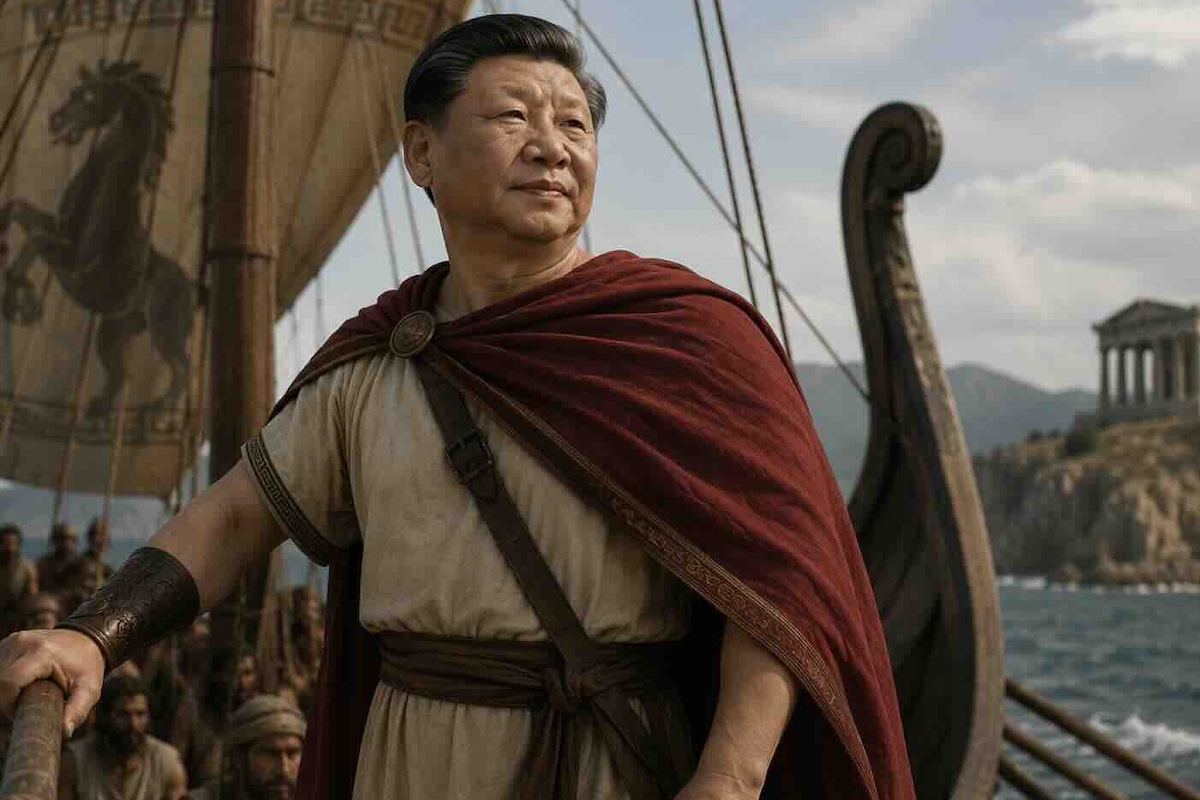
Xi’s odyssey through Western confusion
Full Article
Original Source
Read the full article at Asiatimes →KhanList aggregates and links to publicly available news content. We do not host full articles from third-party sources. Always verify important information with original sources.