
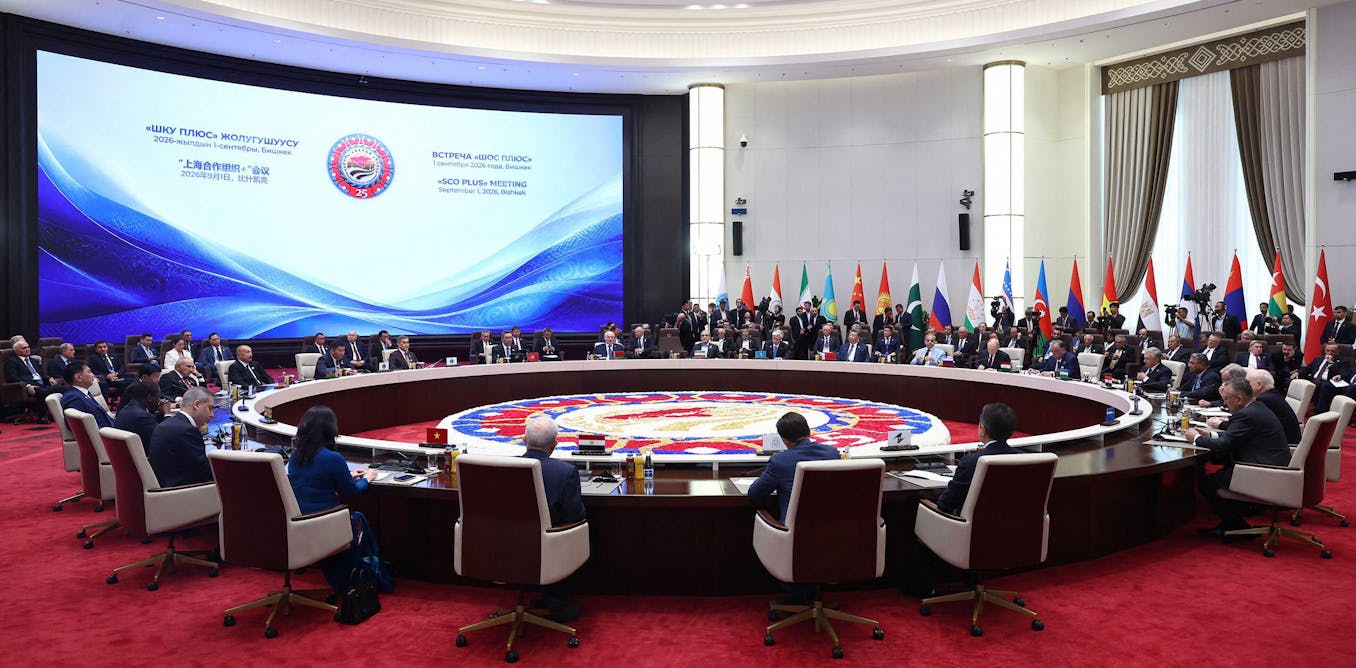
The Shanghai Cooperation Organisation (SCO) marked its 25th anniversary in Bishkek, the capital of Kyrgyzstan, with all the trappings a diplomatic milestone demands. There were 21 heads of state and government present for a ceremonial “family photo” and two-page Bishkek Declaration on September 1. A further 28 agreements included “strengthening multilateral partnership in nuclear safety and nuclear security”. On the face of it, the SCO appeared to be a confident bloc speaking with one voice for roughly a quarter of humanity, while representing between 23% and 25% of global GDP. Shanghai Cooperation Organisation countries: J4keeS237/Wikimedia Commons, CC BY The real picture, however, is far less flattering. A quarter of a century in, it remains primarily a forum for multiple parallel bilateral engagements and deals between leaders. So far, so functional. What the SCO has never become in 25 years is a body able to adjudicate the disputes its members bring to the room – still less, the ones they wage outside. At its best, the SCO has been something narrower: a vehicle for bilateralism which lets its most powerful members strike deals and settle scores. As they often do this in very public ways, the messages they send more often than not are for domestic consumption, to present themselves as staunch defenders of strategic national interests. Take the plenary address by the Indian prime minister, Narendra Modi. With Pakistan’s prime minister Shehbaz Sharif at the same table, Modi declared that “there can be no place for double standards” in dealing with terrorism, and that “terrorism can never be a strategic asset for anyone”. He further called for dismantling “the entire ecosystem of terrorist financing, recruitment, radicalisation and safe havens”. Modi did not need to name Pakistan to make it clear who he was aiming his remarks at. Everyone in the room – and at home – will have recognised this as the language India uses to criticise Pakistan for its alleged support of transnational terrorist networks. The added benefit of the SCO summit for Modi was that he was able to deliver this criticism directly into Sharif’s face. Modi then made a second point, noting that it is essential to “respect the sovereignty and territorial integrity of all countries”. Without saying it directly, this worked as a rebuke for Russia’s war against Ukraine, China’s Belt-and-Road corridor through Pakistan-administered Kashmir, and for Pakistan’s claims to territory that India considers its own. A statement like that not only makes Modi look good at home. It also offers something for India’s partners in the west – who can read it as a criticism of Russia. And it helps shore up India’s traditional role as a champion of the global south – including against Chinese or Russian aspirations in this regard. Modi also had a more direct message for the Russian president, Vladimir Putin, which he delivered in person and on the record. “Every day spent in war pushes humanity backwards,” he told the Russian president after their customary hug, before emphasising the need to move “from an endless war towards an end to the war”. Allies, up to a point: Narendra Modi publicly called on Vladmir Putin to end the war in Ukraine. EPA/Petr Kovalev/Sputnik Kremlin pool While there is a more constructive, less antagonistic bilateral relationship between India and Russia compared with India and Pakistan, it was a notably pointed line. All the more so as it was delivered in public to a fellow leader of a bloc built partly around the idea that its members offer each other unconditional solidarity against the west. This is not the first time Modi has publicly called on Putin to end the war. He also condemned the deaths of Ukrainian children in a Russian missile strike just as the two leaders had a bilateral summit in Moscow in 2024. Putin scurries for support Putin came to Bishkek with the busiest bilateral schedule of any leader. Across the two days of the summit, he met with Modi, Xi Jinping of China and Masoud Pezeshkian of Iran – as well as the presidents of Tajikistan, Mongolia, Kyrgyzstan, Kazakhstan, and the attending non-SCO members Turkey and Armenia. Impressive as this may seem, it is hardly a sign of strength. Because of the International Criminal Court’s arrest warrant against him, Putin’s personal diplomacy is confined to venues like the SCO and sometimes the Brics – the organisation of emerging economies which began with Brazil, Russia, India and China, but has since expanded considerably in size and influence. This is hardly a good look for the leader of a would-be great power that has also suffered recent setbacks in its influence and leverage elsewhere in the world, from Syria to Venezuela to Mali. Three leaders, three agendas Xi, by contrast, was strikingly selective. His only confirmed bilateral meeting was with Putin. This can be seen as a possible signal that Beijing increasingly views the SCO as a lower-value event than its own direct channels with individual capitals, or forums such as Brics. It was striking that Xi then headed straight to Cairo for his first state visit in a decade to Egypt, a country that has been a member of the enlarged Brics since 2024. That organisation’s summit begins in New Delhi on September 12. So, each of the organisation’s “big three” leaders extracted something different and specific from the summit. But none of that depended on the SCO functioning as a collective voice. This doesn’t suggest the SCO is meaningless. Its summits generate bilateral engagements and agreements, and opportunities for members to project non-western solidarity to their domestic and international audiences. But Bishkek’s real anniversary message was not the declaration its leaders signed. Rather, it was the way in which the organisation’s three dominant leaders, Xi, Modi and Putin, used the forum to pursue three entirely separate agendas – and left having resolved none of the issues that divide them.
Xi, Putin and Modi looking in different directions as Shanghai Cooperation Organisation marks 25th anniversary
Full Article
Original Source
Read the full article at Theconversation →KhanList aggregates and links to publicly available news content. We do not host full articles from third-party sources. Always verify important information with original sources.