
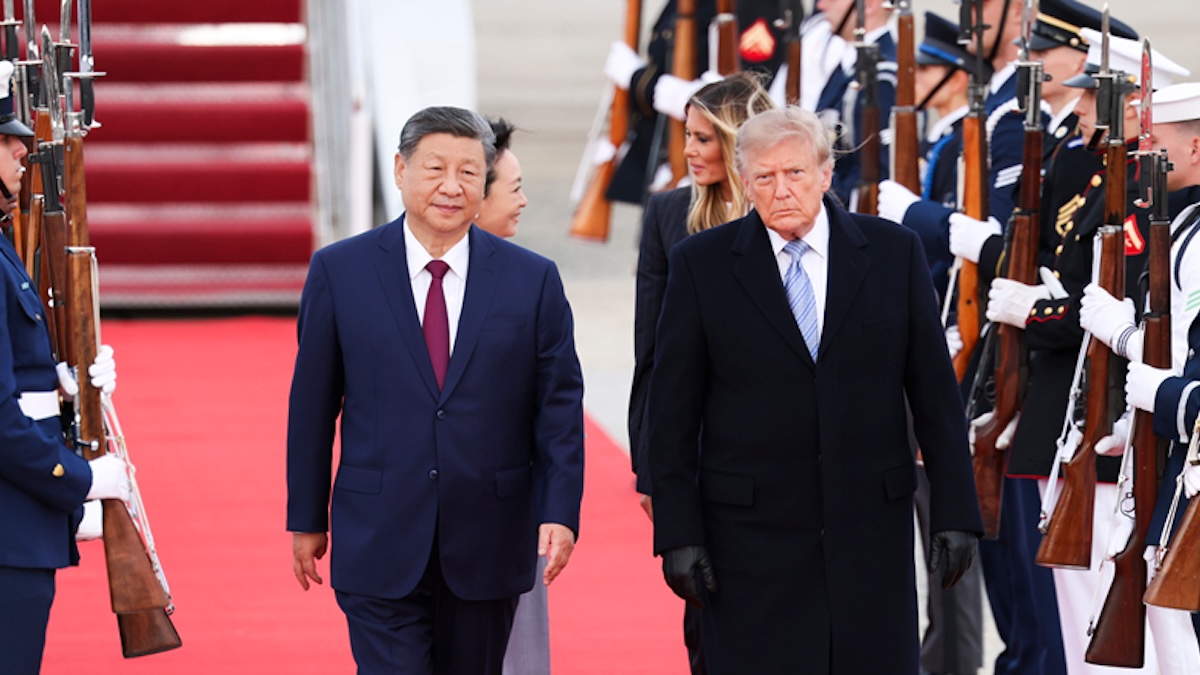
Beijing has agreed to work with Washington to improve governance of artificial intelligence (AI) technologies and to enhance cooperation as Chinese President Xi Jinping and United States President Donald Trump met face-to-face at the White House on Thursday. Xi made the pledge in his speech at a morning welcoming ceremony, before the two leaders held closed-door talks in the Oval Office. It was their first face-to-face meeting since May. According to Chinese state media, Xi raised Taiwan and Iran in the talks, but neither side had announced any trade agreement by Thursday afternoon US time. Xi put forward several initiatives, including: inviting 100,000 young Americans to China for exchanges and study over the next five years; increasing direct flights to facilitate two-way travel and trade; strengthening cooperation on counter-narcotics and law enforcement; and maintaining regular dialogue between the two militaries and improving crisis communication and prevention mechanisms. The youth pledge doubles an initiative Xi launched in San Francisco in November 2023, whose 50,000 target was met in May, two and a half years ahead of schedule, according to China’s Foreign Ministry. “Both China and the US are leading nations in AI. We have both the capability and responsibility to develop and manage AI for good, and ensure that the development of AI is always under human control and serves the well-being of the people,” Xi said. “China-US cooperation may not solve every problem in the world, but without our cooperation, it would be hard to solve many of the world’s problems,” he said. “Working together, we can lengthen the list of cooperation and shorten the list of issues.” Xi’s remarks came after Chinese Vice Premier He Lifeng and US Treasury Secretary Scott Bessent held their first dialogue on AI in New York on Sunday. Bessent said both sides had agreed to launch a hotline to notify each other of AI safety incidents. Taiwan and Iran The Trump administration has put a proposed US$14 billion arms package for Taiwan, the largest ever for the island, on hold since Trump’s summit with Xi in Beijing in May. Trump has described the package as a potential “negotiating chip” with Beijing. It has not yet been decided when to proceed. Xi told Trump in their talks on Thursday that China hopes the US will adhere to the correct position of opposing Taiwan independence and handle the Taiwan question with prudence, Xinhua reported. He said China’s stance on safeguarding its national unity and territorial integrity is crystal clear. Xi also sent a message about Taiwan in the closing lines of his speech at the welcoming ceremony. “Achieving the great rejuvenation of the Chinese nation and making America great again (MAGA) can go hand in hand. Let us meet the people’s expectations and show our historical initiative. Let us keep advancing the cause of friendship between our two peoples and work together to build a better world,” he said. In Xi’s political vocabulary, the great rejuvenation of the Chinese nation includes reunifying Taiwan with mainland China. Washington sees a forcible takeover of the island as an invasion that would extend China’s military reach beyond the first island chain, which runs from Japan through Taiwan to the Philippines. On Iran, Xi told Trump he hoped the US and Iran would return to dialogue and negotiation as soon as possible, Xinhua reported. He said China supports the two countries in returning to the Islamabad Memorandum of Understanding (MoU) and hopes they will ultimately reach a comprehensive agreement covering the nuclear issue and other matters. Signed on June 17, the MoU extended a ceasefire by 60 days and reopened the Strait of Hormuz to commercial shipping. It unraveled in July after Iran struck commercial vessels in the strait. Beijing has so far resisted Washington’s calls to use its leverage over Tehran to end the nearly seven-month war. Flying Tigers remembered In the welcoming ceremony at the White House, Trump’s opening speech, including translation, lasted about 8.5 minutes while Xi’s ran for about 13 minutes. Before the summit, British Prime Minister Andy Burnham asked Trump to press Xi to release Jimmy Lai, Hong Kong’s jailed pro-democracy activist and entrepreneur, who is a British citizen. White House aides were already planning to raise the case with Xi, as Trump did at their Beijing meeting in May. “We do not need to avoid mentioning competition, but our competition should be a healthy one and should be kept within bounds. It should be a race of catching up with one another, not a wrestle in which one either wins or loses,” Xi said on Thursday. He said the two countries must hold the line of no conflict and no confrontation, adding that the Thucydides trap, the idea that a rising power and an established one are destined for war, could be overcome. Both leaders invoked the wartime alliance. Trump praised the Flying Tigers, American volunteer pilots who fought Japan for China in 1941 and 1942. Trump said the US Marines adopted the Chinese phrase “gong he,” short for Chinese Industrial Cooperatives. Marine officer Evans Carlson brought it back from China in the late 1930s, and it entered English as “gung ho.” “The Marines use it as an expression of great enthusiasm, but in Chinese it literally means working together. Just as our people worked together to win that war, President Xi and I will continue working together to forge a better future for both of our nations,” Trump said. “During the Second World War, Chinese and Americans fought shoulder to shoulder against fascist aggression. Chinese people have never forgotten that part of history, nor have the American people,” Xi said. He added that two giant pandas, Ping Ping and Fu Shuang, would move to their new home at Zoo Atlanta in a few days. Xi’s pledge on counter-narcotics cooperation was an apparent reference to Washington’s demand that Beijing curb the flow of fentanyl precursor chemicals. The US cut its fentanyl-related tariffs on Chinese goods to 10% from 20% after last October’s Busan summit. He also said China keeps its door wide open to American companies and hopes Chinese firms are treated fairly in the US. After the ceremony on the State Floor, the two leaders reviewed troops in the Rose Garden, with a B-2 bomber and four F-22 fighter jets flying overhead, before heading into their talks. Meanwhile, US First Lady Melania Trump and Xi’s wife Peng Liyuan toured the Smithsonian National Museum of Asian Art. The Trumps hosted a state dinner for Xi in the evening, and Xi will end his visit at the National Archives on Friday. Truce extended to January Bessent said on Wednesday that the trade truce, agreed upon in Busan last October and due to expire on November 10, would be extended by two months to January 10. That is shorter than the six months some media reported earlier this week. He said the extra time would allow the two sides to explore a bigger deal. “We’re open to the idea of just continuing the Busan arrangement or examining the bigger deal,” he told reporters. “We’re fine with both, and we’re going to do what’s best for the American people.” China’s Ministry of Commerce spokesperson He Yadong said on Thursday that the Bessent-He talks covered: implementing the consensus from earlier rounds of trade talks; reciprocal tariff reductions; setting up a trade council and an investment council; and extending the joint arrangement reached in Kuala Lumpur last October. Bessent said Beijing was meeting its requirement to buy 25 million tons of US soybeans but was lagging on its pledge to buy US$17 billion of other agricultural goods. US officials said last week that China’s rare-earth deliveries were also lagging. Read: US-China open hotline to rein in runaway AI Follow Jeff Pao on X at @jeffpao3
Xi backs AI safety with Trump, draws Taiwan line, urges Iran talks
Full Article
Original Source
Read the full article at Asiatimes →KhanList aggregates and links to publicly available news content. We do not host full articles from third-party sources. Always verify important information with original sources.