
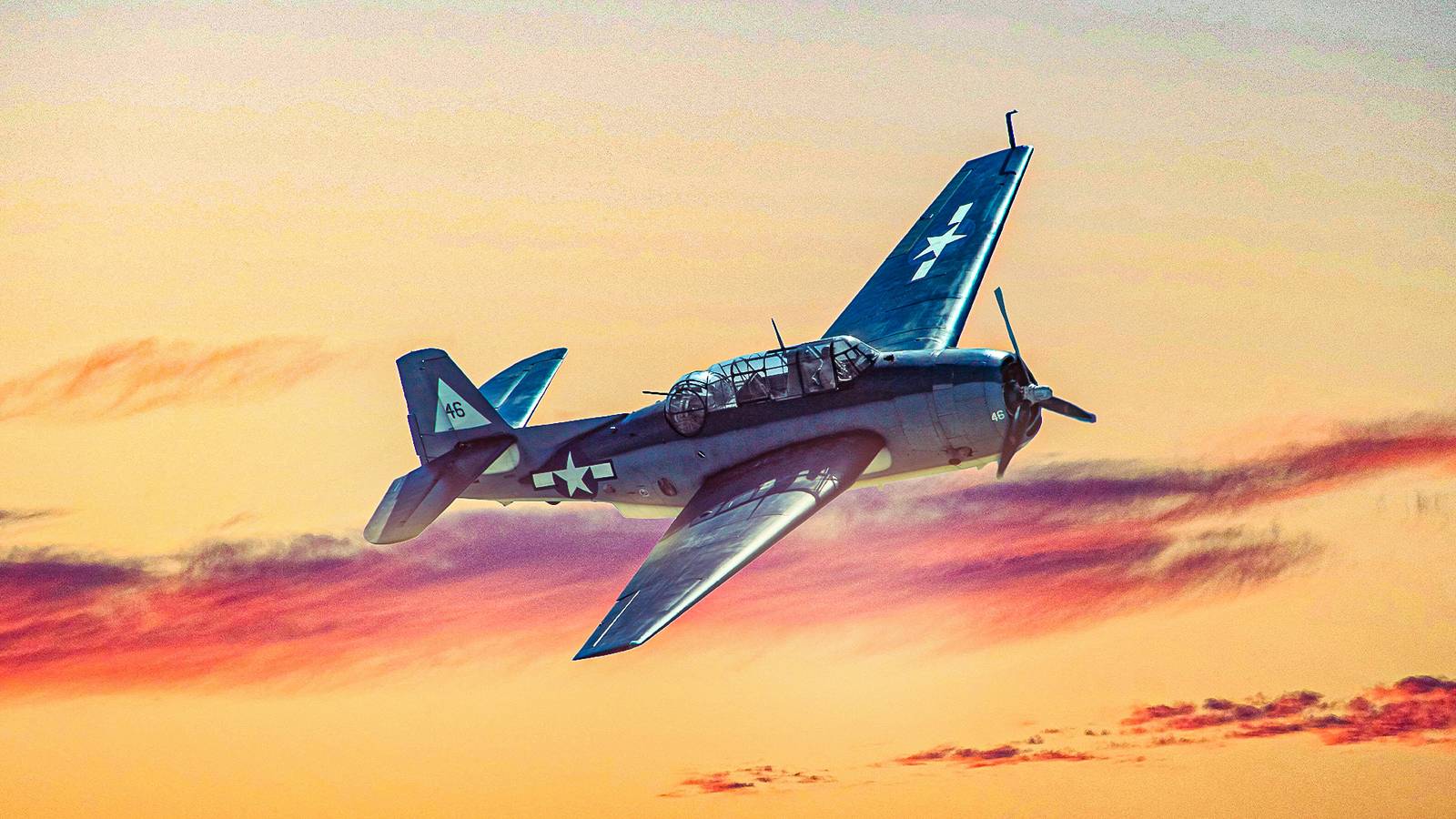
Published Sep 1, 2026, 3:00 PM EDT Passionate about promoting aviation, the beauty of flight and the science behind it, Antonio is an avid reader of aviation magazines and books, and he loves visiting airshows all over the world, taking photos and writing about airplanes and helicopters as well. He is currently based in Palermo, Sicily. Sign in to your Simple Flying account Credit: Lone Star Flight Museum On September 2, 1944, a 20-year-old Navy pilot named George H. W. Bush climbed into the cockpit of a torpedo bomber for the 58th time in combat, dropped his bombs on a Japanese radio station, and then had to jump out of a burning airplane over the Pacific. He was the only one of nine airmen shot down that morning near Chichi Jima who came home. The aircraft that put him there was not some obscure prototype, but the single most mass-produced torpedo bomber of the second world war, a design whose production run of 9,836 units has never been matched by any torpedo bomber before or ever since. That aircraft was the Grumman TBF/TBM Avenger, and on August 7, 2026, it quietly marked 85 years since its first flight, a maiden flight so troubled by yaw instability that Grumman's own test pilot called it hair-raising. How did an airplane that nearly failed its first Navy trial become the backbone of the entire Pacific torpedo bomber force, and how did the same rugged design that carried Bush to war end up saving his life when everything else went wrong that September morning over Chichi Jima? The Navy Bet Its Torpedo Bomber Fleet On An Airplane That Hadn't Flown By 1939, the US Navy's frontline torpedo bomber, the Douglas TBD Devastator, was already obsolete, and planners knew a Pacific war with Japan was no longer hypothetical. In April 1940, the Navy placed an order for 286 examples of a design that had yet to fly: the Grumman XTBF-1, submitted by the Bethpage-based Grumman Aircraft Engineering Corporation, builder of the F4F Wildcat fighter. Grumman had already earned a reputation within the Navy as the "Iron Works," a manufacturer whose airplanes came back from hard landings and hard fighting when other designs failed. As Smithsonian Magazine has documented, the nickname came directly from pilots who kept flying Grumman airplanes home with battle damage that would have brought down a lighter design. Ordering hundreds of an unbuilt airplane on the strength of that reputation was still an enormous bet, and it very nearly did not pay off. According to the Naval History and Heritage Command, the XTBF-1 finally flew on August 7, 1941, powered by a 1,700-horsepower Wright R-2600-8 Cyclone engine, but early tests fell short of the Navy's speed and range targets, topping out at 271 mph (436 km/h). Grumman's test pilot reported severe yaw instability on that first flight, forcing engineers to add a long dorsal fin fillet just to keep the airplane predictable in the air. Grumman barely had time to fix the handling problems before history intervened. The first prototype burned in a bomb-bay fire that November, and the second prototype was cleared for delivery only weeks before the attack on Pearl Harbor turned an already urgent program into a race against the clock. The Navy named the new bomber "Avenger" that same December, a name that would prove grimly appropriate given what its crews were about to fly into. Rushing a brand-new torpedo bomber into combat came with a brutal cost that the Navy would pay just seven months later. The Avenger's Combat Debut Nearly Got The Whole Program Scrapped Credit: Shutterstock The Avenger's first combat mission was the Battle of Midway on June 4, 1942, and it nearly ended in disaster. Six brand-new TBF-1s from Torpedo Squadron 8, flying without fighter escort against the Japanese carrier fleet, pressed a low-level attack through a wall of anti-aircraft fire and defending Zero fighters. Five of the six were shot down, and the lone survivor limped back to Midway so shredded by gunfire that it never flew again. Not a single torpedo found its target that day, and even the ones that did get close were let down by the Mark 13 torpedo itself, a weapon plagued at the time by faulty depth-keeping and a habit of failing to detonate on impact. It would have been easy to write the airplane off entirely after such a debut. But the crews who flew it kept reporting the same thing: the Avenger's deep, boxy fuselage and self-sealing fuel tanks let it absorb damage that would have killed a pilot in a Devastator. That reputation for toughness was not just squadron folklore. The Intrepid Museum's own aircraft history archive records a February 1945 mission in which anti-aircraft fire tore apart the top of an Avenger's fuselage and left wing over Chichi Jima, and the crew still flew it 100 miles (161 km) back to their carrier, USS Bennington, and landed safely. The problem at Midway wasn't the airframe, but the strategy: send six unescorted bombers straight at a fully alerted carrier force. Five months later, at the Naval Battle of Guadalcanal, Avengers helped sink the Japanese battleship Hiei, and within a year the type was flying from every American fleet and escort carrier in the Pacific. Fixing tactics was one problem the Navy could solve. Building enough Avengers fast enough to fight a two-ocean war was another problem entirely, and Grumman's own factory floor was about to become the bottleneck. The Avenger Became The Most Mass-Produced Torpedo Bomber In History With the US Navy also demanding thousands of Grumman's new F6F Hellcat fighters, Grumman handed most Avenger production to a newly formed division of General Motors called Eastern Aircraft, which converted former automobile plants in New York, New Jersey, and Maryland into torpedo bomber factories, redesignating their output TBM instead of TBF. The heavier, more powerful TBM-3, introduced in 1944 with a 1,900-horsepower Wright R-2600-20 engine and underwing hardpoints for rockets and drop tanks, became the definitive wartime version and, later, an effective submarine hunter once fitted with search radar. According to Simple Flying's coverage of the US Air Force's current B-21 Raider ramp-up, even today's most ambitious American bomber programs are measured in dozens, not thousands — the Air Force expects roughly 145 B-21s in total. The Avenger program operated on an entirely different scale: by the time production ended in 1945, Grumman had built 2,290 TBFs and Eastern Aircraft had built 7,546 TBMs, for a combined 9,836 airframes — still the largest production run of any torpedo bomber in history. Great Britain and New Zealand received 921 more of the type, flown briefly under the name "Tarpon" before the US name stuck. Those nearly 10,000 airplanes needed pilots, and by 1943 the Navy's training pipeline was pulling in teenagers straight out of high school, boys who would be flying combat missions in the Pacific before they were even old enough to buy a beer. George H. W. Bush Was Flying Combat Missions At Just 20 Credit: National Archives Catalog One of those pilots was George Herbert Walker Bush, the son of Connecticut senator Prescott Bush, who enlisted in the Navy on his eighteenth birthday in June 1942, just after graduating from Phillips Academy. He completed flight training at NAS Corpus Christi, Texas, and was, for a time, the youngest commissioned aviator in the entire US Navy. By 1944, he was a Lieutenant Junior Grade flying TBM Avengers with Torpedo Squadron 51 (VT-51) aboard the light carrier USS San Jacinto (CVL-30), one of fourteen original pilots in his squadron. Bush had already survived one close call that June, when anti-aircraft fire forced him to ditch a fully bomb-laden Avenger in the ocean; a nearby destroyer pulled him and his crew out within minutes. Over the following months, VT-51's Avengers struck Japanese positions across the Bonin and Palau Islands and Iwo Jima, chipping away at the outer defenses ringing the Japanese home islands. Naval aviation careers that begin this young and this dangerously rarely end quietly, and Bush's would not either. On the morning of September 2, 1944, he was assigned to lead a four-plane strike against a Japanese radio installation on Chichi Jima, a fortified island roughly 700 miles (1,127 km) south of Tokyo whose garrison of more than 20,000 troops made it one of the most heavily defended targets Bush's squadron would ever face. “I was scared, I guess, but the fear wasn't paralyzing,” Bush later said of his combat missions in the Pacific, a recollection preserved by the Naval Submarine League. VT-51 would lose ten of its original fourteen pilots by the time the war ended. Bush's Avenger carried his regular radioman, John Delaney, and a substitute gunner, William "Ted" White, into a bombing run that Japanese gunners on Chichi Jima were about to make personal. Bush's Avenger Was Hit During The Attack On Chichi Jima Credit: Lone Star Flight Museum At roughly 8:30 AM, anti-aircraft fire tore into Bush's Avenger as it began its dive on the radio station, filling the cockpit with smoke and setting the wing on fire. Rather than abort, Bush pressed the attack, released his four 500-pound bombs (227 kg each) on the target, scoring hits on the installation, and only then turned to bail out over open water. The slipstream slammed Bush into the Avenger's tail as he jumped, gashing his forehead and tearing his parachute, which brought him down hard into the sea roughly 7 miles (11 km) off the island. He inflated a life raft and paddled for nearly four hours while a Japanese boat attempted to capture him, beaten back by a strafing run from a squadron mate, until the submarine USS Finback, a 312-foot (95 meters) Gato-class submarine on lifeguard duty, surfaced and pulled him aboard, as detailed by theNaval History and Heritage Command. Bush's two crewmates, Lieutenant Junior Grade William G. White and Radioman Second Class John L. Delaney, were not so fortunate.According to theNaval History and Heritage Command's account of the incident, White was probably already dead or incapacitated when Bush ordered the bailout, while two parachutes were seen from aircraft following the stricken Avenger. Neither White nor Delaney was ever seen again. Of the nine American aircrew shot down during the Chichi Jima strikes that morning, Bush was the only one to survive the war. Bush spent the next month aboard Finback, helping look out for other downed airmen, before returning to San Jacinto and flying combat missions again. According to the George H.W. Bush Presidential Library and Museum, by the time he was honorably discharged in September 1945, he had logged 1,228 flight hours, 126 carrier landings, and 58 combat missions, earning the Distinguished Flying Cross and the Air Medal with two gold stars. He flew 58 combat missions in total before the war ended, and went on to become the 41st President of the United States, but the Avenger itself very nearly disappeared from the skies entirely once the war ended. Only A Handful Of Avengers Are Still Flying Today Credit: Shutterstock Of the nearly 9,836 Avengers built, only a small handful remain airworthy anywhere in the world today. Warbird registries list somewhere around a dozen flightworthy examples globally, alongside a larger number still under restoration or on static museum display, and most of the flying survivors are cared for by volunteer-run warbird organizations rather than institutions with dedicated maintenance budgets. The Commemorative Air Force alone operates three flightworthy TBMs, based in Missouri, Colorado, and Florida, and according to Vintage Aviation News, all three gathered together for the first time in 2026 at the Gathering of Avengers in Peru, Illinois, alongside roughly ten total Avengers, the largest assembly of the type anywhere in the world, with warbird rides sold at $900 per seat to help fund the aircraft's upkeep. The event, now in its eleventh year, closes each spring with a Missing Man formation flight honoring veterans who never got a proper military send-off. Just as Congress recently voted to return a retired F-14 Tomcat to the air under the Maverick Act, keeping any WWII-era combat aircraft flying now depends less on military budgets than on the volunteers, donors, and paying passengers willing to fund an 85-year-old airframe design one flight at a time. Every one of those flights is also a maintenance bill nobody can defer, and as the same warbird community that keeps a handful of Avengers airworthy watches, the United States Air Force retire far younger fighter jets, the kind of drawdowns Simple Flying has tracked among today's F-15Cs and A-10 Warthogs, the open question is how many of these last flying Avengers will still be taking off a decade from now, and who will still be around to fly them.
WWII's Most-Built Torpedo Bomber Later Carried A Future US President Into Combat
Full Article
Original Source
Read the full article at Simpleflying →KhanList aggregates and links to publicly available news content. We do not host full articles from third-party sources. Always verify important information with original sources.