
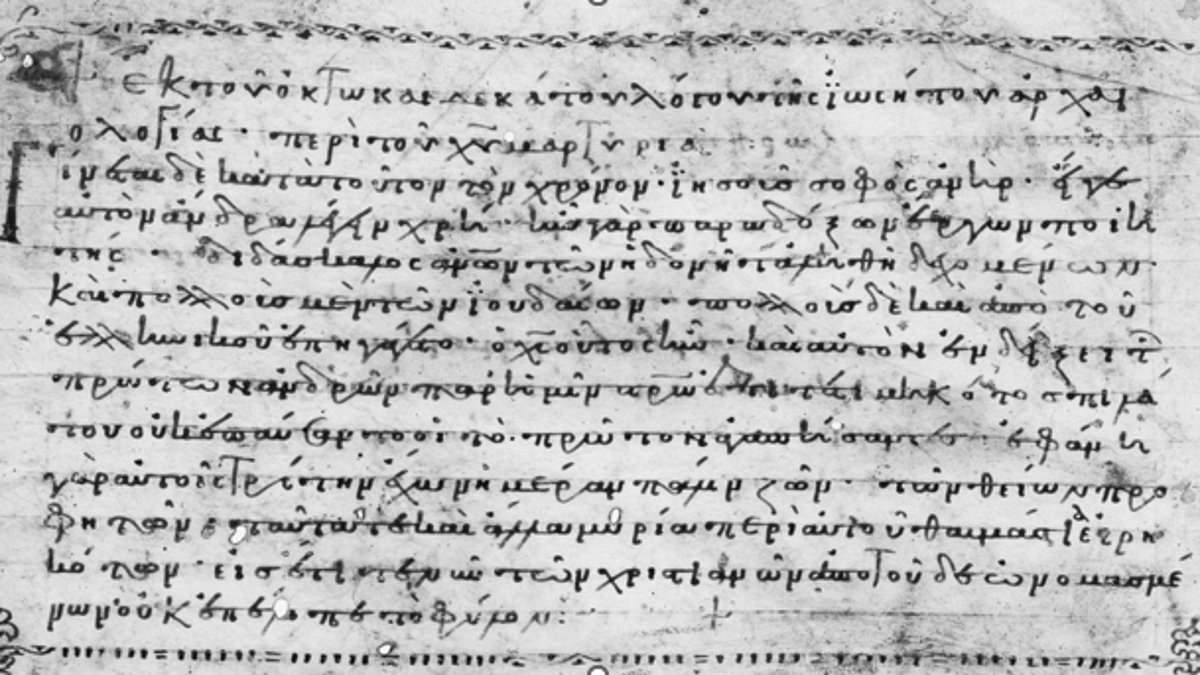
The Bible says Jesus was crucified, rose from the dead on the third day and appeared to his followers nearly 2,000 years ago.Now, a researcher has identified wording in an ancient text that he argues may preserve a first-century written account of Jesus rising from the dead. The disputed passage is attributed to a historian who was not Christian.Known as the Testimonium Flavianum, the passage appears in Jewish Antiquities, a history of the Jewish people that Flavius Josephus wrote around AD 93 to 94 and that was translated into several languages.Independent researcher Jesús Fernández-Pedrera Correa from Spain compared Greek, Latin, Arabic and Syriac versions to investigate which elements may have survived from the original account.The Latin, Arabic and Syriac versions all describe Jesus appearing alive to his followers after his crucifixion.The surviving Greek account states that Jesus appeared alive on the third day and links the event to biblical prophecy, while the Latin states that ‘he appeared to them the third day alive.’The Arabic account specifically presents the appearance as something the disciples reported. Fernández-Pedrera Correa suggests that wording could preserve an earlier passage in which Josephus recorded what Jesus’s followers said they had seen. The Testimonium Flavianum, a passage that appears in Jewish Antiquities, is a history of the Jewish people that Flavius Josephus wrote around AD 93 to 94The four versions appear in works by Christian writers living centuries apart. The Latin account dates to the late fourth century, while the Arabic and Syriac accounts come from the tenth and twelfth centuries. Comparing them gives researchers clues to how the passage changed as it was copied and retold. Comparing these later versions helps researchers work backward to assess which words may have come from Josephus and which were added or altered by Christian copyists. Fernández-Pedrera Correa's new analysis, released in August, revisited the translated versions and argued that their differences offer clues to the passage's earlier form.One clue, the researcher argues, is wording that sounds more like Christian preaching than a non-Christian historian’s account.The surviving Greek version states: ‘He appeared to them alive again on the third day, the divine prophets having foretold these and countless other wonders about him.’Fernández-Pedrera Correa singles out the reference to fulfilled prophecy as particularly Christian language, raising questions about whether Josephus would have written the sentence in that form. Now, a researcher has identified wording in an ancient text that he argues may preserve a first-century written account of Jesus rising from the deadElsewhere, Josephus recorded the beliefs and reports of Jewish religious groups without necessarily accepting them himself. The researcher argued that he could have treated the experiences described by Jesus’s followers in a similar way.That distinction offers a possible explanation for how an earlier historical report could have developed into a stronger statement of Christian belief.However, the researcher acknowledges that this reconstruction remains unproven. The surviving versions cannot establish exactly how much of the resurrection reference Josephus originally wrote.Fernández-Pedrera Correa argues that this pattern could reflect an earlier passage in which Josephus recorded what Jesus’s followers said they had experienced.That would fit the historian’s practice elsewhere of reporting the beliefs and experiences of Jewish religious groups without necessarily accepting them himself.Later Christian copying may have expanded that report into a direct statement that Jesus rose from the dead and fulfilled biblical prophecy.The researcher considers this explanation plausible, particularly given the Arabic wording, but acknowledges that the surviving versions cannot establish exactly what Josephus originally wrote.Scholars have long questioned other statements in the passage that appear to express Christian beliefs, raising suspicions that they were added after Josephus wrote.The clearest case concerns the declaration that Jesus 'was the Christ.' The Latin, Arabic and Syriac versions soften that statement, suggesting he was believed or thought to be the Messiah.The researcher also pointed to Origen, an early Christian writer who said Josephus did not accept Jesus as the Messiah. Together, he argued, those clues provide the strongest evidence that the direct declaration was not the passage's original wording.Another disputed phrase questions whether Jesus should even be called a man, implying he was more than human. It is absent from the Arabic account but survives in the Latin and Syriac versions.The researcher argued that its absence could reflect Agapius shortening the passage, leaving less direct evidence that the phrase was a later addition.Fernández-Pedrera Correa is more confident about the closing statement that Jesus's followers continued to exist in the historian's own day.Its wording and subject fit Josephus's writing habits, he argued, and the versions show no comparable disagreement at that point.
Written account of Jesus rising from the dead identified in 2,000-year-old manuscript, study suggests
Full Article
Original Source
Read the full article at Dailymail →KhanList aggregates and links to publicly available news content. We do not host full articles from third-party sources. Always verify important information with original sources.