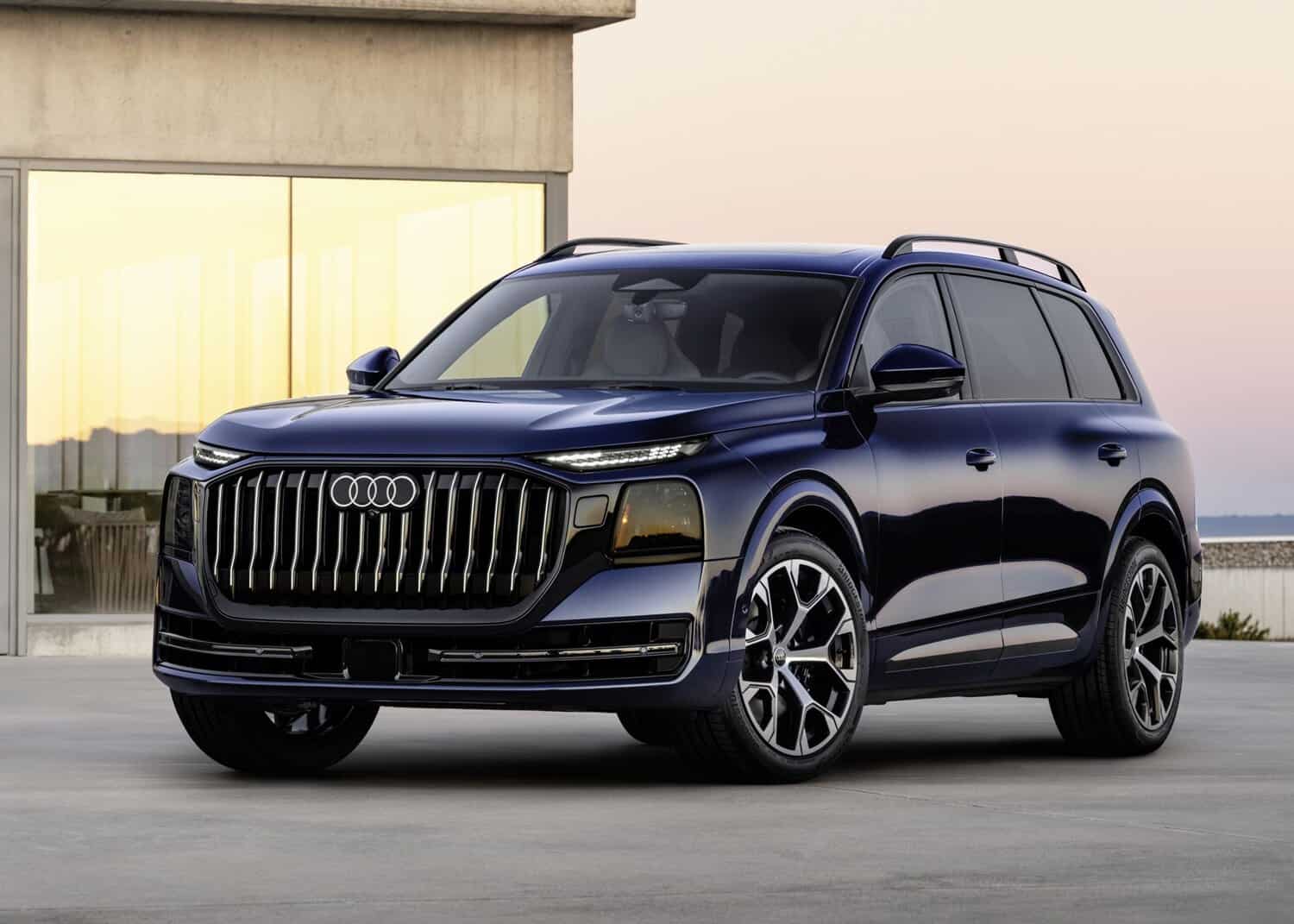
Q9 has been approved for South Africa and will make local market landfall in 2027. Having been on the cards for more than eight years, Audi officially revealed its long awaited all-new Q9 in the early hours of Wednesday morning (29 July). Above Q7 Ingolstadt’s rival for the BMW X7, Mercedes-Benz GLS, Lexus LX and Volvo XC90, the Q9 displaces the Q7 as the brand’s largest SUV that has already been approved for South Africa. Teased on two separate occasions this year, the Q9’s arrival also sees it replace the A8, which was announced in March as ceasing production after 32 years as Audi’s flagship and most technologically advanced product. Dimensions Joining its now “smaller” Q7 sibling, the Q9 rides on the Premium Platform Combustion (PPC), but with the following dimensions: Length: 5 310mm; Wheelbase: 3 140mm; Height: 1 810mm; Width: 2 210mm As such, it is 253mm longer than the Q7, 198mm wider and two millimetres taller. Also longer is its wheelbase by 145mm. Similar to its sibling, the Q9 seats seven, but for the first time in any Audi SUV, can be equipped with six seats utilising a pair of captain’s style chairs in the second row. Different looks Compared not only to the Q7, but also the Q3 and Q5, the Q9 receives a different take on Audi’s latest Singleframe grille design as the inner slats have a horizontal look instead of a honeycomb pattern. Sporting the widest design of any Audi to date, the grille’s outer surround has a black finish, but as an option can be illuminated. Rear facia design is different from any other current Q model. Picture: Audi Retaining the same split headlight arrangement as its siblings, the Q9 gets the otherwise optional Matrix I.Q lights as standard, while the Digital LED Matrix lights, which projects active functions on to the road, can be had as an option. Available with up to 23-inch alloy wheels, the side profile is visibly stretched from the Q7, while the rear facia is unique to the Q9 and sees not only a larger and newer tailgate, but restyled OLED light clusters and the numberplate to the bumper instead of on the bootlid. Kept, though, is the illuminated Audi four rings logo and the full-width LED bar that runs underneath the light clusters. Slight revisions underneath Underneath, the move to the PPC platform, essentially a heavily revised version of the MLB Evo that underpinned the previous Q7, has seen added revisions compared to the new Q7. These include the new adaptive air suspension system as standard, uprated 400mm at the front and 350mm ventilated disc brakes, and all-wheel steering as standard. Inside Showcased in a series of teaser images earlier this year, the interior is near identical to the Q7. Apart from the electrically opening doors, the dashboard has been fitted with three displays as standard; a 12.3-inch digital instrument cluster, the 14.5-inch MMI infotainment display and a 12.3-inch display on the passenger’s side. Q9’s interior is identical to that of the Q7 in look and design. Picture: Audi As with the Q3, the Q9 has the same multi-stalk design for the indicators, lights and wipers on the on, and the gear selector on the other. It has the same flush centre console as the Q7, the same steering wheel and a pair of wireless smartphone charging pads. Q9 will have seven seats as standard, but with the option of a six-seat configuration for the first time. Picture: Audi A further unique addition is an optional 22-speaker, 1 360-watt Bang & Olufsen 4D surround sound system and the standard fitting of a panoramic sunroof which, as on the Q7, uses Polymer Dispersed Liquid Crystal technology instead of a roller blind to switch from transparent to opaque. Ambient lighting is also standard, as are the electrically folding second and third rows, with the optional of having the middle heated when specified in six-seat form. TDI for Europe, TFSI and SQ9 elsewhere On the power front, the European market Q9 carries over the mild-hybrid 3.0 TDI V6 from the Q9 with outputs of 180kW/500Nm or 220kW/630Nm. An additional 18kW for short spells is again provided by the 48-volt system. First ever SQ9 will be solely for markets outside Europe. Picture: Audi Drive is again routed to all four wheels through an eight-speed Tiptronic gearbox. Outside of Europe, two further engine options are provided; the 2.9 TFSI with 320kW/600Nm and the 4.0-litre bi-turbo V8 that makes 441kW/800Nm in the first ever SQ9. Wait till 2027 Available for ordering at the end of July in Europe, priced from €108 400 in Germany, which amounts to R2 065 718 when directly converted and without taxes, the Q9 has been approved for South Africa and will arrive as one of eight models in 2027.
Wraps finally come off South Africa-bound long awaited new Audi Q9
Full Article
Original Source
Read the full article at Citizen →KhanList aggregates and links to publicly available news content. We do not host full articles from third-party sources. Always verify important information with original sources.