
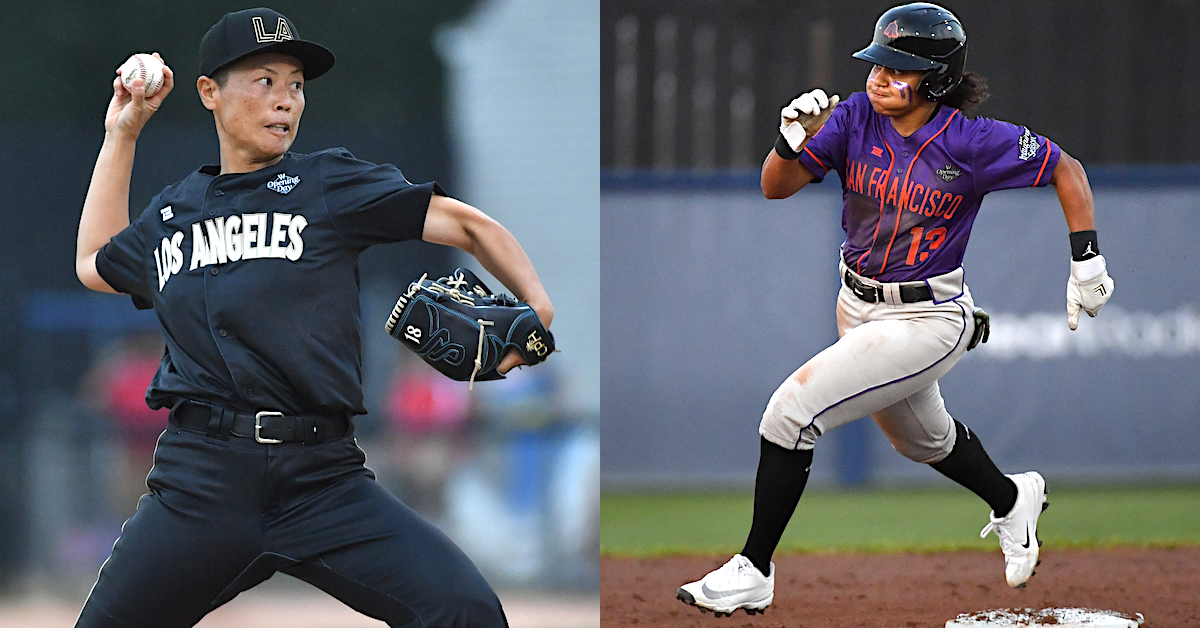
Ron Johnson-Imagn Images Welcome to your weekly WPBL recap! Week Five marked the league’s second-to-last week of the regular season, and several teams are using their last few games to test out new defensive alignments and lineup configurations with an eye toward optimizing their strategies before the postseason. Certain tactics were more effective than others, and as such, no team’s performance this week was an unqualified success. Rather, the teams that flourished demonstrated an ability to puke and rally when things went sideways. As a reminder, these weekly roundups are designed to cover each week’s action by highlighting the most notable players, moments, and anything else I deem worthy of further commentary. For each edition of the recap, I re-license the naming rights to this list of highlights to whichever team I feel has won the week. And how does a team win the week? Well, unlike actual wins and losses in baseball, this type of win is purely subjective and will operate under the time-honored tradition of making it up as we go along. Along with the list of highlights, the Unforced Errors section discusses the more confounding aspects of the prior week because good faith criticism is a necessary component of continuing progress. Rounding things out are the Historic Firsts of Lesser Renown. The league’s momentous firsts will obviously get their shine, but there’s something to be said for the more strange and mundane firsts, the smaller day-to-day occurrences that make a new league feel familiar and complete. Think of these firsts as the knickknacks on a shelf that make a new house feel like a home. Baseball fans won’t really feel settled into a new league until the first time a player on their favorite team commits a TOOTBLAN. If you need a refresher on the league’s structure and mechanics, check out the Week One recap. With only five games this past week, the league’s four teams have no longer played an equal number of games, which makes comparing records slightly trickier, but we’ll get through it together. The Queens (2-1) and the Firebells (2-0) both wrapped the week with two wins, while the Heights (1-2) and the Hunters (0-2) both logged two losses. For the winning teams, it was all about the comebacks. Los Angeles’ Wednesday matchup against Boston and its Saturday meeting with New York each featured three lead changes. San Francisco briefly fell behind Boston on Friday before taking a commanding lead in the bottom of the fourth. Then, on Sunday, the Firebells trailed the Heights from the second inning onward, but a seven-run seventh secured a walk-off win. Following a week of very spiky win probability graphs, here’s how the standings look. Since all four teams make the playoffs, this is more about understanding team quality as a function of how they stack up against one another. You Aren't a FanGraphs Member It looks like you aren't yet a FanGraphs Member (or aren't logged in). We aren't mad, just disappointed. We get it. You want to read this article. But before we let you get back to it, we'd like to point out a few of the good reasons why you should become a Member. 1. Ad Free viewing! We won't bug you with this ad, or any other. 2. Unlimited articles! Non-Members only get to read 10 free articles a month. Members never get cut off. 3. Dark mode and Classic mode! 4. Custom player page dashboards! Choose the player cards you want, in the order you want them. 5. One-click data exports! Export our projections and leaderboards for your personal projects. 6. Remove the photos on the home page! (Honestly, this doesn't sound so great to us, but some people wanted it, and we like to give our Members what they want.) 7. Even more Steamer projections! We have handedness, percentile, and context neutral projections available for Members only. 8. Get FanGraphs Walk-Off, a customized year end review! Find out exactly how you used FanGraphs this year, and how that compares to other Members. Don't be a victim of FOMO. 9. A weekly mailbag column, exclusively for Members. 10. Help support FanGraphs and our entire staff! Our Members provide us with critical resources to improve the site and deliver new features! We hope you'll consider a Membership today, for yourself or as a gift! And we realize this has been an awfully long sales pitch, so we've also removed all the other ads in this article. We didn't want to overdo it. WPBL Team Records Through Week Five Team G W L W% Run Differential Runs Scored Runs Allowed Pythag W% Boston Hunters 12 4 8 .333 -35 68 103 .304 New York Heights 13 6 7 .462 0 103 103 .500 Los Angeles Queens 13 7 6 .538 -3 95 98 .484 San Francisco Firebells 12 8 4 .667 38 119 81 .683 Now, to the players, events, and acts of creative expression that defined the drama of Week Five. I considered crowning the Queens sole victors of the week, despite having an entry in the loss column, since that loss to the Heights on Thursday led to a bounceback win against New York on Saturday. But even with the heroic comebacks, the Queens still have a negative run differential throwing shade at their performance, while the Firebells are 38 runs in the black. And though the list below heavily features Los Angeles, the entries for San Francisco are just as impactful, even if they’re not quite as plentiful. So in the end, it made the most sense to honor all of the comeback queens, even when sometimes those queens happened to be Firebells. The Comeback Qu-Firebells Fan Engagement Fans showing up to the game dressed as the mascot isn’t new, but when the mascot is women’s baseball icon Maybelle Blair, and when a fan who bears very little resemblance to Blair still chooses to cosplay as the mascot, that’s something special. Other things that aren’t new include fan-made signs printed out on regular 8 ½ x 11 copy paper. We all remember SNAKES ALIVE. But putting a printer paper sign in a protective sleeve elevates the concept in a way that is incredibly practical and conveys a level of care heretofore unheard of among printer paper signs. Postseason Prep In general, players in the WPBL are far less locked into their defensive positions when compared to other leagues. The high number of two-way players is partially to blame. Pitching changes can sometimes mean swapping defenders at two or three positions, if the next hurler to take the mound is jogging in from elsewhere on the field. It makes a real mess on the scorecard. As such, defensive versatility is extremely valuable. And though few are formally designated as utility players, primary positions don’t carry as much weight. Filling out the lineup card and making substitutions is a much more complex puzzle for managers to piece together, especially managers new to women’s baseball. Even Heights manager Rocky Henley, who has coached for Team USA and was familiar with a decent chunk of the league’s players heading into the season, still had no say in her team’s roster construction and has had to figure out how to make that specific subset of players fit together on the field. Add in that the WPBL had no preseason games to allow managers the opportunity to scout their own rosters, and it’s no wonder that managers are still tinkering. Jemile Weeks took over as manager of the Hunters a few games into the season, meaning he’s had even fewer opportunities to get to know his roster. When he penciled Alli Schroder into the lineup at first base on Wednesday, it was her first time playing the position since August 2, which pre-dated Weeks’ tenure with the club. “When you’re learning the team and you haven’t been there all season, you start putting people in different places and seeing what they can do,” Weeks told reporters after the game. “As I got more practices in, I got a chance to see [Schroder] on the infield and working in different places.” In her first game back in the field, Schroder (who doesn’t typically hit when she pitches) led the offense with three hits and made an impressive stretch grab on a bang-bang play at first, keeping her foot on the bag as she reeled in a high throw from Denver Bryant at third. Later in the game, Weeks called on Schroder to pitch the team out of a jam as the Hunters attempted to protect a one-run lead. The inning did not go Boston’s way, as Schroder let two inherited runners score and gave up an earned run of her own, but she did rack up three strikeouts to get out of the inning, and if called upon to cover high-leverage relief innings in the postseason, she’ll have some recent reps to build on. While Weeks experimented with putting a pitcher in the field, Queens manager Eric Young Sr. gave a couple of fielders some run on the mound. Outfielder Thaima Maximiliana threw an inning for Los Angeles back on August 5, but she didn’t toe the rubber again until August 23, when she threw an inning and a third. Both times out, she allowed one earned run and looked pretty wild. Then, this past week, Maximiliana added two more outings to her pitching ledger. During Wednesday’s 8-6 win over the Hunters, she pitched 2 2/3 innings and allowed one run on two hits and no walks, and tallied two strikeouts. And in Saturday’s 10-6 win against the Heights, she got the start and went three-plus innings, allowing four earned runs on eight hits and two walks. Though her results haven’t been perfect, she’s added length each time out and dramatically decreased her walk rate. Moreover, when Young made the call to bring Maximiliana into the game in the third inning on Wednesday, it was an act of preservation. Starter Michelle Roche was at 64 pitches and, as Young told reporters after the game, “I didn’t want her to go 70, because our focus is on where we’re going. Our focus is on the playoffs. I have to make sure I’m not trying to wear her out trying to get this game tonight.” The effort to avoid overtaxing his pitchers has led Young to expand his pitching corps. Maximiliana is one such example. In her case, Young admitted he should have made her a regular contributor on the mound sooner. “I just wasn’t smart enough to realize she’s pretty good,” he said following her outing on Wednesday. Another example is infielder Amira Hondras, who made her pitching debut for the Queens on Thursday. Hondras came on in relief of starter Ayami Sato and threw 2 2/3 innings, allowing one run on six hits and no walks. “She’s been telling me the whole season she can pitch,” Young said when discussing Hondras’ outing during the postgame press conference. “Again, another decision I didn’t know about until I heard some of the players say, ‘Yes, she can pitch. She can do this.’ So, I’m learning that as well.” As with Maximiliana, Young didn’t have firsthand knowledge of what Hondras was capable of on the mound, so he had to be willing to trust the scouting report from her teammates and to take a risk. But now he knows what to expect from both Hondras and Maximiliana should he need them to pitch in a postseason game. Upgraded Outfield Celebration What started as the traditional “outfielders jump up and slam into each other” postgame celebration has evolved. There’s choreography now. Whatever Ashton Lansdell Has Instead of a Regular Human Arm I’ve been impressed with Lansdell’s arm since Opening Day. Sure, a lot of it is the strength and accuracy, which you can see in the clip below, as she fields a low liner, then sends a bullet to first to double off Heights first baseman London Studer. But it’s more that the strength and accuracy don’t change even when she’s not able to plant her feet and throw. She can sling it off one foot… … or fire from her knees. Doesn’t seem to matter — it always leads to a baserunner fatality. The Bottom of the Order for the Heights After Week Three, the Heights were 2-5 with a -11 run differential. Two weeks later, they are 6-7 and have now scored exactly as many runs as they’ve allowed. And while they have given up fewer runs per game in recent weeks, the more impactful change has come on offense. For the first few weeks of the season, New York’s offense rested entirely on the shoulders of catcher Denae Benites and right fielder Natsuki Yonetani, and when the pair was combining for an OPS over 2.000, that was a winning formula. But both hitters have cooled off relative to their scorching hot starts, and even though their combined OPS still sits around 1.400, it turns out that’s not quite high enough to carry a lineup. Therefore, it should come as no surprise that New York’s recent turnaround has coincided with a spike in productivity from the bottom half of the order. When the Heights put up 12 runs in a win against the Queens on Thursday, shortstop Emi Saiki contributed four hits from the eight-hole, while second baseman Madison Willan came through with three hits out of the nine-hole. Prior to Thursday, Willan had logged just one hit over 17 plate appearances. Meanwhile, Benites failed to reach base for the first time all season. The Heights lost 10-6 in a rematch with the Queens on Saturday, but the bottom of the order held its own with four of the team’s eight hits. And though Benites did work a walk in this one, she went hitless for a second straight game. On Sunday, the Heights fell to the Firebells, 11-9, but the six-through-nine hitters for the Heights were responsible for five of the team’s seven hits and two of its four walks. And when Benites busted her slump with a grand slam in the second inning, she hit in Claire Eccles (batting seventh), Elodie Ciamarro (batting eighth), and Suzu Narasaki (batting ninth). The Heights may have gone 1-2 on the week, but an extremely top-heavy offense is no longer the source of their struggle. A Statement Tag Defensive tags are an art form in their own right, but I’m not sure I’ve ever seen a tag make a statement before. However, the one applied by Firebells shortstop Joely Leguizamon to seal San Francisco’s 14-6 win over Boston on Friday clearly had something to say. The game’s final play contained a dropped third strike, a throwing error, an off-line throw that wasn’t technically an error but was pretty pointless, and an incredibly rad behind-the-back tag that screams I AM PUTTING A STOP TO THIS NONSENSE RIGHT NOW. A Trope Rejection On numerous occasions, the league’s broadcasters have gone out of their way to try and tap into the regional sports rivalries that exist between Boston and New York and San Francisco and Los Angeles. It’s a bit silly. Most of the players are not from their team’s home city (several are not even from the U.S.), and the teams have not yet played in their home cities or had a chance to connect with the fans that live in those cities and experience those rivalries. But usually when the broadcast mentions a budding rivalry, it’s easy enough to shrug off, and I can’t really blame them for wanting to crank up the narrative machine and add some stakes to a regular season that counts for very little. But when they try to bring the players in on the bit, it backfires every time. For reasons unknown to the viewer, the broadcast often doesn’t have a traditional color commentator, and instead they bring a player or coach into the booth for a multi-inning interview. During these interviews, they often ask players about the rivalry they feel toward other teams. Without fail, these interviewees immediately start gushing about how much they love so many of the other players in the league and explaining that they’ve all known each other for years because they grew up playing together on national teams and on various other circuits. And not only is it very funny that this keeps happening every time the announcers try to make a rivalry happen, it also reveals a far more interesting dynamic than your standard rivalry trope. These women all have a long, winding history with one another on the field, and they’re bringing that entire history with them every time they suit up for a game in the WPBL. Way back on Opening Day, as the Queens faced off against the Heights, the second batter to step into the box against Sato was Yonetani. During a media availability prior to the game, Sato explained that while pitching in Japan, she’d faced Yonetani many times over the years. Then she joked that she hoped Yonetani didn’t give away all of her tactics to the rest of the Heights hitters. However, at least one of Yonetani’s teammates didn’t need any inside information; Kylee Lahners has played for Team USA since 2018 and faced Sato and Team Japan several times during that span. Here’s how Lahners fared in her first trip to the plate vs. Sato on Thursday: Sato has faced the Heights three times this season, and in those starts, Lahners has gone 4-for-6 with a home run, a double, and a hit-by-pitch. A few innings after Lahners homered off Sato, Michelle Roche (who got the start in right field that night) stepped into the box to face Heights closer Jaida Lee. “We’re pretty good friends off the field, and I’ve never faced her before,” Roche told reporters after the game. “I think she thought she could blow her fastball by me, so I was pretty ready for it.” Ready indeed. “I know she wanted to strike me out, but yeah,” Roche concluded. And sometimes the code switch from competitor to friend and back again doesn’t require a ton of exposition. In the immortal words of John Kruk, “That’s just people helping people.” Two-Way Whitmore While it’s true that two-way play is more common in women’s baseball than it is in the men’s game, it’s still pretty rare to find a player who truly excels on both sides of the ball. Most two-way players in the WPBL are good-to-great at one thing and passable at the other. And even those who are above average at both find it difficult to pair dominance on the mound with a productive day at the plate in the same game. Firebells two-way player Kelsie Whitmore is the only qualified hitter in the top five by OPS who also makes weekly starts on the mound. Whitmore’s nearest competitor in balanced two-way play is teammate Jill Albayati, who ranks sixth in OPS (1.200 compared to Whitmore’s 1.805). Albayati has pitched better than Whitmore, but due to a hamstring strain, she’s only accumulated half as many innings. Before this week, Albayati owned the most impressive two-way performance within a single game. On August 8, she went 3-for-3 at the plate with a walk and two RBI, and she threw four scoreless innings that featured four strikeouts, just one walk, and five hits. On Friday, Whitmore joined Albayati with a striking two-way performance of her own. She pitched five innings, and though she allowed three runs, she also logged six strikeouts (setting a new league record for most in a start and tying the league record for the most in a single outing). At the plate, Whitmore notched a double, a home run, three RBI, and two walks. And for what it’s worth, Whitmore is still working to improve her ability to juggle the two tasks within the same game. In her postgame media availability on Friday, she said, “This game was the most deep breaths I’ve taken, just to slow down the inning.” She was speaking to how the game can feel sped up, especially when making the mid-inning transition back to pitching from hitting. And if this is how she plays when she feels rushed, the rest of the league better hope she doesn’t master that breathwork and learn how to consistently get into a rhythm. Otherwise it’s over for everyone else. The Andréanne Leblanc Walk-off Grand Slam On Sunday night, the Firebells entered the bottom of the seventh trailing the Heights by a score of 9-4. Claire O’Sullivan came on to pitch for the Heights in relief of Jacqui Reynolds. Things unfolded as follows: hit-by-pitch, single, error, double, strikeout, lineout, intentional walk, single. And then — finally — this: Unforced Errors Messy Legal Filings Last week, Mina Kim, a member of the WPBL’s Board of Directors, filed a records request with a Delaware court regarding what she described as “improper stonewalling” in response to a separate records request made to the league itself on June 12. Kim’s concerns center on undisclosed conflicts of interest and wire transfers that were completed without proper board approval. In response to the filing, the league released a statement alleging that the litigation is motivated by a personal grievance and claims. “All of the other board members of the WPBL are opposed to Ms. Kim’s proceedings,” the league said, “and stand unified in their repudiation of any allegations or assertations made by Ms. Kim.” Tamara Holmes, an independent director of the WPBL, said in a separate statement: “Our players have waited too long to have this league and now is time for solidarity and support. Too much is at stake to be distracted by something like this.” Holmes is correct in her assessment that this type of distraction is detrimental to the league, but a problem clearly exists, be it financial impropriety or personal grievance, and sweeping it under the rug in the name of solidarity will only allow the situation to fester and create larger problems for the league moving forward. The Broadcast Completely Missing Key Moments Twice during Sunday’s game between San Francisco and New York, Firebells manager Matt Williams came onto the field to animatedly discuss a call made by the officials. First, in the bottom of the fifth, Firebells third baseman Jua Park flied out to center field with runners on first and second. Initially, the runners did not tag up in an attempt to advance. The broadcast then switched to a shot of Park heading back to the dugout. Several seconds later, it became clear that something happened off camera. As the camera angle shifted back to the infield, Alexia Jorge (who was the runner at second to start the play) seemed to have just slid into home and looked livid about whatever call the umpire had made. Williams was visible on the field arguing his case, but there weren’t enough context clues for the viewers or commentators to assess what was happening. Eventually, the broadcasters got word that the runners attempted to advance after the ball had been ruled dead, but no further explanation was given about what actually happened with the ball once it was thrown back to the infield. Just one inning later, in the bottom of the sixth, Leguizamon was called out after swinging at the first pitch of the plate appearance. The booth was able to infer that batter’s interference was called, but nevertheless, Williams rushed out to argue the call. At this moment, the broadcast chose to cut away from the conflict on the field to do a segment in the stands with sideline reporter A.J. Andrews and the owner of the local training facility where the Firebells have been practicing. Most of the dispute between Williams and the umpire happened off camera. A picture-in-picture shot caught the tail end of the exchange before the full shot resumed as Williams retreated to the dugout. In both cases, the Firebells were attempting to mount a comeback and a pivotal call thwarted their efforts, but viewers were not able to understand what was going on, much less properly experience the drama unfolding on the field. Historic Firsts of Lesser Renown In the bottom of the fifth inning of Friday’s game against the Firebells, Hunters catcher Beth Greenwood was called for catcher’s interference when Jua Park’s 2-0 swing made contact with Greenwood’s glove.
WPBL Week Five: The Comeback Qu-Firebells
Full Article
Original Source
Read the full article at Blogs →KhanList aggregates and links to publicly available news content. We do not host full articles from third-party sources. Always verify important information with original sources.