
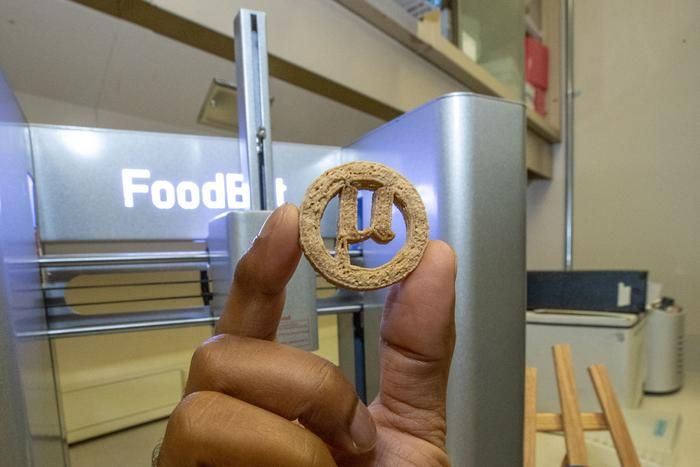
A team of researchers programmed yeast to turn broken-down plastic and agricultural waste into sweet treats called µBites. They might come in handy during deep-space missions or in disaster zones, although some critics say the food is impractical August 31, 2026 11:42 a.m. A µBites cookie, which is pronounced "microbites" SIU Carbondale Communications Researchers may have addressed three problems with one stone—or rather, one cookie. On August 24, a team presented µBites (pronounced “microbites”), edible cookies made from upcycled plastic, at the American Chemical Society Fall 2026 meeting in Chicago. They created the sweet treats by programming microbes to turn plastic and agricultural waste into proteins and flavoring molecules, adding some traditional food ingredients and then producing the cookies with a 3D printer. The innovative snacks could one day come in handy during deep-space crewed missions or in disaster zones, and they could even help address world hunger. “When an astronaut goes to Mars, they have to survive in extreme conditions,” Lahiru Jayakody, a microbiologist at Southern Illinois University Carbondale who worked on the research, tells the Guardian’s Hannah Devlin. “The round-trip is three years. You have to use everything you have.” Jayakody and colleagues invented the cookies as a way to feed future Mars-bound astronauts as part of NASA’s Deep Space Food Challenge, and they described their initial process in 2024 in the journal Trends in Biotechnology. It involves using water and oxygen at high temperature and pressure to turn carbon-based waste materials, including PET bottles and biomass like corn plant stalks, into smaller molecules. Then, genetically engineered microbes, specifically different strains of yeast, munch on those pieces and transform them into nutrients including proteins, fats and acids. Adding fiber, starch and sweetener to the mixture results in a dough-like substance that can be extruded through a 3D printer, and voila—freshly printed protein-rich cookies. Quick fact: Other Deep Space Food Challenge projects In 2021, NASA and the Canadian Space Agency chose 38 teams that would each receive $25,000 to develop a proposed idea to feed astronauts on a long voyage. Some winners of that phase included a project to create protein through gas fermentation and another to make ready-to-bake bread packaged in a multifunctional plastic bag. But the goods presented at the conference earlier this month went a step further. Since the original work, Sandhya Jayasekara, a microbiologist at Southern Illinois University Carbondale, has programmed yeasts to convert broken-down plastics and agricultural waste into even more cookie ingredients. The microbes can now make vanillin, the chemical compound for the flavor and scent of vanilla, as well as beta-carotene, a nutrient in carrots and other fruits and vegetables that the body turns into vitamin A. “We’re using microbes to develop the cookie into a more attractive, consumer-friendly product,” Jayasekara, who presented the research at the ACS meeting, says in a statement. Whether consumers are ready for this sort of food remains an open question. Vanilla flavoring might not be enough to get over the plastic hump, especially with more research finding microplastics in the human body, although scientists aren’t sure about the potential health effects. Still, with the cookies, “it’s important to note that humans aren’t eating raw plastic,” Forbes reporter Mary Whitfill Roeloffs tells James Coomarasamy on the BBC’s “Global News Podcast.” The plastics are being broken down into nutritional molecules, which go into the food, she notes. Nevertheless, “I think that if I was in a disaster zone and didn’t have anything else to eat, that I would eat it, but I’m not sure I would pick it off the shelf over an Oreo.” Would you eat this cookie? | Headline Science For now, no one is eating the cookies. µBites are safe to eat, according to the researchers’ data, but the team still needs the institutional green light before they can carry out taste tests. So far, participants have sniffed the printed goods, which apparently smelled good. Most of them said they would consume µBites in resource-limited contexts. Jayakody hopes the cookies will be ready for public consumption within a few years and that they could one day help reduce world hunger. “Global food demand is expected to rise 35 to 56 percent by the year 2050, and about 30 percent of the world population will be at risk of hunger in the future,” he says in the statement. “The way to address that, I believe, is by using microbes.” Not everyone’s convinced. Jason Hallett, a chemist at Imperial College London who was not involved in the study, doesn’t think the cookie will have practical applications, especially for addressing plastic pollution. “We produce 400 million tons a year of plastic waste. You’re not going to turn it all into cookies,” Hallet tells New Scientist’s Matthew Sparkes. “So, it’s not a solution to the plastic-waste crisis. There’s no way you could do this commercially. We’re not gonna be eating plastic cookies.” Stephen Wallace, a chemist at the University of Edinburgh in Scotland who also wasn’t involved in the work, was more diplomatic. “It is an exciting demonstration of what biological upcycling could achieve,” he tells Chemical Engineer’s Sam Baker, but “there are important questions around safety, scalability and public acceptance.” You Might Also Like Get the latest stories in your inbox every weekday. More about: Chemistry Food Hunger Natural Disasters Plastic Pollution Space Travel
Would You Eat a Cookie Made From Upcycled Plastic? Scientists Propose a New Way to Deal With Waste and Provide Food in Extreme Environments
Full Article
Original Source
Read the full article at Smithsonianmag →KhanList aggregates and links to publicly available news content. We do not host full articles from third-party sources. Always verify important information with original sources.