
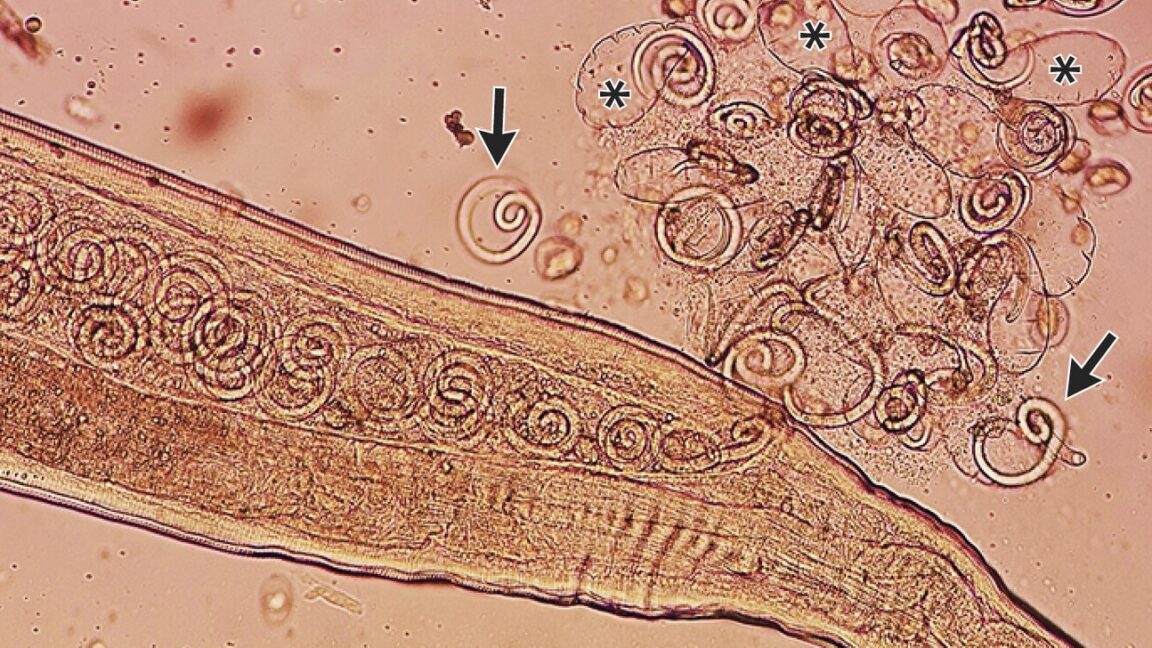
The worms’ life cycle depends on flies that feed from the animals’ eyes, slurping up tears and secretions. When they feed from an infested eye, the flies can pick off the worms’ first-stage larvae, which use the insect as both an incubator and an air taxi. Inside the fly, the larvae molt twice, becoming third-stage larvae, which then migrate to the fly’s mouthparts and await the next stop at a suitable watery eyeball. The larvae disembark their flying nannies and take up a permanent peeper residence, where they develop into adults after one more molt. Adult worms then live and mate directly on a victim’s eyes. Worm measuring 11 to 20 mm in length were removed with fine forceps (Panels A and B). Some of the female worms (Panel C) were pregnant and released embryonated eggs (asterisks) and densely coiled first-stage larvae (arrows) from their uteri. The male worms had ventrally curved posterior ends with copulatory spicules (Panel D, arrow) Worm measuring 11 to 20 mm in length were removed with fine forceps (Panels A and B). Some of the female worms (Panel C) were pregnant and released embryonated eggs (asterisks) and densely coiled first-stage larvae (arrows) from their uteri. The male worms had ventrally curved posterior ends with copulatory spicules (Panel D, arrow) Credit: New England Journal of Medicine, 2026 Unlike other worms, female T. callipaeda are ovoviviparous, meaning that embryos develop within eggs inside the female worm’s body. Females release large broods of densely coiled first-stage larvae, which await being lapped up by a thirsty fly. Some of the female flies pulled from the man’s eyes were plump with embryonated eggs. Doctors noted that coiled larvae began bursting out of some of them after they were pulled from the man’s eyes. The male worms, meanwhile, were identified by their copulatory spicules, needle-like structures used to facilitate mating. Luckily for the man, having all of the adult worms plucked from his orbs meant the infection was over—no antiparasitic medication required, even if some of the larvae had been left behind. At a follow-up appointment two months later, doctors noted that all his eye symptoms had resolved and there were no more worms.
Worms mate in man's eyes, get plucked out right before larvae burst out
Full Article
Original Source
Read the full article at Arstechnica →KhanList aggregates and links to publicly available news content. We do not host full articles from third-party sources. Always verify important information with original sources.