
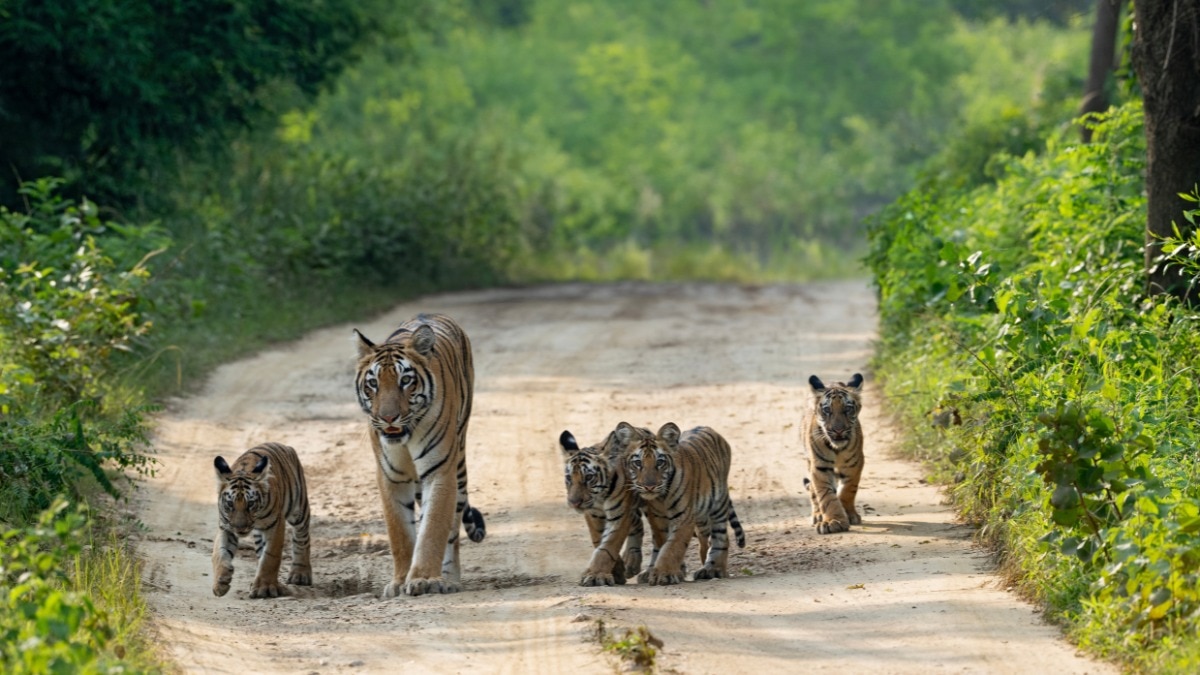
The world’s monitored wildlife populations have shrunk by an average of 73 per cent in 52 years, according to WWF’s Living Planet Report 2026, released on October 8. But the report, produced with the Zoological Society of London (ZSL), argues the slide is not inevitable, and points to India’s big cats as evidence.The Living Planet Index draws on 35,803 population trends across 5,790 vertebrate species between 1970 and 2022. Freshwater ecosystems fared worst, with an 85 per cent fall, followed by terrestrial (69 per cent) and marine (59 per cent). Latin America and the Caribbean saw the steepest regional decline at 95 per cent, then Africa at 80 per cent and Asia-Pacific at 49 per cent. North America (28 per cent) and Europe and Central Asia (23 per cent) show smaller falls, partly because large-scale damage there predates 1970.The figure does not mean 73 per cent of animals have vanished. It is the average proportional change in monitored populations. Half of those populations are stable (7 per cent) or increasing (43 per cent), but the declines are larger than the gains. Habitat loss is the most commonly reported threat, followed by overexploitation, climate change, pollution, invasive species and disease.Among the recoveries the report cites are green turtles, bluefin tuna, southern African elephants and tigers. Global wild tiger numbers rose from 3,200 in 2010 to around 5,700 in 2025. India’s latest count stands at 3,682, as per the 2022 All India Tiger Estimation. Other Indian species on the rise include the greater one-horned rhino (3,300-plus), the common leopard (13,874) and the snow leopard (718). The Asiatic lion has grown from 674 in 2020 to 891 in 2025. India’s first range-wide river dolphin assessment, covering 8,507 km of 28 rivers in 2021-23, estimated 6,324 Ganges river dolphins.Conservation alone cannot reverse the losses, the report says. It blames three systems: food, which drives habitat loss; energy, which fuels climate change; and finance. In 2023, around $7.3 trillion flowed into nature-harming activities, against $220 billion for protecting or restoring nature. A $1.3 trillion annual biodiversity financing gap remains.Citing University of Exeter research, the report says a positive tipping point, where change becomes self-reinforcing, has already been passed in energy. It says India is shifting to a solar-powered economy faster than China. India met its target of 50 per cent non-fossil installed capacity by 2030 five years early, and non-fossil sources made up 54.88 per cent of capacity as of August 31, 2026. Its new target is 60 per cent by 2035.“Twenty-five years ago, decoupling growth from fossil fuels seemed almost impossible. Today, India has taken significant leadership in energy, and there is movement in redesigning agriculture too. Despite the challenges, the solutions are there. If we work on them collectively, growth, development and conservation can happen side by side,” says Sejal Worah, programme director, WWF-India.The recovery of flagship species such as tigers and lions is commendable on one hand, but it hangs in fragile balance on the other. Tiger range has grown 30 per cent in two decades, but forest cover has shrunk by 92,989 sq km between 2011 and 2021, nearly half of it inside reserve forest areas. With 45 per cent of tigers now living in multiple-use habitats, the animals are sharing space with 66 million people. The human toll is also rising: over 600 deaths between 2014 and 2024, with fatalities climbing after 2022 as tigers increased about 6 per cent a year. Contrary to tiger habitats spread in 58 wildlife reserves across 18 states, the lion population is growing under significant threat, being confined to singular habitat in the Saurashtra peninsula of Gujarat. Spread over 35,000 sq km of the Gir landscape, the habitat is shared with industry, farmlands, highways, rail tracks and urban settlements.Subscribe to India Today Magazine- Ends
World's wildlife down 73% since 1970, but India's big cats defy the slide
Full Article
Original Source
Read the full article at Indiatoday →KhanList aggregates and links to publicly available news content. We do not host full articles from third-party sources. Always verify important information with original sources.