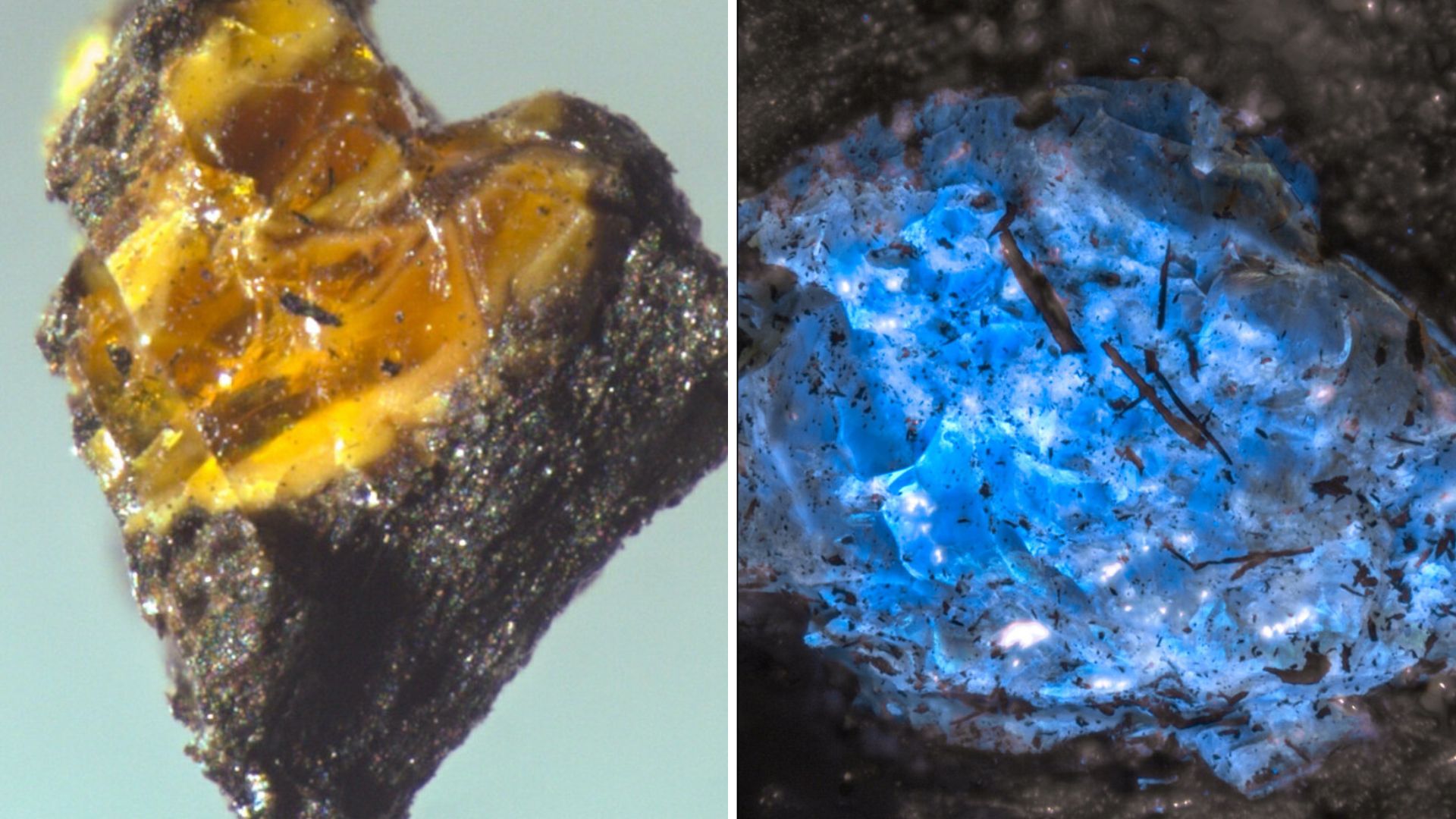
A 385-million-year-old amber (fossilized tree resin), which is the oldest of its kind, has been discovered in the Xinjiang region of China. The team from the Chinese Academy of Sciences’ Nanjing Institute of Geology and Paleontology identified and verified this world’s oldest amber. Interestingly, it pushes back the confirmed timeline for plant resin production by roughly 65 million years. Researchers isolated 241 tiny amber fragments (0.1 mm to 1.5 mm wide) from 10 kg (22 pounds) of coal collected in West Junggar, Xinjiang. They were expecting ancient plant fossils, but not amber. Early defensive role Amber forms through complex geological processes that fossilize tree resin over millions of years, turning it into a natural time capsule capable of preserving delicate organic molecules, insects, and tiny organisms from ancient ecosystems. Until this recent discovery, every confirmed piece of amber found isolated in rock had come strictly from seed plants — the advanced plant group that includes modern trees and conifers. Discovered in 2019, the fragments do not look like much. Yet when hit with ultraviolet light, these microscopic specks burst into a vibrant, electric blue. Further chemical testing confirmed the particles as true amber. Chemical spectroscopic analysis reveals signatures similar to modern conifer-type resin, pointing to the early presence of complex enzymes like terpene synthase. Until now, experts widely assumed that complex resin synthesis was an evolutionary trick reserved for seed-bearing plants, which didn’t spread until much later. This discovery changes these assumptions. In the Middle Devonian world, plants were just beginning to conquer land. Forests were primitive. Dinosaurs were still millions of years away. Even hungry leaf-munching insects had barely shown up. So why make sticky, chemically complex resin? In this ancient time, primitive tree-like plants likely relied on resin as a vital survival tool. Rather than fighting off plant-eating animals, which had not yet widely evolved, these early land plants used the sticky compound as a waterproof, antimicrobial bandage to quickly seal physical tears caused by wind or wildfires. It also shielded exposed tissue against invasive fungi thriving in moist swamp environments. “The early emergence of resin production may have promoted the ecological success of Devonian-Carboniferous terrestrial floras by enhancing protection and wound sealing,” the researchers wrote in the study paper. Primeval candidates The amber likely came from Earth’s earliest tree-like plants, long before modern seed plants or flowers existed. Scientists point to two main primeval candidates: progymnosperms (evolutionary stepping stones that had wood like modern pine trees but reproduced with spores like ferns) and arborescent lycopsids (giant, scaly, tree-sized club mosses). Though primitive, these ancient plants had already developed the complex internal plumbing needed to synthesize sticky, protective resin. This early emergence of resin likely gave Devonian-Carboniferous land plants the durability and protection they needed to thrive and conquer ancient terrestrial ecosystems. Before this discovery, the oldest chemically verified amber ever extracted from rock reportedly dated back roughly 320 million years to the Late Carboniferous period. This era coincided with a major milestone in Earth’s history: the emergence of the world’s very first plant-eating animals. The findings were published in the journal Science Advances. Recommended ArticlesGet the latest in engineering, tech, space & science - delivered daily to your inbox.Mrigakshi is a science journalist who enjoys writing about space exploration, biology, and technological innovations. Her work has been featured in well-known publications including Nature India, Supercluster, The Weather Channel and Astronomy magazine. If you have pitches in mind, please do not hesitate to email her.
World’s oldest 385-million-year-old amber found in China shifts plant timeline
Full Article
Original Source
Read the full article at Interestingengineering →KhanList aggregates and links to publicly available news content. We do not host full articles from third-party sources. Always verify important information with original sources.