
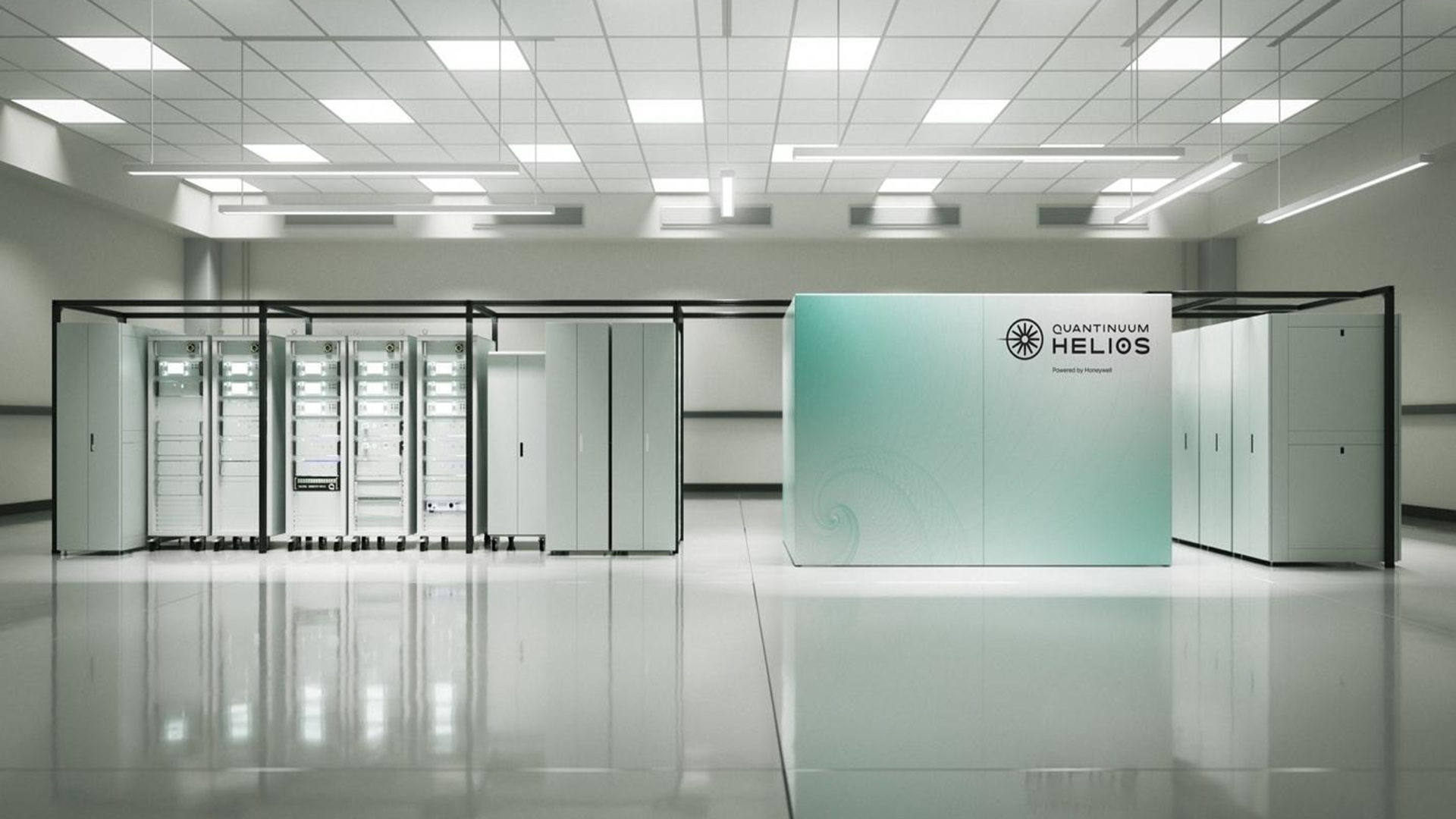
The world’s most accurate quantum computer has reportedly set a new record in quantum error correction, after achieving 99.9995 percent logical fidelity and an error rate 100 times lower than Google Quantum AI’s published result. Helios, Colorado-based Quantinuum’s 98-qubit trapped-ion commercial quantum computer, made just five errors per million logical operations in its latest tests. As per the company, the results bring quantum computers closer to everyday use. The Honeywell-powered computer’s error rate is currently 10 times lower than its previous record from September 2026. Additionally, it is 100 times lower than the best published result from competing hardware technologies, reported by Google Quantum AI. Quantinuum revealed that the achievement brings it closer to developing Apollo, its planned universal fault-tolerant quantum computer. The company expects to launch the system by 2029. “With this result, we’ve proven that we have the error-correction architecture and trapped-ion technology required to achieve universal fault-tolerance,” Rajeeb Hazra, PhD, Quantinuum CEO, stated. Record low quantum errors Quantum computers use qubits to process data, but these are highly sensitive to outside disturbances. Heat, stray electromagnetic signals, vibrations, and cosmic rays can disrupt their delicate quantum states, causing errors during calculations. Because of this, scientists use quantum error correction to reduce mistakes. The method combines multiple physical qubits into more reliable logical qubits that can better protect information. For its latest experiment, Quantinuum used a technique known as a color code on its commercial Helios system. It hit 99.9995 percent logical fidelity, thus setting a new benchmark for quantum error correction. The Helios chip, which generates tiny electromagnetic fields.Credit: Quantinuum Meanwhile, the team also evaluated how Helios performed as they increased the code distance, which determines how strongly quantum information is protected against errors. Each tested increase reduced the remaining logical errors by a factor of 12. According to the team, adding further error correction could significantly improve the reliability as quantum computers become larger. The tests also indicated that practical fault-tolerant system could need fewer physical qubits than expected. Robin Blume-Kohout, PhD, Sandia National Laboratories’ Quantum Performance Lab co-director, who was not involved in the study, described the results as an important milestone. “The paper demonstrates real, serious performance gains from quantum error correction – a logical qubit nearly 100 times better than its component physical qubits.” Two major breakthroughs The news comes a month after the firm announced its first major breakthrough. At the time, the team utilized a different error-correction method called Helix to demonstrate record-setting logical memory and computation. Both experiments were carried out on the same Helios hardware. This proved that the company can improve performance by changing its error-correction methods without replacing the computer. The Helix method required 10 physical qubits for each logical qubit, while the newer color code used as many as 37. Although the color code required additional qubits, it delivered significantly lower error rates. To detect and fix mistakes during quantum calculations, Quantinuum combines AI decoding with real-time error correction. The company believes the latest results strengthen its plans to introduce Apollo by 2029. “A scaled-up version of this system could reach the reliability required for useful fault-tolerant computation at a feasible size – less than a million physical qubits – which improves the outlook for practical quantum computing,” Blume-Kohout said in a press release. “These findings go a long way to retire one of the field’s central technical risks.” Get the latest in engineering, tech, space & science - delivered daily to your inbox.Based in Skopje, North Macedonia. Her work has appeared in Daily Mail, Mirror, Daily Star, Yahoo, NationalWorld, Newsweek, Press Gazette and others. She covers stories on batteries, wind energy, sustainable shipping and new discoveries. When she's not chasing the next big science story, she's traveling, exploring new cultures, or enjoying good food with even better wine.
World’s most precise quantum computer hits 99.9995% accuracy, slashes errors 10x
Full Article
Original Source
Read the full article at Interestingengineering →KhanList aggregates and links to publicly available news content. We do not host full articles from third-party sources. Always verify important information with original sources.