
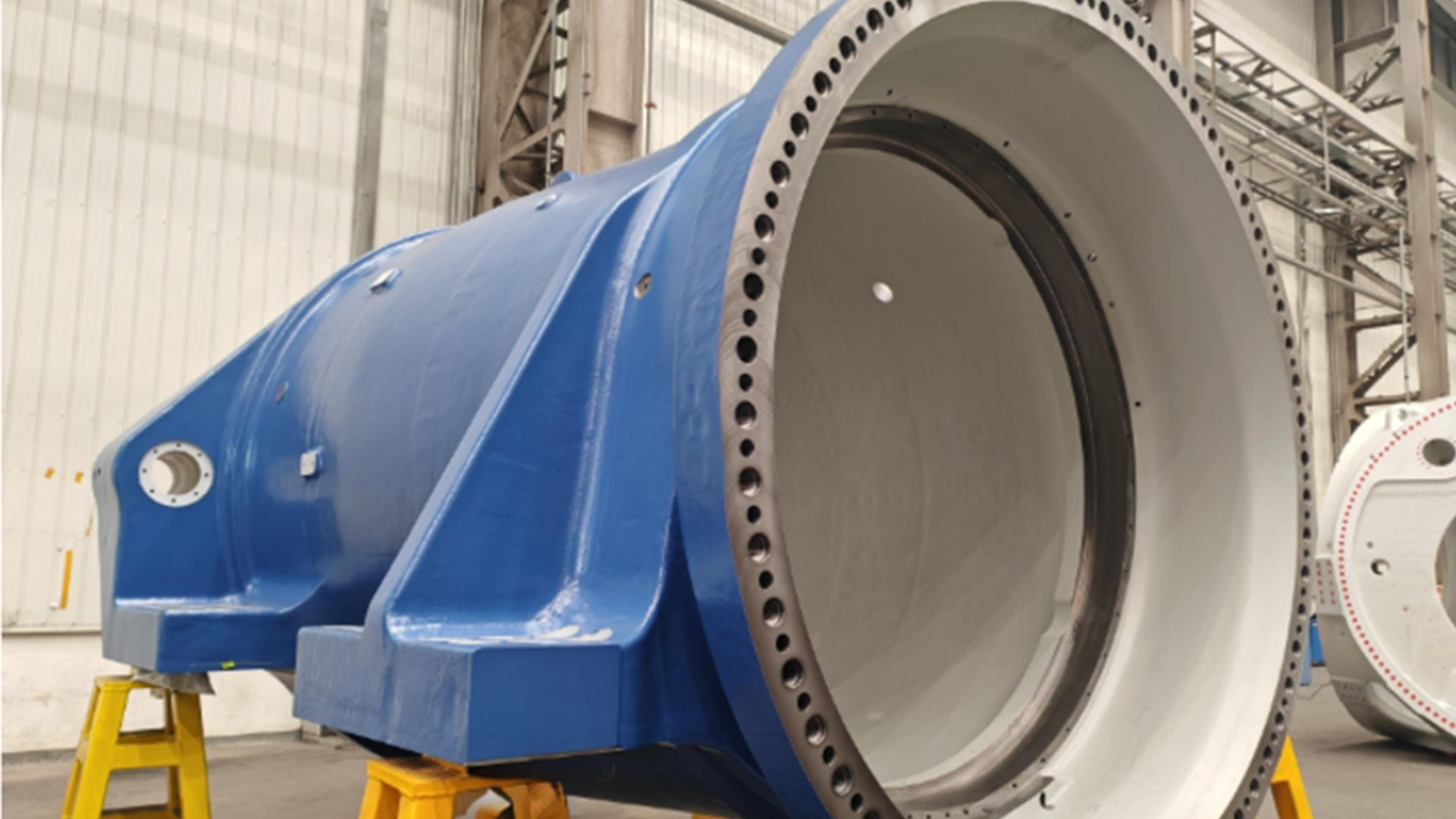
China has delivered the core castings for a 15-megawatt (MW) onshore wind turbine, marking a major step in the development of extra-large components for land-based wind power, as reported by Science and Technology Daily on August 12. The components were developed independently by Dalian Huarui Heavy Industry Group Co., Ltd. (DHHI). They are designed for a 15 MW doubly fed onshore wind turbine and include the bearing housing and base castings. This delivery shows the ongoing effort to build bigger onshore turbines that can generate more electricity from each unit. Castings built for extreme loads The bearing housing and base are key parts of the turbine’s structure. They have to support the heavy weight of the machinery and handle the forces from the wind and spinning blades. Loads from the blades and hub are transferred through these components toward the generator. This allows the turbine’s main shaft to maintain stable rotation while operating under changing conditions. According to Science and Technology Daily, the delivered products passed all customer inspections and tests on the first try before being delivered. Making parts this large needs careful control of materials and precise manufacturing. Even small flaws in big castings can affect how well they handle the forces during turbine use. One turbine can reach 16 MW DHHI designed the turbine parts in modules, so the system can change its power output based on how it’s running. The turbine can work at different power levels, from 13 MW to 16 MW. This helps it adjust to various wind conditions in different places. This flexible setup also makes the turbine a good fit for places where wind speeds and conditions change a lot. A higher output lets developers better match the turbine’s performance to local wind resources. Rotor spans up to 853 feet The turbine’s rotor is between 240 and 260 meters (about 787 to 853 feet) wide. It can be set up on towers from 135 to 190 meters (about 443 to 623 feet) tall, depending on the setup. The blades sweep an area of about 53,000 square meters (roughly 13.1 acres). Science and Technology Daily said this is about the size of eight standard soccer fields, each 105 by 68 meters. The huge rotor allows the turbine to cover a large area as the blades spin so that it can capture more wind energy from one installation. Giant castings raise manufacturing demands Making castings for such a big turbine is a major engineering challenge. The materials have to be very strong, and the casting process must keep quality high across these huge parts. Dimensional accuracy is also critical because the components must fit precisely within the turbine’s drivetrain and supporting structure. Internal defects that may be insignificant in smaller castings can become serious concerns when components grow to this scale. The successful validation and delivery of the parts demonstrate DHHI’s research, development, and manufacturing capabilities in producing super-large wind power castings, according to Science and Technology Daily. The achievement also reflects the industry’s broader move toward higher-capacity onshore turbines, where larger machines can potentially increase electricity generation from individual land-based wind installations. Get the latest in engineering, tech, space & science - delivered daily to your inbox.A versatile writer, Sujita has worked with Mashable Middle East and News Daily 24. When she isn't writing, you can find her glued to the latest web series and movies.
World’s most powerful 15-megawatt onshore wind turbine gets giant new castings
Full Article
Original Source
Read the full article at Interestingengineering →KhanList aggregates and links to publicly available news content. We do not host full articles from third-party sources. Always verify important information with original sources.