
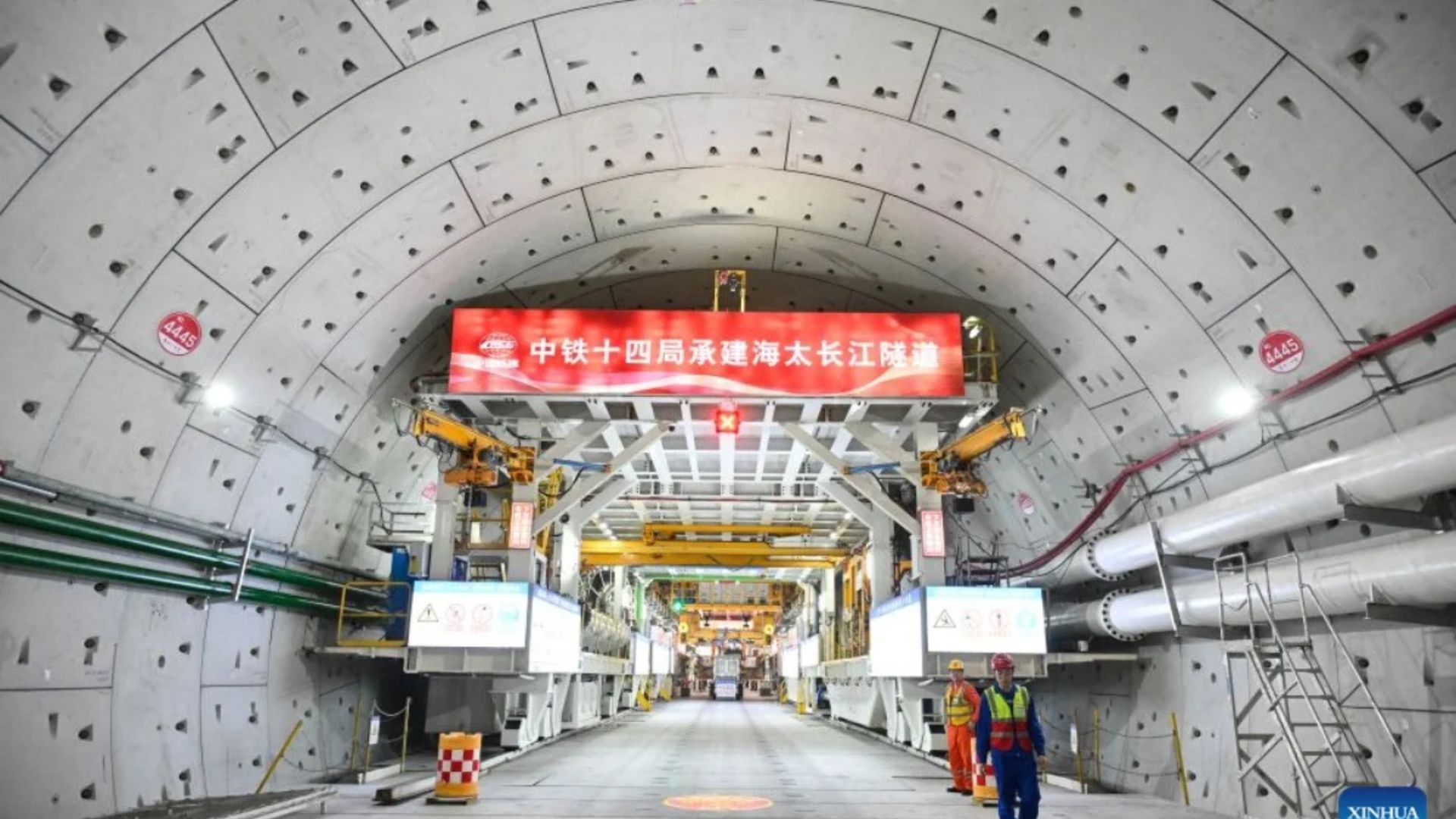
A colossal feat of modern engineering has successfully carved its way beneath China’s river. On Thursday, the right-hand bore of the Haitai Yangtze River Tunnel reportedly reached the south bank. Yangtze River Tunnel is said to be the world’s longest underwater shield-built highway tunnel. It is the first of the tunnel’s two parallel passages to complete the perilous sub-river crossing. Powering this milestone is a homegrown behemoth named Jianghai. This domestically developed tunnel boring machine has a huge excavation diameter of 54.6 feet (16.64 meters). It chewed through rock and riverbed silt for roughly 14 months to complete the 4.64-mile (7.46 kilometers) under-river stretch. Mechanical giant conquers the Yangtze Full construction began in September 2022, and the tunnel is scheduled to open to traffic in 2028. Excavation started on the north bank in April 2025, and crews pushed beneath the riverbed five months later in September. Advancing at an average pace of around 66 feet (20 meters) a day, the machine steadily carved out a vital new artery for eastern China, according to Meng Defeng, who oversees shield tunneling for the China Railway 14th Bureau Group. Once fully operational, the Haitai tunnel will reshape regional travel. The dual-bore corridor stretches approximately 24.28 miles in total, including a 6.95-mile underwater section. It links Haimen in Nantong with Taicang in Suzhou, uniting two economic powerhouses in Jiangsu Province. Once operational, drivers will cross the river between Nantong and Suzhou or Shanghai in just 10 minutes. Commuters and freight haulers moving between Nantong, southern Jiangsu, and Shanghai will soon see dramatic cuts in travel time. Faster transit will tighten economic integration across the bustling Yangtze River Delta. Fast traffic flow The tunnel will operate as a bidirectional six-lane expressway. Vehicles will travel through the corridor at a design speed of 62 miles per hour, ensuring fast and smooth traffic flow beneath the river. An underwater tunnel keeps busy Yangtze shipping lanes completely clear, unlike a bridge. It also operates uninterrupted through severe weather like fog or typhoons while minimizing disruption to the river ecosystem. Backed by an estimated investment of 35.741 billion yuan, the project spans six years a construction. Crews are on track to open the tunnel to traffic in 2028. This milestone coincides with China’s broader push to modernize its national transit network. A Ministry of Transport blueprint unveiled in July outlines plans to build a seamless, integrated transport system by the end of the 15th Five-Year Plan period in 2030. Officials are using this national strategy to link different modes of travel. Passenger transfers will become far more convenient, while freight logistics will receive a major efficiency boost. Apart from major transit hubs, the blueprint merges transport with tourism and strengthens rural passenger, cargo, and delivery networks. Mega-projects like the Haitai tunnel will anchor this faster, better-connected future. The project joins a growing network of massive crossings across the Yangtze River Delta. Nearby, crews are also building the Chong-Tai Yangtze River Tunnel, which will carry high-speed trains at around 218 mph (350 km/h) beneath the river mouth. Get the latest in engineering, tech, space & science - delivered daily to your inbox.Mrigakshi is a science journalist who enjoys writing about space exploration, biology, and technological innovations. Her work has been featured in well-known publications including Nature India, Supercluster, The Weather Channel and Astronomy magazine. If you have pitches in mind, please do not hesitate to email her.
World’s longest underwater highway tunnel reaches milestone after 4.6 mile dig
Full Article
Original Source
Read the full article at Interestingengineering →KhanList aggregates and links to publicly available news content. We do not host full articles from third-party sources. Always verify important information with original sources.