
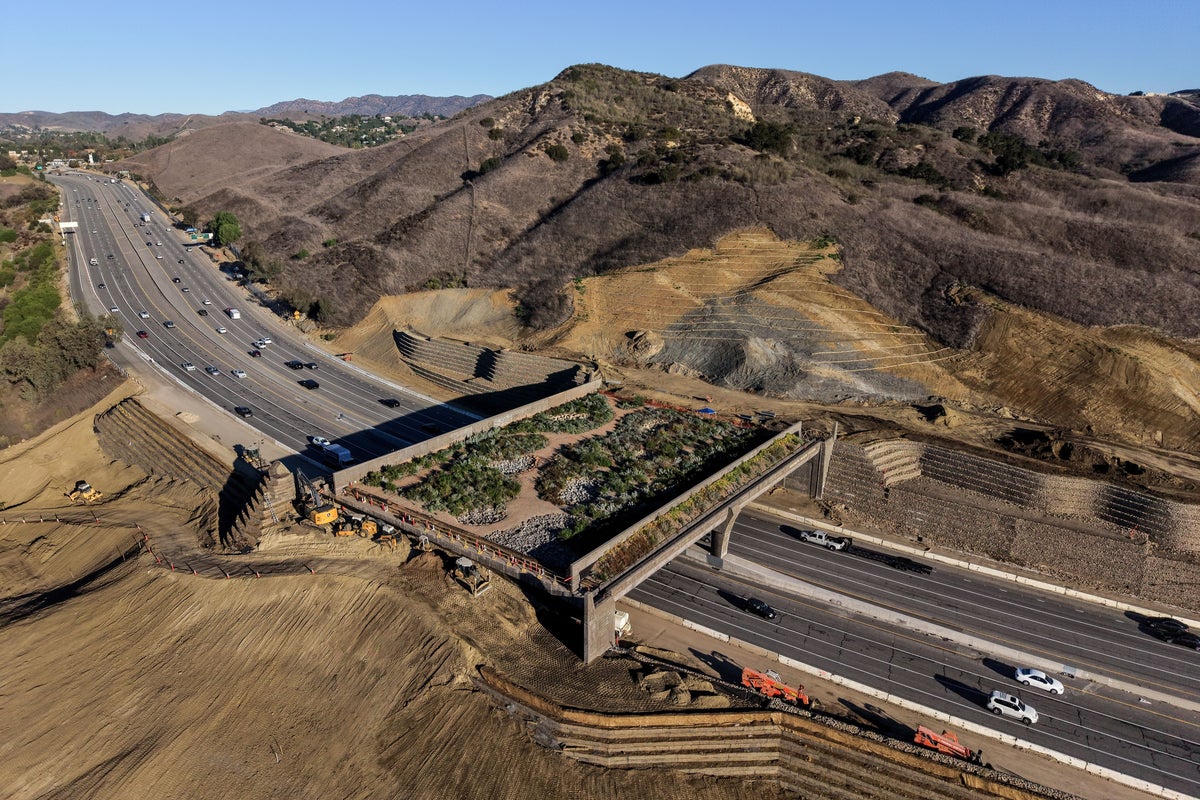
Navigating the newly planted native flora on the world’s largest wildlife overpass, Beth Pratt paused and raised a hand, asking for quiet."Hear that? We're listening to birdsong right now, on top of one of the busiest freeways in the U.S.!" exclaimed Pratt, a key figure behind the project. "That makes my heart glad."The sounds of birds provided fresh evidence that creatures are already utilizing the structure—which crosses U.S. 101 and an adjacent frontage road around 35 miles (56 kilometers) northwest of downtown Los Angeles—prior to its formal Dec. 2 opening ceremony.Only two weeks prior, motion-sensor cameras recorded a single coyote, thought to be the first mammal making a safe passage. Shortly after, three young coyotes were filmed playing under the 10-foot (3-meter) sound walls lining the span."They don't care about ribbon cuttings," joked Pratt, president of the nonprofit Wildlife Crossing Fund.The Wallis Annenberg Wildlife Crossing in Agoura Hills, California (AP Photo/Jae C. Hong)Roughly 300,000 vehicles pass daily along this section of highway in Agoura Hills, a municipality situated within a network of protected habitats that the bridge links together. Fences placed along the road direct wildlife toward the passage.Designed to blend into nearby hills, the 1,250-foot (380-meter) two-section span stretches over the roadway, giving animals restricted by urban growth a safe route toward the Santa Monica Mountains and beyond.Named the Wallis Annenberg Wildlife Crossing, it honors the late philanthropist whose foundation donated $25 million toward the $114 million total cost. Increased from an initial $92 million, funds came from 6,000 public donors, non-profit grants, and state conservation funds. Leonardo DiCaprio was among the earliest donors when fundraising launched a decade ago.For Pratt, the true inauguration will occur when a mountain lion—a species designated as threatened within California—uses the bridge to cross.The campaign was inspired by P-22, a famed local cougar that crossed major freeways to settle in a large Los Angeles park. Euthanized in 2022 after a likely vehicle strike, P-22 became a symbol of dwindling genetic diversity among animals trapped by urban development. Thousands attended his memorial.The bridge, with a landscape that's indistinguishable from surrounding hillsides, stretches 1,250 feet (380 meters) in two sections over the roadways (AP Photo/Jae C. Hong)Decades of tracking mountain lions with GPS collars revealed to researchers that major roads effectively trapped animals within coastal ranges near Malibu and across central Los Angeles toward Griffith Park, where P-22 resided.Pratt wore a shirt bearing the iconic puma's image during the recent walkthrough, noting her wish to eventually install a permanent statue of P-22 beside the bridge.Trapped by concrete, struck by cars, and poisoned by rodenticides, isolated pumas face extinction from inbreeding, according to wildlife officials. A University of California, Davis report revealed that vehicles kill at least 780 mountain lions annually—18% of the state’s population."The story of P-22 was just so compelling," said Mari Galloway, California program director for the nonprofit Wildlands Network. "We saw the peril in what happened to that particular cat. It was demonstrative of what these mountain lions are facing in this part of the landscape."Although Galloway’s group was not involved with the Annenberg bridge, it hopes the project inspires similar crossings nationwide. The network is working with state transit officials to plan a wildlife bridge over a highway in the Mojave Desert east of Los Angeles where bighorn sheep reside.Wildlife passages, including overpasses and underpasses, are already widely utilized across Canada and western Europe. A prominent crossing in Banff National Park, Alberta, crosses the Trans-Canada Highway and sees regular traffic from bears, elk, and moose.It give animals hemmed in by urban sprawl a safe path to the nearby Santa Monica Mountains and beyond (AP Photo/Jae C. Hong)In Colorado, a major overpass stretching across Interstate 25—combined with additional measures such as fencing and underpasses—helped cut wildlife-vehicle collisions by 91%, as reported by state wildlife officials in September.On top of the Annenberg structure, Anthony Deascentis, a field inspector for the California Department of Transportation, signaled for Pratt to look at a patch of scrub brush. He highlighted an orb-weaver spider, roughly the size of a silver dollar, constructing a detailed circular web."There's also a good amount of bees enjoying the native plants," said Deascentis. He has also seen an oak titmouse, sparrows, and hummingbirds—proof that wildlife is adapting to the terrain while crews continue landscaping the bridge's south side.Jeff Sikich, a biologist for the National Park Service who tracks cougars, said the next step involves implanting "biologgers" to monitor physiological data like heart rate, body temperature, and activity. This will reveal if animals feel stress while crossing or "if they're relaxed up there."Sikich noted that researchers recently detected various mammals in the surrounding hills, including gray foxes, deer, bobcats, and a female cougar accompanied by two kittens.He noted that they are "sniffing around," potentially preparing to cross.
World’s largest wildlife crossing opens over busy freeway and becomes an instant hit
Full Article
Original Source
Read the full article at Independent →KhanList aggregates and links to publicly available news content. We do not host full articles from third-party sources. Always verify important information with original sources.