
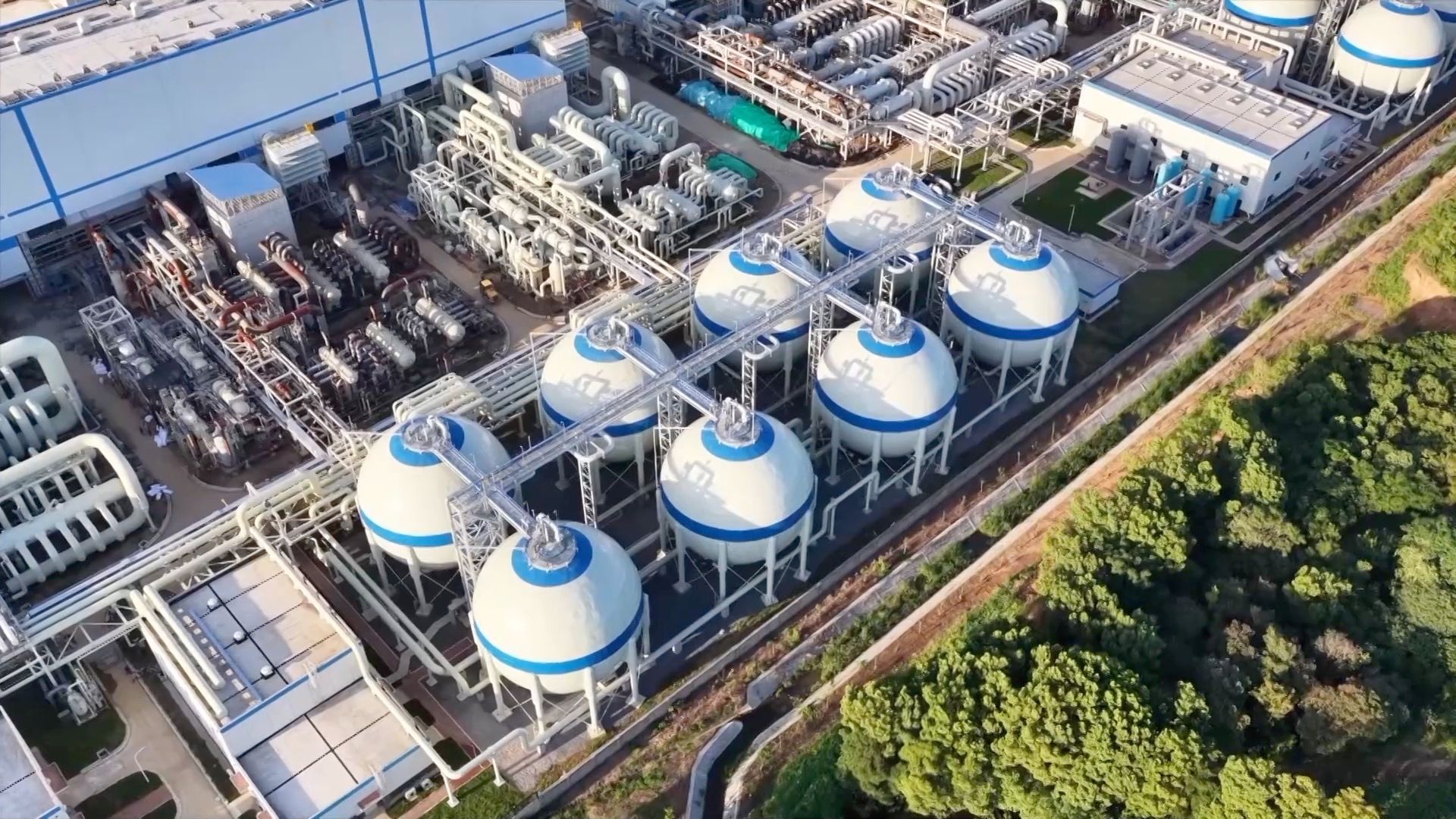
China has completed the full startup of two units at a major compressed air energy storage project in Jiangsu Province, marking a new step for large-scale storage built inside underground salt caverns. The Huaneng Jintan salt cavern compressed air energy storage Phase II project reached the milestone on Saturday, CCTV News reported. Located in Changzhou, East China, the facility has a capacity of 350 megawatts (MW) per unit. Once fully completed and operational, its energy conversion efficiency is expected to exceed 70 percent. The project is being described as a “super power bank” for the electricity grid. Underground caverns store compressed air Compressed air energy storage uses surplus electricity when demand is low to run compressors. The machines force air into underground caverns, where it remains stored until the grid needs additional power. During high-demand periods, the compressed air is released and used to drive turbines that produce electricity. The Jintan facility uses deep salt caverns as its storage chambers. Salt formations are dense and highly impermeable, which helps prevent the stored air from escaping over long periods. Air is pushed to extreme pressure When electricity demand is low, excess grid power compresses air to more than 130 atmospheres, or about 1,910 pounds per square inch (psi), before it is injected into the underground caverns. When demand rises, the stored air is released and sent through the generation system. The project captures heat produced during compression and stores it for later use, helping limit energy losses during the power generation cycle. This heat-management system includes what CCTV News described as Asia’s largest single-set thermal storage water tank matrix for compressed-air storage. It has 16 spherical tanks, each holding 3,500 cubic meters of water (about 925,000 gallons). Together, they hold 56,000 cubic meters (roughly 14.8 million gallons) of water. Large gas well handles huge flow The project also includes a major gas-handling system built for continuous operation. It also includes what is described as China’s largest single intake and injection gas well in the compressed air energy storage sector. Engineers said it can handle up to 2.16 million cubic meters of air per hour (76.3 million cubic feet per hour). The well has received special anti-corrosion and sealing treatment. These measures are intended to support long-term operation and reduce the risk of air leakage, according to CCTV News. China has been expanding salt cavern energy storage as electricity demand grows and renewable generation becomes a larger part of the power mix. Operators monitor storage deep underground At the control center, operators can track data from surface equipment and the underground caverns in real time. The caverns are located about 1,000 meters (3,280 feet) below ground. Centralized digital management allows the facility to monitor the storage system and respond as grid conditions change. Its scale reflects China’s push to expand physical energy storage for a changing power grid. Get the latest in engineering, tech, space & science - delivered daily to your inbox.A versatile writer, Sujita has worked with Mashable Middle East and News Daily 24. When she isn't writing, you can find her glued to the latest web series and movies.
World’s largest underground ‘super power bank’ starts up with 700 MW capacity
Full Article
Original Source
Read the full article at Interestingengineering →KhanList aggregates and links to publicly available news content. We do not host full articles from third-party sources. Always verify important information with original sources.