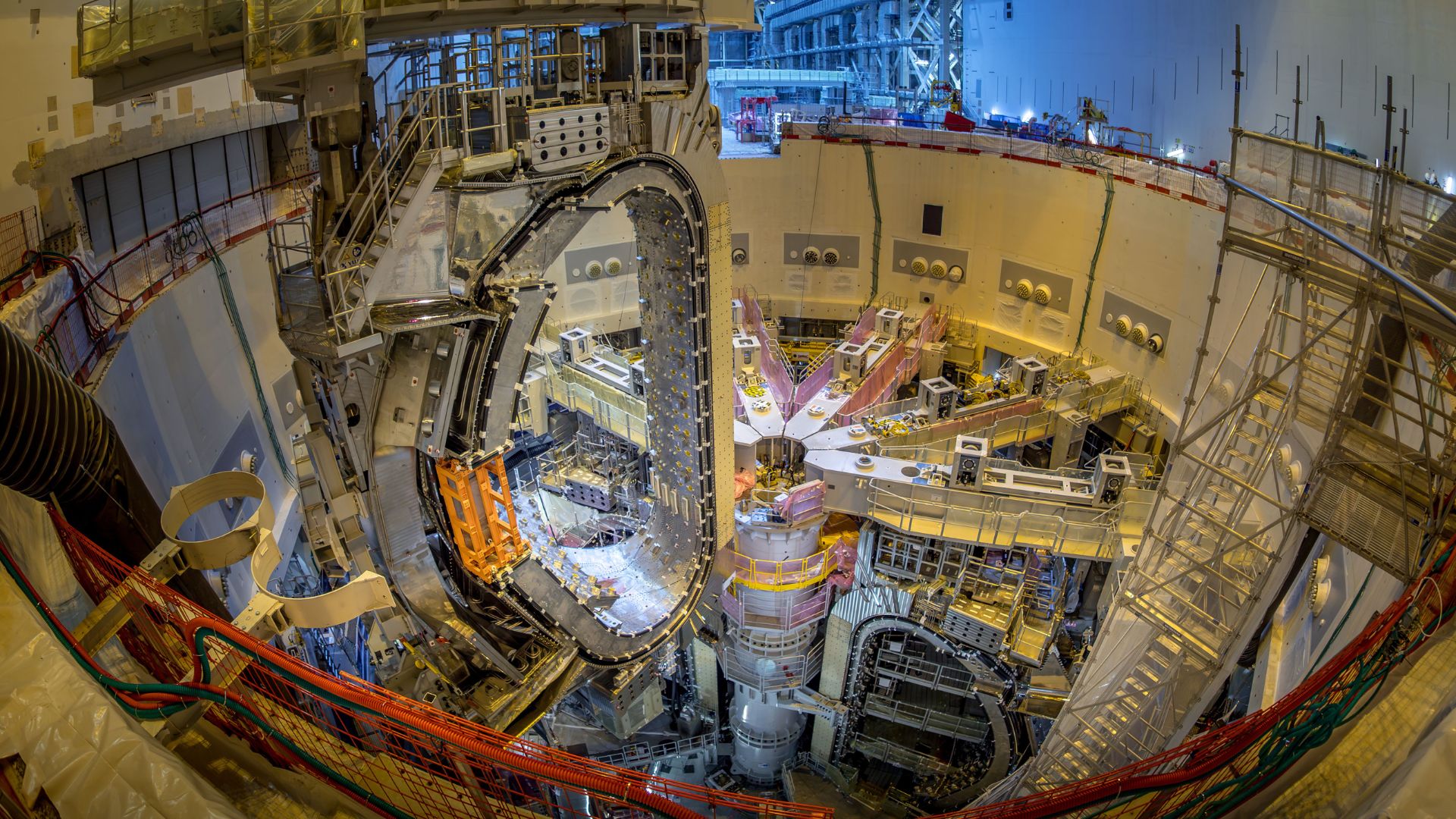
Assembly crews at the ITER facility successfully lowered the sixth tokamak sector module into the reactor pit on 28 July. The operation brings two-thirds of the machine’s central torus-shaped core into its final position inside the reactor pit. Technical teams finished the installation almost six months ahead of the baseline project schedule. Lowering the sub-assembly into the pit required a carefully coordinated 30-hour crane operation. The module itself weighs roughly 1,100 tonnes, but adding the custom lifting rig brought the total suspended load to nearly 1,400 tonnes. Operators moved the structure out of the Assembly Hall and lowered it into the pit with continuous positioning controls to manage the heavy payload safely. Primary confinement boundary for plasma The vacuum vessel serves as the primary confinement boundary for the fusion plasma inside the reactor. Once workers position all nine modules in the pit, technical teams will begin welding the sectors together to form the continuous torus chamber. Upon full assembly, the double-walled stainless-steel structure will measure 19 meters across, stand 11 meters high, and weigh about 5,200 tonnes before internal systems are installed. The double walls hold cooling water and shielding material while supporting equipment that heats, diagnoses, and controls the plasma. Assembly teams have been installing these core sector modules sequentially since April 2025. Field crews gathered operational experience from each successive lift, translating those lessons into faster execution, stronger coordination, and a more predictable workflow. “Installing six sector modules is not simply a question of repeating the same operation six times,” said Sergio Orlandi, Head of the ITER Construction Project. “Each module requires the precise integration and positioning of some of the largest and most complex components ever manufactured for a fusion machine.” These assembly improvements allowed project managers to advance the targeted completion date for the final module from December 2027 to mid-2027, with teams continuing to seek further schedule optimizations. Integrating heavy components into single unit Before a module enters the pit, technicians must integrate three heavy components into a single unit inside the Assembly Hall. They place a central 440-tonne double-walled vacuum vessel sector between two toroidal field coils, which weigh approximately 310 tonnes each, and attach thermal shield panels. Engineers must align all parts to millimeter-level tolerances during pre-assembly so the components fit accurately once placed in the reactor cavity. The sixth module centers around vacuum vessel sector number one, which is the fourth and final sector manufactured by the Republic of Korea. Under the project’s division of manufacturing responsibilities, South Korea produced four vacuum vessel sectors, while European industrial suppliers were responsible for the remaining five. Result of international collaboration Representatives from Korea and the ITER Organization gathered on 22 July for ITER Korean Fusion Day to celebrate the completion of Korea’s vacuum vessel manufacturing program. During the ceremony, Sung Soo Kim, Deputy Minister of Korea’s Ministry of Science and ICT, noted that participation in ITER provided Korea with advanced manufacturing techniques and international collaboration experience for future fusion industries. Hyuk-Woon Kwon, Ambassador of the Republic of Korea to France, added that while fusion energy development requires long-term patience and multi-generational cooperation, the installation milestone demonstrates steady progress.Recommended ArticlesGet the latest in engineering, tech, space & science - delivered daily to your inbox.An active and versatile journalist and news editor. He has covered regular and breaking news for several leading publications and news media, including The Hindu, Economic Times, Tomorrow Makers, and many more. Aman holds expertise in politics, travel, and tech news, especially in AI, advanced algorithms, and blockchain, with a strong curiosity about all things that fall under science and tech.
World’s largest tokamak ITER installs 1,100-ton core module to confine fusion plasma
Full Article
Original Source
Read the full article at Interestingengineering →KhanList aggregates and links to publicly available news content. We do not host full articles from third-party sources. Always verify important information with original sources.