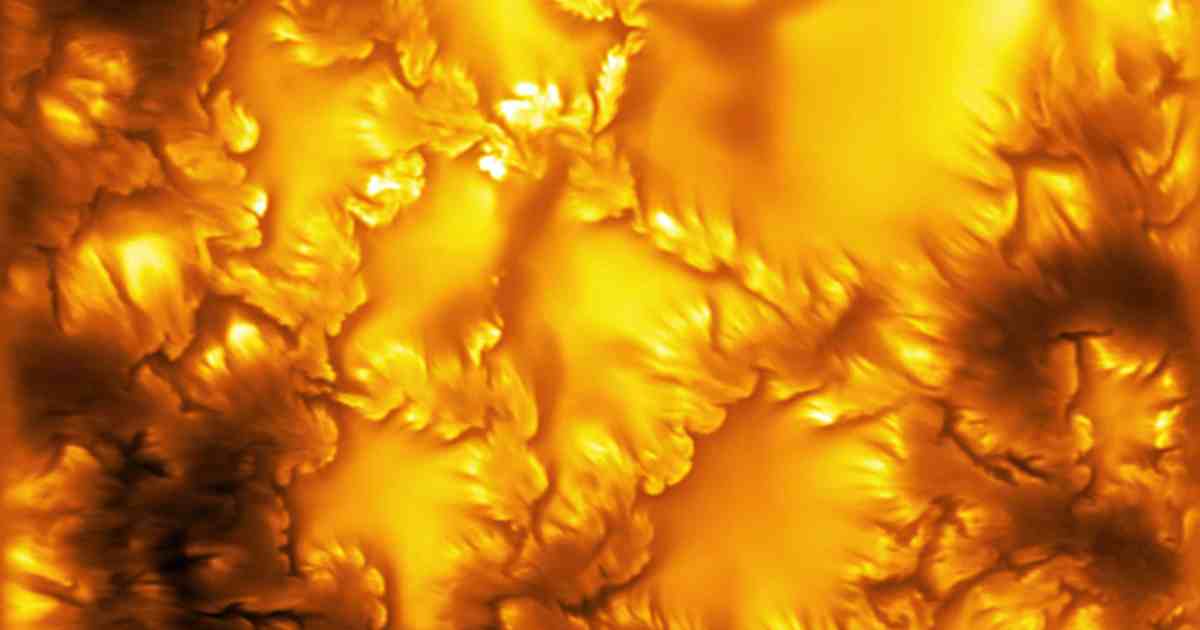
The Daniel K. Inouye Solar Telescope's new high-speed camera captured a fluid-dynamics phenomenon on the Sun, hinting at how its corona gets so hot. | Published: August 17, 2026 Wave-like curls break up the dark magnetic lanes separating the Sun’s granules in the highest resolution image ever taken of the solar photosphere. Captured by the Daniel K. Inouye Solar Telescope, the image reveals the first confirmed evidence of Kelvin-Helmholtz instabilities on the Sun. Credit: NSF/NSO/AURA/MPS The sharpest images ever taken of the Sun’s surface reveal ribbons of solar plasma curling into tight, wave-like vortices near the edge of a sunspot — a pattern never before seen on our star. The experiment behind the discovery was designed to push the technical limits of a new camera system, not hunt for new solar phenomena. But the vortices it captured turned out to be the signature of a well-known fluid dynamics phenomenon called the Kelvin-Helmholtz instability — the first confirmed sighting of the process on the Sun. The serendipitous discovery may also help answer one of solar physics’ longest-standing mysteries: why the Sun’s outer atmosphere runs hotter than the surface below it. “We didn’t intend to produce big science results, certainly not big science results that end up on the cover of Nature with this experiment,” said Thomas Rimmele, study co-author and National Science Foundation’s Daniel K. Inouye Solar Telescope (DKIST) associate director, in an Aug. 11 American Astronomical Society webinar. Astronomers captured the images with the largest solar telescope in the world, the 4-meter DKIST atop Haleakalā on Maui, over three minutes on April 14, 2025. The team, led by David Kuridze, astronomer and research fellow at Queen’s University Belfast, and Friedrich Wöger, astronomer at the National Solar Observatory, published their findings in Nature on Aug. 5, 2026. The observations used a high-speed camera built by the Max Planck Institute for Solar System Research, tuned to a wavelength of 416 nanometers, affording the highest resolution possible on the telescope. Each pixel spans roughly 4 miles (6 kilometers) of solar surface, and the full field of view covers an area roughly half Earth’s diameter, at 3,600 by 2,700 miles (5,800 by 4,350 km) — only a small sliver of the Sun’s disk. The image reveals a landscape of granules, the cell-like structures that make up the Sun’s visible surface, or photosphere. Solar granules form when hot convection cells push plasma up to the surface. As the plasma spreads and cools, it descends along the dark lanes separating the individual granules. At the images’ new level of detail, astronomers spotted whirlpool-like structures along those boundaries, measuring roughly 25 to 170 kilometers across. First described in the 19th century, the Kelvin-Helmholtz instability appears whenever two fluids slide past each other at different speeds, curling their shared boundary into repeating waves. On Earth, it manifests occasionally in our atmosphere, when fast-moving air slides over slower air and curls the edges of clouds to look like breaking ocean waves. It also shows up in the magnetosphere, where the solar wind rushing past Earth rolls the magnetosphere’s perimeter into swirling eddies. Once the team realized what they were looking at, the result still caught them by surprise. “When we first saw the movies, of course, there was this big wow feeling, but we didn’t at first know what we were looking at,” Rimmele said. “[It] took quite a while to do the interpretation of the data using the numerical models … to understand that this is really the signature of the Kelvin-Helmholtz instability.” Those numerical simulations of the photosphere’s magnetic and convective flows were produced by the High Altitude Observatory. Astronomers had long predicted that these vortices should exist in the Sun’s photosphere, and the fact that the new observations matched the models helped verify those predictions. The findings may help answer one of solar science’s biggest mysteries: As you move away from the Sun’s surface toward the corona, the plasma heats up by orders of magnitude — the opposite of how we typically think of heat behaving. The team believes this heating can be explained in part by the work of the Kelvin-Helmholtz instabilities they observed. “What we just found with this Kelvin-Helmholtz instability in the photosphere are twisted vortices that twist the magnetic field,” Rimmele said. Just like a twisted rubber band, the Sun’s coiled magnetic field can store energy. This “is a key ingredient for this coronal heating, transporting energy up into the corona and dissipating it there,” he said. Brooks Mendenhall is a staff writer for Astronomy magazine and is based in Chattanooga, Tennessee.
World’s largest solar telescope reveals the Sun’s hidden texture
Full Article
Original Source
Read the full article at Astronomy →KhanList aggregates and links to publicly available news content. We do not host full articles from third-party sources. Always verify important information with original sources.