
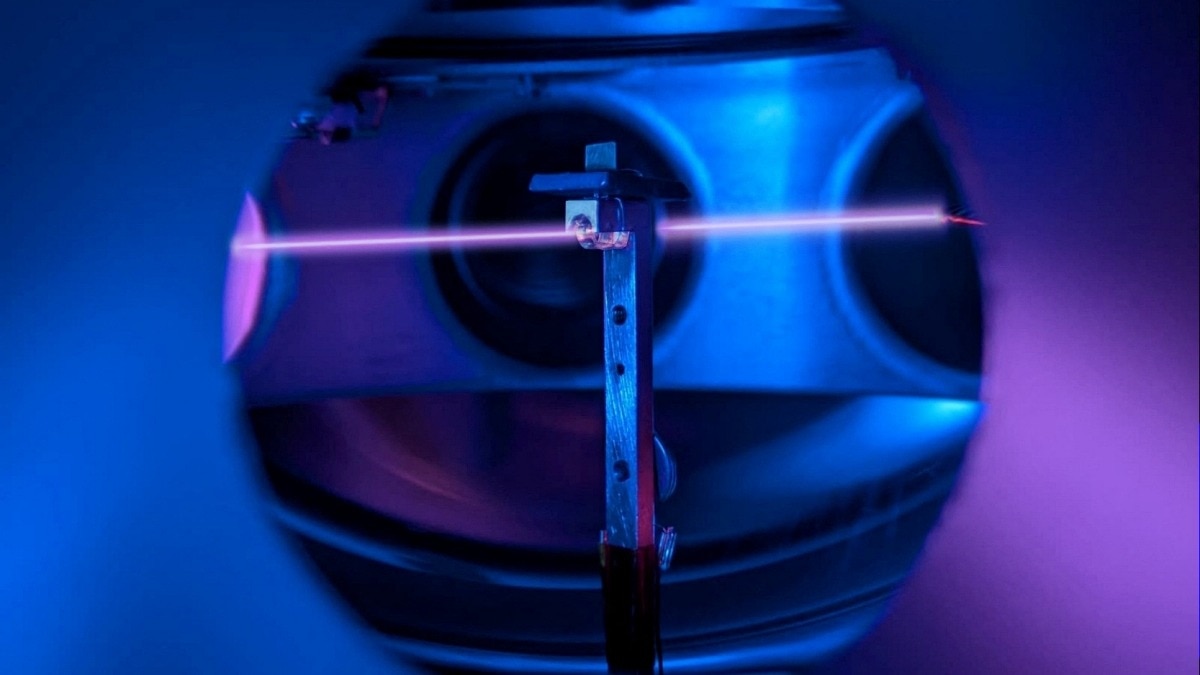
Scientists in Austria and China have independently built the first operating nuclear clocks. The breakthrough could advance precision timekeeping and open a new tool for probing dark matter and other physics.A calcium fluoride crystal, in its holder, that incorporates large numbers of thorium nuclei is seen inside the vacuum system of a nuclear clock, with a laser beam probing the thorium nuclei, at a laboratory at TU Wien in Vienna.New Delhi,Oct 8, 2026 13:22 ISTScientists in Austria and China have independently built the world’s first operating nuclear clocks, opening a new chapter in precision timekeeping and giving physicists a powerful new way to probe the fundamental laws of nature.Two teams, one led by researchers at TU Wien in Vienna and another involving Tsinghua University and other institutions in Beijing, reported their breakthroughs separately in two papers published in Nature on October 7.The achievement marks the first practical demonstration of clocks that use transitions inside an atomic nucleus rather than the movement of electrons around it.The technology is based on the radioactive isotope thorium-229, embedded in calcium fluoride crystals. A carefully controlled ultraviolet laser interacts with the thorium nuclei, causing them to jump between two energy states. Those extremely precise nuclear transitions provide the reference against which time can be measured. That is what makes these devices fundamentally different from today's atomic clocks.From electrons to the nucleus Conventional atomic clocks keep time by measuring changes in the energy states of electrons surrounding atoms. The world's most precise optical atomic clocks are extraordinarily accurate, but they are sensitive to external disturbances and can involve complex, delicate systems.A nuclear clock instead uses transitions occurring inside the atomic nucleus, involving protons and neutrons.Because the nucleus is much smaller and more tightly bound than the electron shell, scientists expect nuclear transitions to be less susceptible to certain environmental disturbances. That could eventually allow nuclear clocks to surpass today's best atomic clocks in stability and accuracy. NatureBut that future has not arrived yet.The two new clocks currently do not outperform the best existing optical atomic clocks. Researchers say several orders of improvement are still possible.WHY DOES A BETTER NUCLEAR CLOCK MATTER?Ultra-precise timekeeping underpins technologies people use every day, including satellite navigation, telecommunications, financial systems and synchronisation of data networks.Future nuclear clocks could potentially make these systems even more precise while offering compact, robust alternatives to some existing technologies.But perhaps the more exciting application is fundamental physics.The Vienna team used its nuclear clock to search for tiny variations in the thorium-229 transition that could be caused by interactions with ultralight dark matter. The experiment did not detect dark matter, but it demonstrated that the clock can already perform precision measurements competitive with leading atomic-clock experiments.Dark matter remains invisible to conventional telescopes despite being thought to make up much of the matter in the Universe.A nuclear clock could therefore become more than an extraordinarily accurate timekeeper. It could become a new detector for physics beyond the Standard Model.For physicists, the significance is summed up by the fact that the two teams reached the milestone independently using different approaches. Their simultaneous success suggests that thorium-229 nuclear clocks are not dependent on a single experimental trick.The decades-long dream of measuring time using the nucleus has finally become a working technology. The next challenge is to make it accurate, stable and practical enough to leave the laboratory — and precise enough to reveal new physics hiding in the ticking of time itself.- Ends
World's first nuclear clock is ready: What is it, and why does it matter?
Full Article
Original Source
Read the full article at Indiatoday →KhanList aggregates and links to publicly available news content. We do not host full articles from third-party sources. Always verify important information with original sources.