
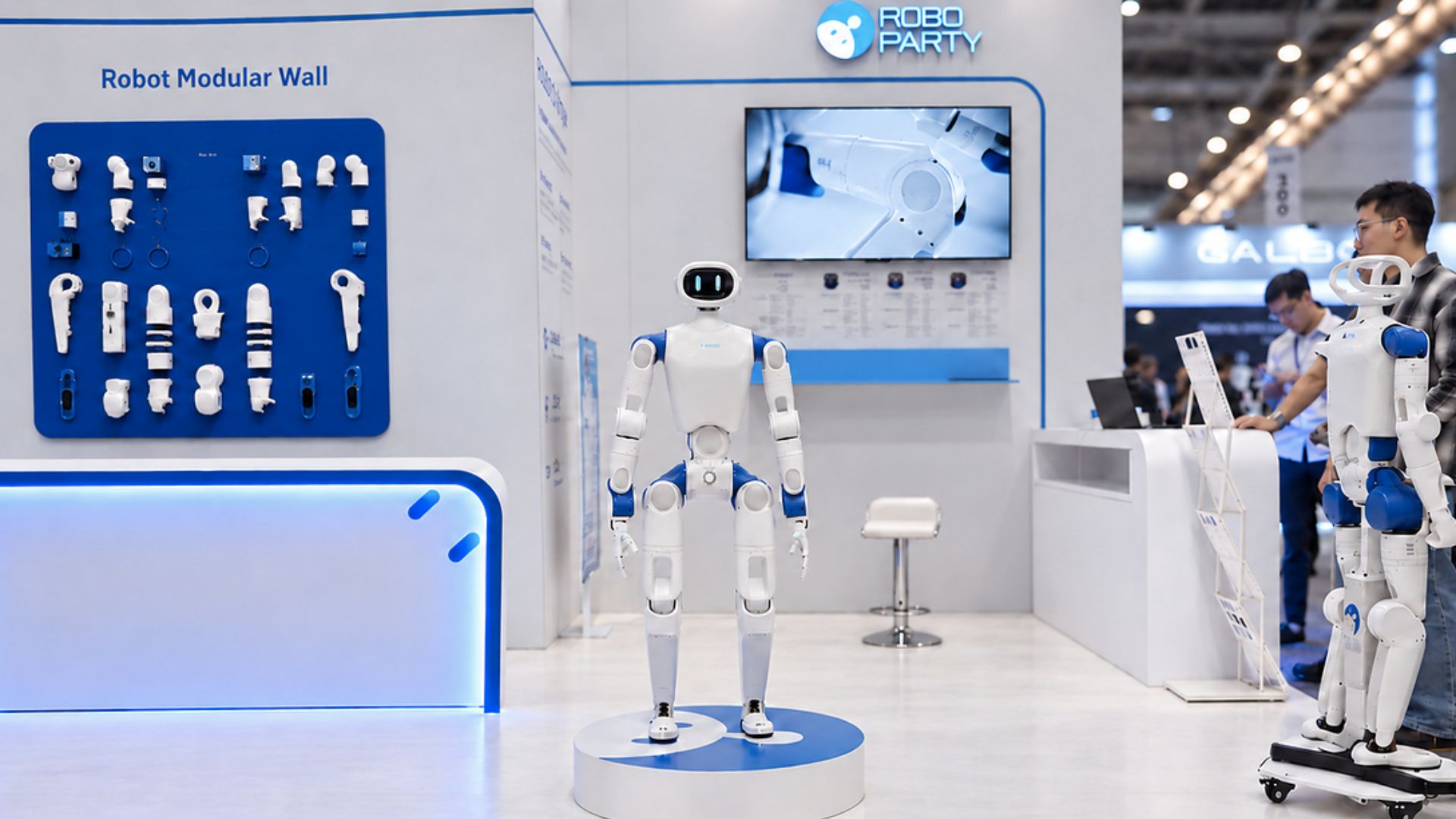
RP1 is designed around the requirements of dynamic motion, disturbance recovery and long-term development experiments.RoboPartyA Pittsburgh-based firm has unveiled its high-performance open source humanoid robot. Called RP1 (ROBOTO 01), the robot was publicly unveiled at at IROS 2026, marking the robot’s global debut.The company positions RP1 as the world’s first high-performance full-stack open-source bipedal humanoid robot. RP1 is designed for researchers, educators, robotics developers and embodied AI teams, with the goal of providing a humanoid robotics system that can be used, modified, trained and continuously extended in real development workflows. Visitors could directly apply external disturbances to the robot “Humanoid robots should not be closed systems that only a small number of teams can build while everyone else can do little more than watch,” said Yi Huang, founder of RoboParty. “We want RP1 to become an open foundation that developers can access, modify, train and continuously improve. Full-stack open source has been our technical direction since the RPO project.” Visitors could directly apply external disturbances to the robot At RoboParty’s IROS booth, the “Kick Me” interactive demonstration was one of the most direct ways for visitors to experience RP1’s capabilities. During the demonstration, visitors could directly apply external disturbances to the robot. When pushed or kicked, RP1 rapidly adjusted its posture and recovered its balance. Unlike demonstrations based only on predefined motions, this open interaction allowed visitors to observe the robot’s dynamic stability and control performance under external disturbances, according to a press release.The repeated high-intensity interactions also provided a direct test of the robot’s body performance and system-level robustness.RP1’s dynamic motion and disturbance-recovery capabilities at IROS were supported by PartyOS, RoboParty’s open R&D foundation for humanoid robotics, which integrates the UFO framework. Robot is designed to provide a high-performance humanoid platform for dynamic motion The company also highlighted that the RP1 is designed to provide a high-performance humanoid platform for dynamic motion, embodied AI model training, validation and deployment, data collection and continuous development.RoboParty also revealed that the RP1 delivers peak joint torque of up to 160 N•m. From its in-house-developed Romomo actuator modules and mechanical structure to its real-time motion-control system, RP1 is designed around the requirements of dynamic motion, disturbance recovery and long-term development experiments.The company also underlined that during the “Kick Me” interaction, visitors directly applied external disturbances while RP1 adjusted its posture and regained its balance. The robot also demonstrated continuous motion, disturbance recovery and fall recovery. These behaviors reflected not only algorithmic performance but also the coordination of the robot body, actuator modules and motion-control system.The company revealed that RP1 builds on RoboParty’s broader full-stack open-source roadmap. RoboParty began with RPO, its fully open-source bipedal humanoid robotics project. Through the development and community adoption of RPO, RoboParty expanded its technical capabilities to cover core actuators, robot bodies, motion control, dexterous manipulation and robotics software systems.Get the latest in engineering, tech, space & science - delivered daily to your inbox.Prabhat, an alumnus of the Indian Institute of Mass Communication, is a tech and defense journalist. While he enjoys writing on modern weapons and emerging tech, he has also reported on global politics and business. He has been previously associated with well-known media houses, including the International Business Times (Singapore Edition) and ANI.
World’s first high-performance full-stack open-source bipedal humanoid robot showcased
Full Article
Original Source
Read the full article at Interestingengineering →KhanList aggregates and links to publicly available news content. We do not host full articles from third-party sources. Always verify important information with original sources.