
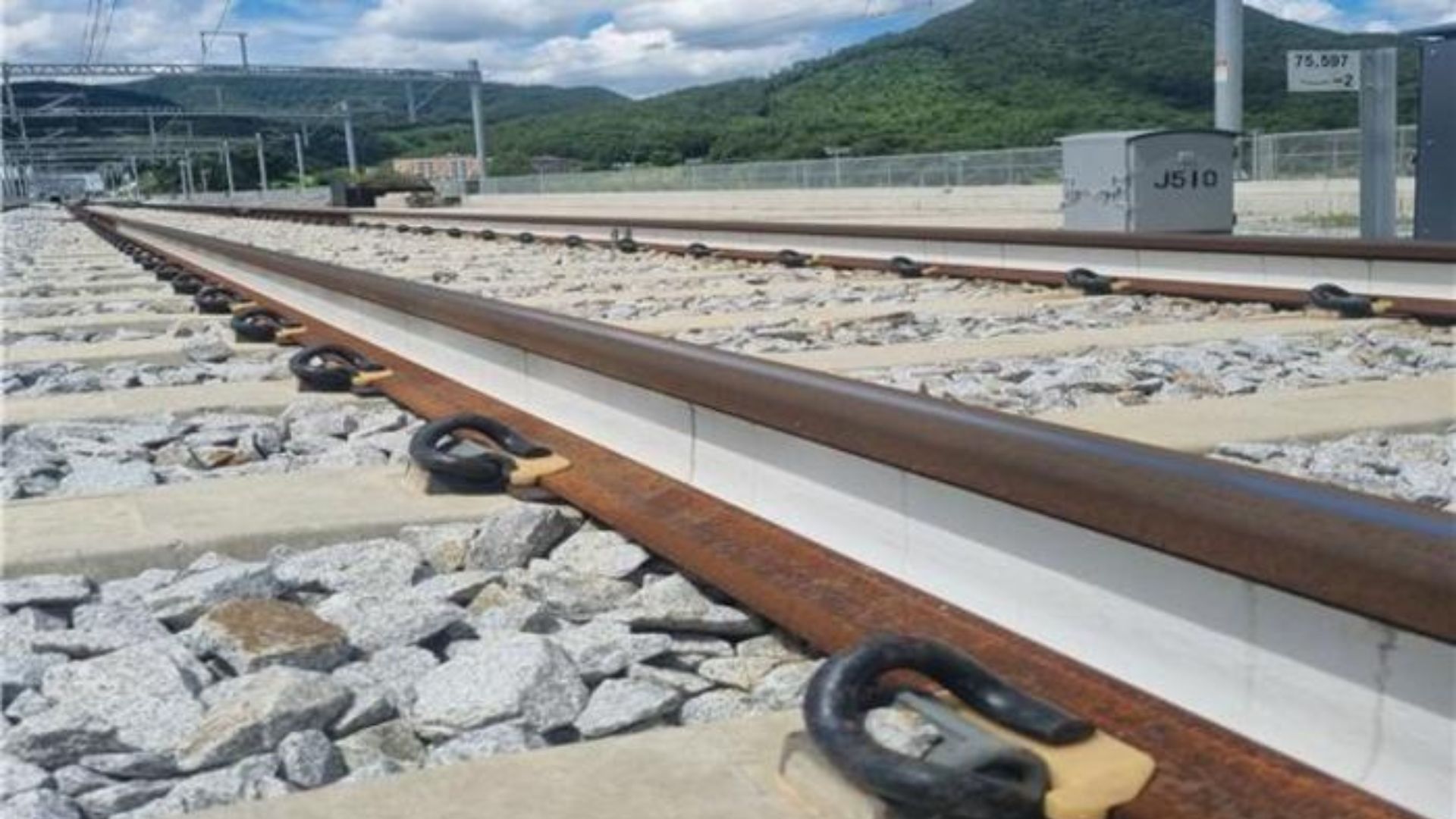
The Korea Railroad Research Institute (KRRI) has designed “the world’s first automated, rail-mounted thermal-blocking textile system.” Designed as a water-free alternative to costly water-spraying setups, this technology mitigates high track temperatures caused by extreme heat waves, reducing deformation risks and speed delays. “This is a demand-driven research outcome that allows the public to use railways with confidence even during extreme summer heat. In an era where climate crisis directly translates into national risk, we will further advance this technology to ensure safe railway operations and expand its application to overseas markets,” said President Sagong Myung of KRRI. On-site Application and Operation of the All-in-one System for Thermal-blocking Textiles (cleaning, installation, retrieval). Credit: Korea Railroad Research Institute Sunblock for steel Frequent heat waves have pushed steel railway track temperatures past 60°C (140°F), posing derailment risks and forcing transit authorities to impose speed limits. Conventional mitigation methods mostly use costly, water-intensive spraying systems, but KRRI’s technology eliminates water entirely. The innovation uses a light-reflecting, magnetic “thermal blocking textile” that snaps directly onto iron rails, shielding them from intense solar radiation to lower track temperatures and support safe high-speed rail operations. In this system, a multilayer textile clips directly onto the sides of tracks using high-strength magnetic forces. Interestingly, the textile comes with a specialized outer coating that bounces away more than 85 percent of incoming solar radiation. Reinforced with internal fiberglass, it shields the iron core from intense sun exposure. It acts like sunblock for heavy infrastructure. Once installed on the rail, it costs no extra dollars to run and is not susceptible to breakdowns like mechanical pumps. Drops railway temperatures To prevent high-speed aerodynamic forces from ripping the heat shields off, researchers secured the magnetic strips with dual mechanical fasteners. This combined anchoring system provides a grip capable of withstanding winds up to 66 m/s — roughly well over 1.5 times the intense gale force generated by a KTX train passing at 300 km/h (186 mph). As per the study, the field trials completed on the Gwangju Line in 2024 and the Jungbu Inland High-Speed Line in 2025 logged a maximum track temperature reduction of 10.9°C (19.6°F). Moreover, certified testing by the Korea Testing & Research Institute (KTR) verified the materials won’t degrade, rating them for over 10 years of continuous use. Installation doesn’t require crews to manually crawl along hundreds of miles of line. KRRI engineers designed a compact, all-in-one automated machine. The modular rig can be carried and assembled by just two operators. Cruising down the tracks at speeds over 2 km/h, the machine performs three tasks in a single pass: it scrubs foreign debris off the rail heads, lays down the magnetic textile, and also retrieves it when autumn arrives. Chief Researcher Kang Dong-hoon at KRRI stated, “This technology goes beyond simply lowering rail temperatures—it presents a new paradigm for protecting railway safety in the era of climate crisis. We plan to expand its application beyond railways to various fields that require heat mitigation, such as building exteriors and roadside facilities.” The institute now plans to use these heat-blocking fabrics for building exteriors, roadside facilities, and international transit markets facing their own scorching summers.Get the latest in engineering, tech, space & science - delivered daily to your inbox.Mrigakshi is a science journalist who enjoys writing about space exploration, biology, and technological innovations. Her work has been featured in well-known publications including Nature India, Supercluster, The Weather Channel and Astronomy magazine. If you have pitches in mind, please do not hesitate to email her.
World’s first heat-blocking textile to cool rail tracks even under 186-mph trains
Full Article
Original Source
Read the full article at Interestingengineering →KhanList aggregates and links to publicly available news content. We do not host full articles from third-party sources. Always verify important information with original sources.