
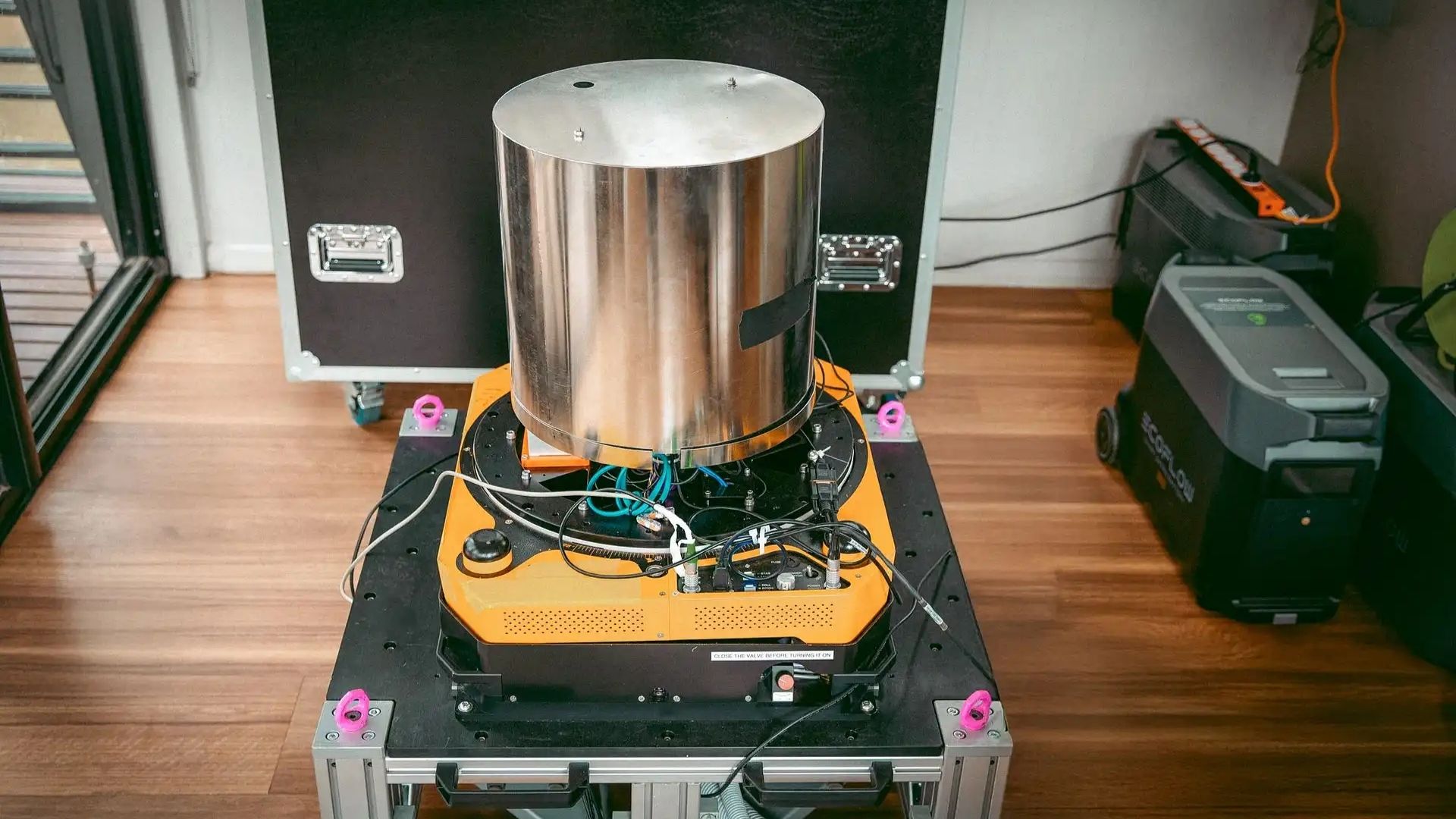
Q-CTRL, an Australian quantum software company, has successfully demonstrated GPS-free navigation at sea during trials in the Coral Sea. Using quantum sensors, the company achieved ten times the accuracy of conventional satellite-based navigation systems, while maintaining the one nautical mile positioning accuracy. In addition to helping us navigate our way to a new restaurant or new city, the Global Navigation Satellite System (GNSS) is central to the navigation of maritime vessels and aircraft too, as it is capable of accurately determining the latitude and longitude as well as the altitude of the navigating device. The increasing reliance on the system also makes it a target in electronic warfare where GNSS signals are jammed or spoofed to prevent battleships and aircraft from determining their exact positions near the conflict zone. In 2026 alone, more than 978,000 instances of GPS jamming were recorded across the globe, making it paramount to develop alternatives that are resilient to such attempts. Quantum sensors to the rescue “The proliferation of GPS-jamming and spoofing instruments highlights that our adversaries are not waiting – there’s no time to lose when it comes to leading the race to deriving defense advantage from quantum technology,” said Michael J. Biercuk, CEO and Founder, Q-CTRL, in a press release. Unlike navigational systems that work actively with satellites to know their exact locations, quantum sensors work passively to make measurements of physical properties like gravitational or magnetic fields to determine their position. Quantum sensors can sense the tiniest of changes in the gravity or magnetic field and use a previously prepared map of these properties to determine their location. Since a quantum sensor does not need to receive or send a signal to an external device, it cannot be hacked or be spoofed by a fake incoming signal either. This makes it ideal for use in defense applications, where GNSS or GPS signals are unavailable or compromised by adversarial forces. Sydney-based Q-CTRL is developing not just quantum sensors but also the necessary software to support their usage by defense forces and recently completed the first field demonstration of its system for maritime environments. Q-CTRL’s quantum sensor Q-CTRL previously built the MagNav, which used a quantum sensor to detect changes in magnetic fields across the planet. After successful demonstration in ground and airborne trials, the company turned its attention to a GravNav, a system that senses changes in gravity fields. Maps of the Earth’s gravity fields are more widely available and more suited for maritime vessels for technical reasons. While the concept was conceived decades ago, a public demonstration of a system that does not rely on GPS signals or any other special installation infrastructure has not been achieved till now. Crucial to this achievement is Q-CTRL’s AI-powered software, which stabilizes the quantum sensor and allows it to work even in the rugged environments of the sea without the need for specialized temperature control or gyroscopic motion stabilization. For the demonstration, the system was installed in the passenger cabin of the ship and worked autonomously. The team achieved 10 times better performance than GNSS systems, with a one nautical mile of positioning accuracy. “Q-CTRL’s demonstration shows a credible path to accurate navigation without reliance on external satellite signals,” said Steve Sklenka, Lieutenant General, U.S. Marine Corps (Ret), in the press release. “This is exactly what distributed maritime operations and contested logistics require to function when – not if – GPS is denied.”Get the latest in engineering, tech, space & science - delivered daily to your inbox.Ameya is a science writer based in Hyderabad, India. A Molecular Biologist at heart, he traded the micropipette to write about science during the pandemic and does not want to go back. He likes to write about genetics, microbes, technology, and public policy.
World’s first GPS-free quantum navigation test delivers 10x better accuracy at sea
Full Article
Original Source
Read the full article at Interestingengineering →KhanList aggregates and links to publicly available news content. We do not host full articles from third-party sources. Always verify important information with original sources.