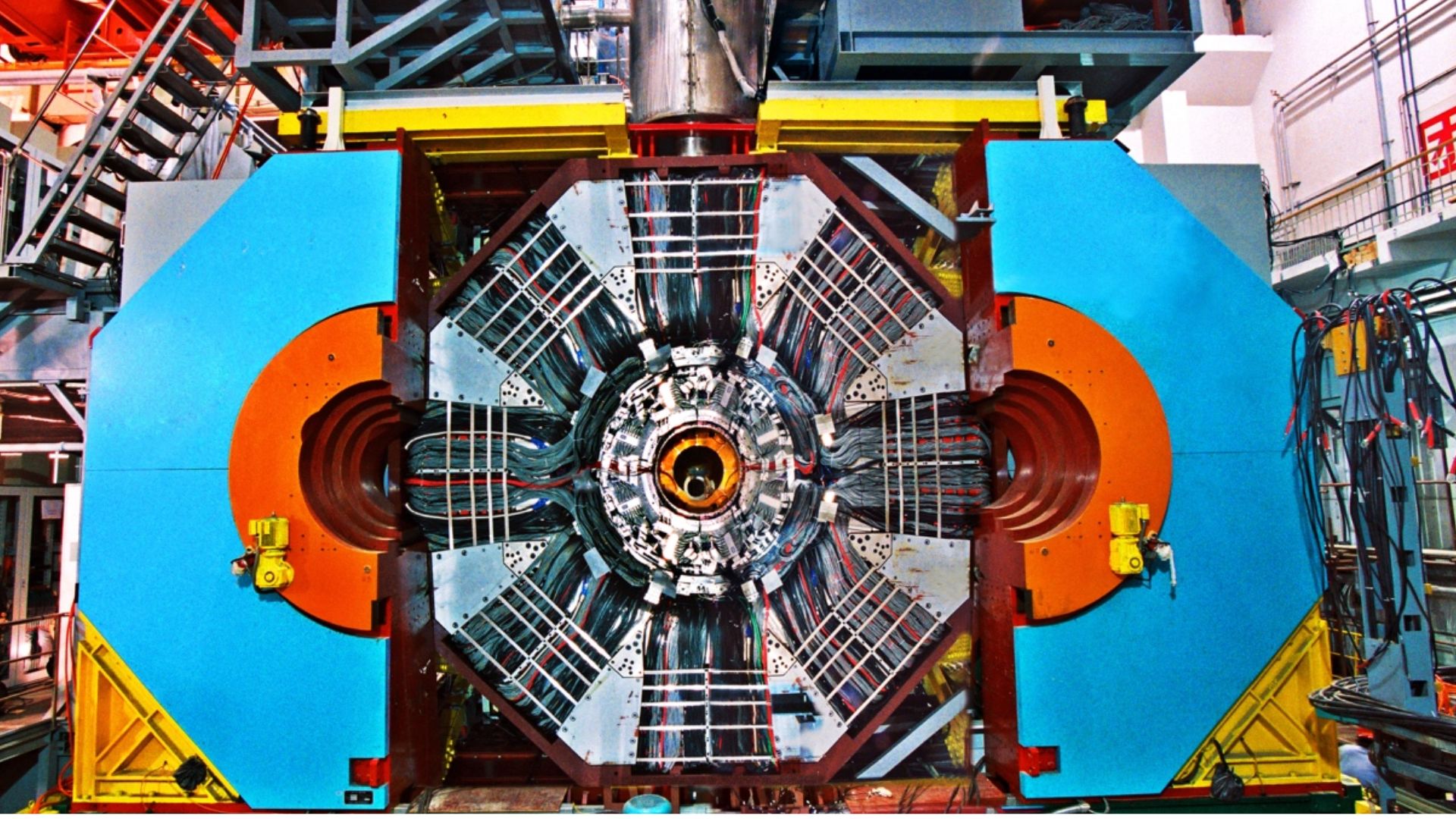
In a global first, researchers at the Institute of High Energy Physics (IHEP) in China have found experimental evidence to confirm the presence of a glueball, a new form of matter. The research findings were made at the Beijing Spectrometer III (BESIII) experiment, as part of an international collaboration headed by the Chinese Academy of Sciences (CAS). The Standard Model of physics states that the building blocks of our universe, atoms, are made up of matter particles and force carriers. Matter particles, or fermions, named quarks, build up protons and neutrons, the positively and neutrally charged particles inside the atomic nucleus. A force carrier holds the quarks together; this carrier is called a gluon. Physicists have long held that gluons can also attract each other and bind together to form a glueball, an entirely new form of matter that is composed only of a force carrier. For the past five decades, multiple experiments have been carried out to prove the existence of a glueball. However, it was only in 2011 that scientists in China spotted a potential glueball candidate in the experiments conducted at the Beijing Spectrometer III (BES III). How was the glueball found? The BES III is a particle physics experiment of the IHEP designed to study quantum chromodynamics (QCD) further and look for physics beyond the Standard Model. The BES III experiment collects data emerging from the Beijing Electron-Positron Collider II (BEPC II), a circular collider with a circumference of 787 feet (240 m). Since the BEPC also produces a large number of J/ψ particles, whose decays are the best avenues for glueballs, researchers at the BES III have been looking for them since the experiment began nearly two decades ago. In 2011, the team first spotted a new particle that they referred to as X(2370). Over the next 13 years, they recorded decays of over 10 billion J/ψ particles to determine its spin-parity quantum number as 0⁻⁺. With the mass and quantum numbers of this new particle in complete agreement with predictions of a glueball, the researchers became more confident of actually calling it so. Why is it important? More recently, the researchers also found many new decay modes of X(2370) while also determining its ‘flavor-singlet’ nature, where they lack quark flavor signatures. This is the most important and defining characteristic of a glueball and establishes a complete chain of experimental evidence for a pseudoscalar glueball. This confirms the theoretical prediction that gluons can bind to each other and form an entirely new kind of matter. The discovery is also a direct test of the non-Abelian gauge structure in quantum chromodynamics (QCD), which also states that gluons are capable of attracting and binding each other, without the involvement of quarks. This is important, since it also helps establish that QCD is a correct theory and it has been validated at low energies. As the clearest experiment in over 50 years to have found the evidence for glueballs, the finding also demonstrates the importance of the BEPC II in studies of strong interactions. The research was presented at the International Conference of High Energy Physics in Brazil. Recommended ArticlesGet the latest in engineering, tech, space & science - delivered daily to your inbox.Ameya is a science writer based in Hyderabad, India. A Molecular Biologist at heart, he traded the micropipette to write about science during the pandemic and does not want to go back. He likes to write about genetics, microbes, technology, and public policy.
World’s first glueball confirmed, proves force particles can form new matter
Full Article
Original Source
Read the full article at Interestingengineering →KhanList aggregates and links to publicly available news content. We do not host full articles from third-party sources. Always verify important information with original sources.